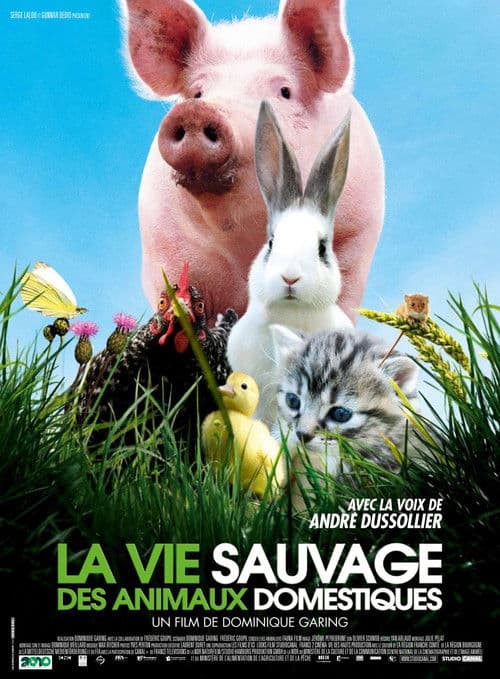
La vie sauvage des animaux domestiques
Does this age rating seem accurate to you?
Detailed parental analysis
The Wild Life of Domestic Animals is a contemplative and pastoral documentary, with an overall warm tone but threaded through with real tensions linked to the agricultural world. It follows a year of life on a farm, observing domestic animals in their behaviours, their hierarchies and their fate within human exploitation. The film is aimed at a young school audience, around 6 to 10 years old, but carries messages about animal husbandry and animal death that parents would do well to anticipate.
Underlying Values
This is the most thought-provoking dimension of the film for an attentive parent. The documentary presents an idealised vision of the farm, where the farmer is benevolent, nature is ordered and the destiny of livestock animals is obvious and acceptable. The phrase "The pig is made for that" sums up a discourse that naturalises slaughter without ever questioning it. The departure of piglets towards fattening is shown as an ordinary episode in the agricultural cycle. This romantic and reassuring vision is not neutral: it conveys an acceptance of intensive farming conditions by dressing them in a bucolic aesthetic, washing drying in the sun, peasant good nature, without questioning their realities. This is not a fatal flaw for family viewing, but it is precisely the type of message that merits being named and discussed after the film.
Violence
The violence in the film is real but brief and functional. The most striking scene shows a hen being attacked by a fox, with a shrill cry from the bird that may surprise or frighten a child under 5 or 6 years old. Fights between animals for the establishment of territories and hierarchies are also present, notably between hens and between horses. These sequences are authentic and pedagogically honest about animal life, but their emotional impact depends strongly on the child's age and sensitivity. The narrative music accompanies these moments of tension by underlining them, which amplifies the potential fear effect in younger viewers.
Social Themes
The film touches implicitly but tangibly on contemporary debate about animal husbandry, animal welfare and the relationship between humans and animals in an agricultural context. Human domination over animals is presented as natural and benevolent: man feeds, protects, regulates and decides. This posture is not questioned, which makes the film an interesting object for initiating with a child a first reflection on the provenance of food, the status of livestock animals and the difference between an idealised farm and a real farm.
Strengths
The film possesses a genuine quality of observation: the camera is patient, close to the animals, and restores with sincerity the behaviours, the births, the conflicts and the rhythms of life on the farm. The sow's farrowing, in particular, is treated with a documentary frankness that can constitute a concrete and non-anxiety-inducing introduction to the question of animal reproduction for a young child. The tone is poetic without being mawkish, and the narration sustains attention over time. For supervised educational use, particularly in a school or family context, the film offers a solid starting point for talking about living things, the seasons and the cycle of nature.
Age recommendation and discussion points
The film is suitable from 6 years old, with parental guidance recommended between 6 and 8 years old for children sensitive to scenes of predation or animal separation. Two angles of discussion merit being opened after viewing: ask the child what they think about the fact that the pigs leave in a lorry, and whether this seems fair or normal to them, then explore together the difference between the farm as it is shown in the film and what we know of intensive farming today.
Synopsis
On an ordinary farm, between the first buds of spring and the end of summer, our pets appear to live in peace and harmony. But if we look more closely, however tame these animals might be, when we immerse ourselves in their daily lives, reality is more complex and surprising than expected, sometimes tragic, always funny.
About this title
- Format
- Feature film
- Year
- 2010
- Runtime
- 1h 30m
- Countries
- France, Germany
- Original language
- FR
- Directed by
- Dominique Garing, Frédéric Goupil
- Main cast
- Luise Bähr, André Dussollier
- Studios
- France 2 Cinéma, Les Films d'Ici, NDR Naturfilm, StudioCanal, Studio Hamburg Atelierbetriebe, Vie Des Hauts Production, WDR, LOOKSfilm
Content barometer
- Violence2/5Moderate
- Fear2/5A few scenes
- Sexuality0/5None
- Language0/5None
- Narrative complexity2/5Moderate
- Adult themes0/5None
Values conveyed
- Acceptance of difference
- nature
- observation
- humor
- empathy