

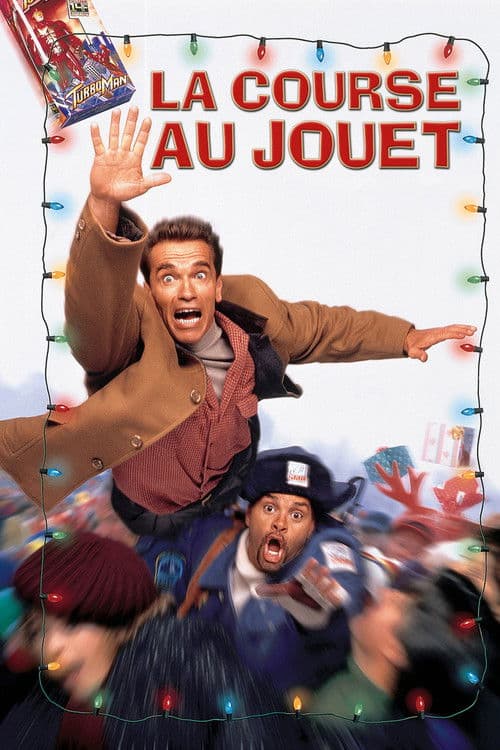
Jingle All the Way
Does this age rating seem accurate to you?
Detailed parental analysis
Toy Rush is a family Christmas comedy with a deliberately burlesque and frenetic tone, driven by pervasive physical humour. The plot follows an overwhelmed father who desperately attempts to find the year's most coveted toy for his son, just hours before Christmas Eve. The film targets a broad family audience, but its actual content is better suited to children aged 8 and above than to very young children.
Violence
Slapstick violence is the film's primary comic engine and recurs at a sustained pace throughout the narrative. Punches, falls, electrocutions, trampling, kicks to the groin and projections across rooms follow one another in a clearly cartoonish register. One scene involves a bomb threat followed by a real explosion leaving burn marks, which exceeds the purely comic register. A person of small stature is struck and projected across a room with openly comic intent, which warrants being flagged. Violence is never presented as serious or painful, which mitigates its immediate impact but may also normalise blows as a humorous device.
Parental and Family Portrayals
The film rests entirely on a highly codified representation of the family: the father is absent, absorbed by his work, unable to keep his commitments to his son, and his redemption forms the central arc of the narrative. The mother, meanwhile, organises the household, bakes biscuits, receives neighbours and forgives with a consistency bordering on self-effacement. This division of roles is never questioned by the film; it is simply presented as natural. The final message is sincere: the child renounces the toy upon understanding that the father's presence is worth more than any gift, which offers a genuine entry point for a conversation about family priorities.
Discrimination
The film contains an explicitly racist joke, formulated without distance or irony: a character compares his perspiration to that of a dog in a Chinese restaurant. This line is not contextualised, not turned around, not sanctioned by the narrative. It is presented as an ordinary humorous trait. Furthermore, the main rival character, played by a black actor, is treated as a poorly nuanced antagonist whose characterisation rests more on agitation and obstruction than on genuine depth. These elements merit being named explicitly with a child or adolescent.
Underlying Values
The film superficially criticises Christmas consumerism, the race for toys and social pressure around gifts, but this critique remains shallow: the entire narrative is constructed around a frenzied quest for that very toy, and the father is valorised precisely because he ultimately obtains it in another way. The final anti-materialist message is real but fragile, carried by a child who renounces the toy in a burst of affection, without the film genuinely questioning the logic of possession. The father's professional performance is presented as a weakness to correct, not as a system to interrogate.
Substances
Alcohol is present repeatedly: characters pour alcohol into their coffee, drink from the bottle, and a fantasy scene shows a child drinking alcohol. These moments are treated in comic fashion without any critical distance. The presence of alcohol is not central to the narrative but is sufficiently recurrent to warrant flagging, particularly for younger children.
Sex and Nudity
The film contains a few light sexual allusions clearly intended for adults in the audience: a reference to a woman having had relations with all her office colleagues, and an attempt by a neighbour to seduce a married woman. These elements generally pass over the heads of young children but are perceptible to pre-teens and adolescents.
Language
The language is punctuated by mild to moderate profanities, in the usual register of American family comedies from the 1990s: softened oaths, mild insults, aggressive phrases. Nothing extreme, but the frequency is sufficient to be noted with young children.
Strengths
The film functions as an effective physical comedy action piece within its genre, with sustained pacing and several well-constructed sequences of chaos. Its principal merit is to pose a concrete and universal family question: what does a present father look like, and what does a child really expect from Christmas? The emotional resolution, though predictable, is sincere and can touch both children and parents. Beyond this, the film has no particular artistic pretension and fully assumes its status as seasonal entertainment without further depth.
Age recommendation and discussion points
The film is not recommended for children under 8 years old due to repeated violence, allusions for adults and a racist joke that requires explanation. From age 8 or 9 onwards, it can be watched as a family provided the viewing is accompanied. Two angles of discussion are worth opening after the film: why does the father chase after a toy rather than simply being present, and what does this say about what adults believe children want for Christmas? The racist joke also merits being named directly, without waiting for the child to pick up on it themselves.
Synopsis
Howard Langston, a salesman for a mattress company, is constantly kept busy at his job, disappointing his son. After he misses his son's karate exposition, Howard vows to make it up to him by buying an action figure of his son's favorite television hero for Christmas. Unfortunately for Howard, it is Christmas Eve, and every store is sold out of Turbo Man. Now, Howard must travel all over town and compete with everybody else to find a Turbo Man action figure.
Where to watch
Availability checked on Apr 28, 2026
About this title
- Format
- Feature film
- Year
- 1996
- Runtime
- 1h 26m
- Countries
- United States of America
- Original language
- EN
- Directed by
- Brian Levant
- Main cast
- Arnold Schwarzenegger, Sinbad, Phil Hartman, Rita Wilson, Robert Conrad, Martin Mull, Jake Lloyd, Jim Belushi, E.J. De la Pena, Laraine Newman
- Studios
- 1492 Pictures, 20th Century Fox, Fox Family Films
Content barometer
- Violence3/5Notable
- Fear1/5Mild
- Sexuality1/5Allusions
- Language2/5Moderate
- Narrative complexity1/5Accessible
- Adult themes2/5Present
Watch-outs
- Alcohol
- Strong language
- Gender stereotypes
- Ethnic or racial stereotypes
- Violence
Values conveyed
- Forgiveness
- family
- redemption
- perseverance
- parental love