

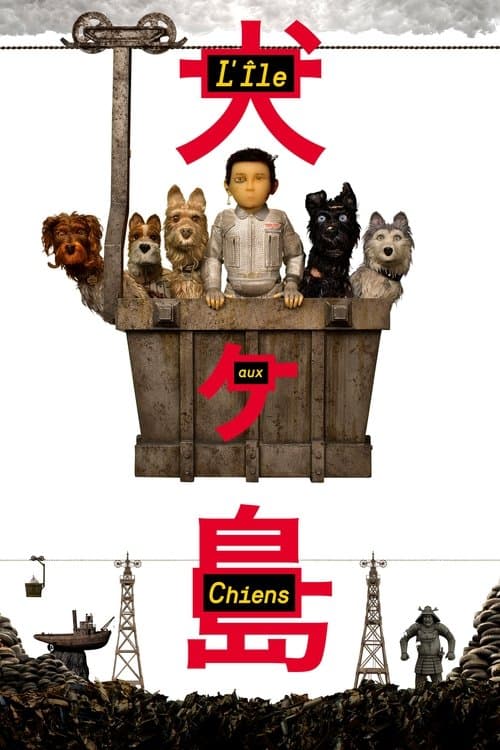


Isle of Dogs


Isle of Dogs
Your feedback improves this guide
Your feedback highlights guides that need a second look and keeps the rating trustworthy.
Does this age rating seem accurate to you?
Sign in to vote
Watch-outs
What this film brings
Content barometer
Violence
3/5
Notable
Fear
3/5
Notable tension
Sexuality
0/5
None
Language
1/5
Mild
Narrative complexity
2/5
Moderate
Adult themes
0/5
None
Detailed parental analysis
ⓘ- Violence
- Discrimination
- Social Themes
- Underlying Values
- Parental and Family Portrayals
- Language
Isle of Dogs is an animated film with refined aesthetics and a decidedly dark atmosphere, aimed primarily at adolescent and adult audiences. The plot follows a young boy who ventures onto a rubbish dump island to find his dog, banished along with all the city's dogs by an authoritarian government. Despite its animated format, the film is not intended for young children, and several of its sequences may unsettle even pre-adolescents.
Violence
Violence is present recurrently and sometimes graphically, even within an animated film. Dog fights are depicted as swirling clouds of dust from which limbs and spurts of blood emerge, a stylisation that diminishes but does not erase the brutality. A torn-off ear with visible blood, a poisoned character whose corpse with bulging eyes is shown at the morgue, a metal antenna ripped from a child's head with drops of blood, constitute striking images for a young audience. The film also mentions a dog's suicide and shows skeletons of dogs in cages, the implicit result of slow death by deprivation. These elements follow a narrative logic, denouncing the horrors of authoritarian oppression, but their accumulation clearly exceeds the register of a children's film.
Discrimination
The film raises a serious debate about how it represents Japanese culture. Japanese human characters speak their language without translation, relegating them to the background of a narrative where English-speaking dogs occupy the emotional centre. More troubling still, it is a white American student, Tracy, who embodies the role of resistance heroine, whilst Japanese characters remain passive or secondary in their own city. Japanese culture is furthermore invoked in the form of surface-level references: sushi, sumo, yakuza tattoos, haiku. This treatment is not without consequence and can serve as a starting point for a useful conversation about how non-Western cultures are sometimes represented in productions aimed at Western audiences.
Social Themes
Politics lies at the heart of the film: an authoritarian mayor manipulates public opinion through fear and misinformation to persecute a segment of the population, here the dogs. The analogy with real political mechanisms, propaganda, scapegoating, state conspiracy, is readable and intentional. The film also depicts a form of civic resistance, notably through investigative journalism, and shows the difficulty of standing alone against a corrupt institutional machine. These themes offer rich material for discussing democracy, civil disobedience and the role of information with an adolescent.
Underlying Values
The narrative is structured around loyalty, courage in the face of injustice, and solidarity amongst vulnerable beings. These values are consistent and conveyed with conviction. In exchange, the film tends to glorify the individual action of the hero or heroine at the expense of a collective logic, which is a classic narrative pattern but warrants noting. Resistance to oppressive authority is presented as a moral necessity, something that can be discussed positively with an adolescent.
Parental and Family Portrayals
The young protagonist boy is an orphan: his parents were killed in a train accident, and he lives under the guardianship of the mayor, his adoptive uncle, who proves to be the principal antagonist. The parental figure is thus both absent and malevolent, which constitutes a strong emotional driver of the narrative. This dynamic may affect children sensitive to themes of abandonment or betrayal by adults meant to protect them.
Language
The language contains a few mild expletives and a reference to genitalia and mating, without particular emphasis. The overall content remains within the norms of a standard American mainstream film rated PG-13.
Strengths
Isle of Dogs is an ambitious cinematic object, with meticulous aesthetics and remarkable visual attention to detail. The writing skilfully operates on multiple levels of reading: an adventure legible for older children, a satire accessible to adolescents, a reflection on loyalty and persecution for adults. The construction of the fictional world, with its references to post-war Japanese aesthetics, gives the film a visual and cultural density rare in Western animation. The themes of propaganda, resistance and scapegoating are treated without condescension, making it a solid vehicle for introducing adolescents to political reflection and critical analysis of narrative.
Age recommendation and discussion points
The film is best reserved for children aged at least 10 years, with parental guidance for ages 10-12 due to visual violence, themes of death and persecution, and certain frankly unsettling images. For a viewing without reservations, an age of 12 constitutes a more suitable threshold. Two angles of discussion are particularly worth pursuing after viewing: why does the film choose to have dogs speak English whilst leaving Japanese humans without a voice, and what does this reveal about how we tell stories of other cultures? And also: how can one recognise, in real life, the mechanisms of propaganda that the film stages, the designation of an enemy, the manipulation of fear, the silence of institutions?
Synopsis
In the future, an outbreak of canine flu leads the mayor of a Japanese city to banish all dogs to an island used as a garbage dump. The outcasts must soon embark on an epic journey when a 12-year-old boy arrives on the island to find his beloved pet.
Where to watch
No verified platform for the US market yet. We keep this section updated as availability changes.
Availability checked on Apr 01, 2026
About this title
- Format
- Feature film
- Year
- 2018
- Runtime
- 1h 41m
- Countries
- United States of America, Germany
- Original language
- EN
- Studios
- Studio Babelsberg, American Empirical Pictures, Indian Paintbrush, Scott Rudin Productions
Content barometer
Violence
3/5
Notable
Fear
3/5
Notable tension
Sexuality
0/5
None
Language
1/5
Mild
Narrative complexity
2/5
Moderate
Adult themes
0/5
None
Detailed parental analysis
ⓘ- Violence
- Discrimination
- Social Themes
- Underlying Values
- Parental and Family Portrayals
- Language
Isle of Dogs is an animated film with refined aesthetics and a decidedly dark atmosphere, aimed primarily at adolescent and adult audiences. The plot follows a young boy who ventures onto a rubbish dump island to find his dog, banished along with all the city's dogs by an authoritarian government. Despite its animated format, the film is not intended for young children, and several of its sequences may unsettle even pre-adolescents.
Violence
Violence is present recurrently and sometimes graphically, even within an animated film. Dog fights are depicted as swirling clouds of dust from which limbs and spurts of blood emerge, a stylisation that diminishes but does not erase the brutality. A torn-off ear with visible blood, a poisoned character whose corpse with bulging eyes is shown at the morgue, a metal antenna ripped from a child's head with drops of blood, constitute striking images for a young audience. The film also mentions a dog's suicide and shows skeletons of dogs in cages, the implicit result of slow death by deprivation. These elements follow a narrative logic, denouncing the horrors of authoritarian oppression, but their accumulation clearly exceeds the register of a children's film.
Discrimination
The film raises a serious debate about how it represents Japanese culture. Japanese human characters speak their language without translation, relegating them to the background of a narrative where English-speaking dogs occupy the emotional centre. More troubling still, it is a white American student, Tracy, who embodies the role of resistance heroine, whilst Japanese characters remain passive or secondary in their own city. Japanese culture is furthermore invoked in the form of surface-level references: sushi, sumo, yakuza tattoos, haiku. This treatment is not without consequence and can serve as a starting point for a useful conversation about how non-Western cultures are sometimes represented in productions aimed at Western audiences.
Social Themes
Politics lies at the heart of the film: an authoritarian mayor manipulates public opinion through fear and misinformation to persecute a segment of the population, here the dogs. The analogy with real political mechanisms, propaganda, scapegoating, state conspiracy, is readable and intentional. The film also depicts a form of civic resistance, notably through investigative journalism, and shows the difficulty of standing alone against a corrupt institutional machine. These themes offer rich material for discussing democracy, civil disobedience and the role of information with an adolescent.
Underlying Values
The narrative is structured around loyalty, courage in the face of injustice, and solidarity amongst vulnerable beings. These values are consistent and conveyed with conviction. In exchange, the film tends to glorify the individual action of the hero or heroine at the expense of a collective logic, which is a classic narrative pattern but warrants noting. Resistance to oppressive authority is presented as a moral necessity, something that can be discussed positively with an adolescent.
Parental and Family Portrayals
The young protagonist boy is an orphan: his parents were killed in a train accident, and he lives under the guardianship of the mayor, his adoptive uncle, who proves to be the principal antagonist. The parental figure is thus both absent and malevolent, which constitutes a strong emotional driver of the narrative. This dynamic may affect children sensitive to themes of abandonment or betrayal by adults meant to protect them.
Language
The language contains a few mild expletives and a reference to genitalia and mating, without particular emphasis. The overall content remains within the norms of a standard American mainstream film rated PG-13.
Strengths
Isle of Dogs is an ambitious cinematic object, with meticulous aesthetics and remarkable visual attention to detail. The writing skilfully operates on multiple levels of reading: an adventure legible for older children, a satire accessible to adolescents, a reflection on loyalty and persecution for adults. The construction of the fictional world, with its references to post-war Japanese aesthetics, gives the film a visual and cultural density rare in Western animation. The themes of propaganda, resistance and scapegoating are treated without condescension, making it a solid vehicle for introducing adolescents to political reflection and critical analysis of narrative.
Age recommendation and discussion points
The film is best reserved for children aged at least 10 years, with parental guidance for ages 10-12 due to visual violence, themes of death and persecution, and certain frankly unsettling images. For a viewing without reservations, an age of 12 constitutes a more suitable threshold. Two angles of discussion are particularly worth pursuing after viewing: why does the film choose to have dogs speak English whilst leaving Japanese humans without a voice, and what does this reveal about how we tell stories of other cultures? And also: how can one recognise, in real life, the mechanisms of propaganda that the film stages, the designation of an enemy, the manipulation of fear, the silence of institutions?
Synopsis
In the future, an outbreak of canine flu leads the mayor of a Japanese city to banish all dogs to an island used as a garbage dump. The outcasts must soon embark on an epic journey when a 12-year-old boy arrives on the island to find his beloved pet.