

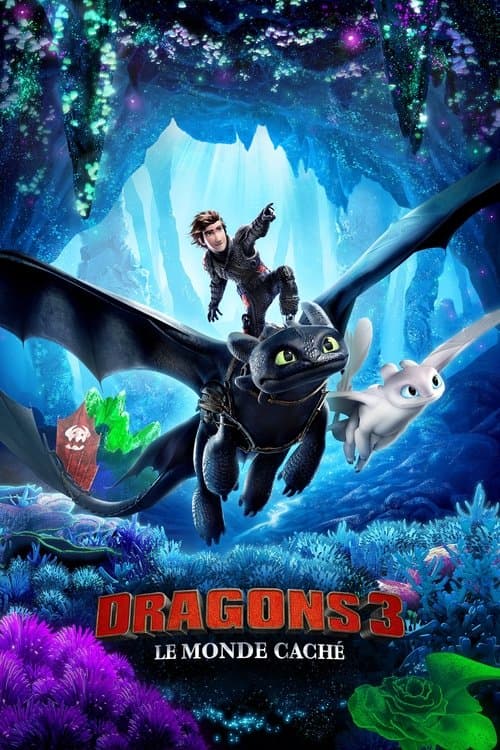


How to Train Your Dragon: The Hidden World


How to Train Your Dragon: The Hidden World
Your feedback improves this guide
Your feedback highlights guides that need a second look and keeps the rating trustworthy.
Does this age rating seem accurate to you?
Sign in to vote
Watch-outs
What this film brings
Content barometer
Violence
2/5
Moderate
Fear
2/5
A few scenes
Sexuality
0/5
None
Language
0/5
None
Narrative complexity
1/5
Accessible
Adult themes
1/5
Mild
Detailed parental analysis
ⓘ- Underlying Values
- Violence
- Parental and Family Portrayals
- Social Themes
How to Train Your Dragon 3: The Hidden World is an animated adventure film with an atmosphere that is both epic and melancholic, bringing to a close a family trilogy driven by a profound bond between a young village chief and his dragon. The plot follows Hiccup and Toothless as they face an unrelenting dragon hunter, whilst a discovery upends the future of their shared world. The film is aimed at children from ages 7-8 onwards, but its emotional weight in the closing scenes resonates as deeply with parents as with children.
Underlying Values
This is the true heart of the film. The narrative carefully constructs a reflection on what it means to love without possessing: Hiccup must accept that Toothless has a life of his own, needs and a destiny beyond his control. This question of attachment and letting go runs throughout the entire film without ever being stated in a didactic manner, which makes it all the more powerful. The resolution of the central conflict comes through withdrawal and protection rather than confrontation, which is a deliberately less spectacular and more mature narrative position. Non-violence as a strategic choice, rather than as weakness, is valued without sentimentality.
Violence
Battle scenes are present and recurrent: clashes between Vikings and dragon hunters, destruction of ships, aerial chases, use of bladed weapons. The violence remains stylised and never ventures into gore: there is no visible blood or realistic injuries. The antagonist Grimmel masters a technique for controlling dragons through venom, which introduces a form of chemical manipulation into the narrative, though this is not presented as a model. The narrative purpose is clear: these sequences serve dramatic tension and underscore what is at stake, without glorifying destruction.
Parental and Family Portrayals
Hiccup fully embraces the legacy of his absent father and takes on responsibility for an entire clan, giving him an arc of maturity that is unusual for a character of his age in this type of film. The maternal figure is present, protective and grounded, without being sidelined. The film treats seriously the question of transmission and the weight that family heritage represents for a young adult who doubts himself.
Social Themes
Coexistence between humans and dragons, put under pressure by organised predators motivated by profit, carries beneath the surface a reflection on the preservation of vulnerable species and on what human societies inflict on creatures they do not understand. This is not a film with an environmentalist agenda, but the subtext is legible and can fuel a conversation with an inquisitive child.
Strengths
The film keeps the promise of an emotionally honest conclusion: it does not seek an easy happy ending and commits to a separation that truly costs the viewer something. The relationship between Hiccup and Toothless, built across three films, achieves here a depth that is rare in mainstream family animation, because it rests on concrete actions rather than declarations. The final scene brings tears even to adults watching the film for the third time, a sign that the film has built something enduring. Narratively, the story knows how to balance action sequences with more contemplative moments, and it affords secondary characters moments of presence that avoid caricature.
Age recommendation and discussion points
The film is suitable from age 8 onwards for comfortable viewing; children aged 6-7 can watch it with an adult available for the tense scenes. After viewing, two angles are worth discussing: why Hiccup chooses to let Toothless go rather than keep him, and how this is a form of courage; and what children feel when faced with the idea that loving someone can sometimes mean parting from them in order to protect them.
Synopsis
As Hiccup fulfills his dream of creating a peaceful dragon utopia, Toothless’ discovery of an untamed, elusive mate draws the Night Fury away. When danger mounts at home and Hiccup’s reign as village chief is tested, both dragon and rider must make impossible decisions to save their kind.
Where to watch
No verified platform for the US market yet. We keep this section updated as availability changes.
Availability checked on Apr 01, 2026
About this title
- Format
- Feature film
- Year
- 2019
- Runtime
- 1h 37m
- Countries
- United States of America
- Original language
- EN
- Studios
- DreamWorks Animation
Content barometer
Violence
2/5
Moderate
Fear
2/5
A few scenes
Sexuality
0/5
None
Language
0/5
None
Narrative complexity
1/5
Accessible
Adult themes
1/5
Mild
Detailed parental analysis
ⓘ- Underlying Values
- Violence
- Parental and Family Portrayals
- Social Themes
How to Train Your Dragon 3: The Hidden World is an animated adventure film with an atmosphere that is both epic and melancholic, bringing to a close a family trilogy driven by a profound bond between a young village chief and his dragon. The plot follows Hiccup and Toothless as they face an unrelenting dragon hunter, whilst a discovery upends the future of their shared world. The film is aimed at children from ages 7-8 onwards, but its emotional weight in the closing scenes resonates as deeply with parents as with children.
Underlying Values
This is the true heart of the film. The narrative carefully constructs a reflection on what it means to love without possessing: Hiccup must accept that Toothless has a life of his own, needs and a destiny beyond his control. This question of attachment and letting go runs throughout the entire film without ever being stated in a didactic manner, which makes it all the more powerful. The resolution of the central conflict comes through withdrawal and protection rather than confrontation, which is a deliberately less spectacular and more mature narrative position. Non-violence as a strategic choice, rather than as weakness, is valued without sentimentality.
Violence
Battle scenes are present and recurrent: clashes between Vikings and dragon hunters, destruction of ships, aerial chases, use of bladed weapons. The violence remains stylised and never ventures into gore: there is no visible blood or realistic injuries. The antagonist Grimmel masters a technique for controlling dragons through venom, which introduces a form of chemical manipulation into the narrative, though this is not presented as a model. The narrative purpose is clear: these sequences serve dramatic tension and underscore what is at stake, without glorifying destruction.
Parental and Family Portrayals
Hiccup fully embraces the legacy of his absent father and takes on responsibility for an entire clan, giving him an arc of maturity that is unusual for a character of his age in this type of film. The maternal figure is present, protective and grounded, without being sidelined. The film treats seriously the question of transmission and the weight that family heritage represents for a young adult who doubts himself.
Social Themes
Coexistence between humans and dragons, put under pressure by organised predators motivated by profit, carries beneath the surface a reflection on the preservation of vulnerable species and on what human societies inflict on creatures they do not understand. This is not a film with an environmentalist agenda, but the subtext is legible and can fuel a conversation with an inquisitive child.
Strengths
The film keeps the promise of an emotionally honest conclusion: it does not seek an easy happy ending and commits to a separation that truly costs the viewer something. The relationship between Hiccup and Toothless, built across three films, achieves here a depth that is rare in mainstream family animation, because it rests on concrete actions rather than declarations. The final scene brings tears even to adults watching the film for the third time, a sign that the film has built something enduring. Narratively, the story knows how to balance action sequences with more contemplative moments, and it affords secondary characters moments of presence that avoid caricature.
Age recommendation and discussion points
The film is suitable from age 8 onwards for comfortable viewing; children aged 6-7 can watch it with an adult available for the tense scenes. After viewing, two angles are worth discussing: why Hiccup chooses to let Toothless go rather than keep him, and how this is a form of courage; and what children feel when faced with the idea that loving someone can sometimes mean parting from them in order to protect them.
Synopsis
As Hiccup fulfills his dream of creating a peaceful dragon utopia, Toothless’ discovery of an untamed, elusive mate draws the Night Fury away. When danger mounts at home and Hiccup’s reign as village chief is tested, both dragon and rider must make impossible decisions to save their kind.