

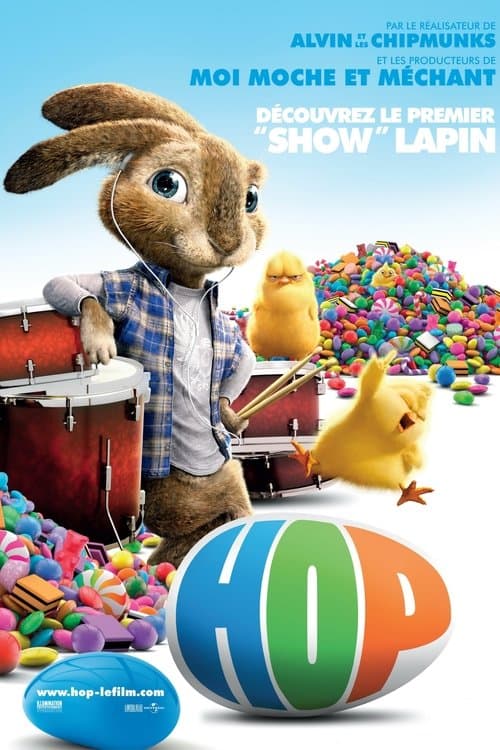
Hop
Does this age rating seem accurate to you?
Detailed parental analysis
Hop is a light and colourful family comedy blending live-action footage with computer-generated animated characters, in a joyful and relaxed atmosphere. The plot follows a young Easter Bunny who refuses to follow in his father's footsteps and flees to Los Angeles to become a drummer, whilst a young man without ambition finds himself unexpectedly tasked with watching over him. The film is primarily aimed at children aged 6-7 and upwards, with a few nods to parents, but these adult asides are precisely what warrants attention.
Discrimination
The character of Carlos, a chick aspiring to take over the Easter factory, concentrates the film's most questionable representations. He is given an exaggerated Hispanic accent, stereotyped to the point of caricature, portrayed by a non-Hispanic actor. More problematic still, his narrative arc presents him as a delusionally ambitious character whose aspirations beyond a subordinate role are treated as comic or indecent. The contrast between this character and the main protagonists, coded as privileged and cultured, structures an implicit message about who legitimately has the right to ambition. This is a concrete point to raise with a child or teenager: why does Carlos's accent make people laugh, and would we laugh in the same way with a different character?
Violence
Violence is omnipresent in the form of slapstick: a character is hit by a car, struck with a broom, bitten by dogs, slapped. These sequences sit within the tradition of physical comedy and are never presented with intent to harm, but their frequency is notable. A few scenes push one notch above the usual comic register: a character narrowly avoids being crushed by a rock, two others find themselves trapped above blades and boiling liquid. The whole thing remains without real narrative consequence and resolves quickly, but these sequences may startle the more sensitive children around 5-6 years old.
Sex and Nudity
The film slips into a slightly adult register on several occasions that has no justified place in a children's comedy. A character describes himself as a 'sexy bunny', a scene suggests an open relationship, and a visit to the famous Playboy magazine mansion is woven into the narrative without being innocent in its cultural significance. Remarks about a female character's physique and flirting behaviour including hair sniffing round out this picture. No scene is explicit, but the accumulation of these references blurs the film's positioning for children under 8 years old, and may generate questions for which the parent does well to be prepared.
Underlying Values
The film sincerely defends the value of pursuing one's passions against family or social expectations, and the necessity for young people to take charge of their own lives. This message is coherent and well-constructed in the arc of the young bunny as well as that of the human protagonist, who must also learn to take direction in his life. Family responsibility is presented as a legitimate counterweight to individualism, and the two values ultimately reconcile rather than oppose each other. The whole thing genuinely works for the target age group.
Parental and Family Portrayals
The human protagonist's father is portrayed as disappointed and unsympathetic towards his son's lack of direction, yet not malevolent. The generational conflict is handled lightly but leads to genuine reconciliation. On the bunny's side, the father symbolises the transmission of a family legacy that the son initially rejects: this tension is the primary emotional driver of the narrative, and it is resolved positively. The film does not present problematic parental representation, but it is worth noting that paternal pressure is shown as an obstacle to overcome before being reassessed.
Strengths
Hop offers little on an artistic or narrative level: the screenplay is mechanical, the plot twists predictable, and the blend of live-action and animation is exploited only for comedic purposes without particular ingenuity. The physical comedy works well for the young target audience, and the film maintains its pace without excessive downtime. Its principal merit is to address, in an accessible package, the tension between personal ambition and family responsibility in a way that school-aged children can understand and feel. It is not a memorable film, but it fulfils its contract as light family entertainment for children around 7 to 10 years old.
Age recommendation and discussion points
The film is suitable from 7 years old, with adult accompaniment for 7-8 year-olds due to a few sequences of tension and scattered adult references. To discuss after viewing: why is the character of Carlos presented as ridiculous when he simply wants to progress, and does the accent we laugh at say something about the way we regard certain people. You can also address with the child the question of ambition and family pressure: how much should one follow what parents imagine for us, and when do we have the right to choose our own path?
Synopsis
E.B., the Easter Bunny's teenage son, heads to Hollywood, determined to become a drummer in a rock 'n' roll band. In L.A., he's taken in by Fred after the out-of-work slacker hits E.B. with his car.
Where to watch
Availability checked on Apr 03, 2026
About this title
- Format
- Feature film
- Year
- 2011
- Runtime
- 1h 35m
- Countries
- United States of America
- Original language
- EN
- Directed by
- Tim Hill
- Main cast
- Russell Brand, James Marsden, Kaley Cuoco, Hank Azaria, Elizabeth Perkins, Gary Cole, Hugh Laurie, David Hasselhoff, Chelsea Handler, Dustin Ybarra
- Studios
- Universal Pictures, Illumination
Content barometer
- Violence2/5Moderate
- Fear2/5A few scenes
- Sexuality2/5Mild
- Language1/5Mild
- Narrative complexity1/5Accessible
- Adult themes0/5None
Watch-outs
- Ethnic or racial stereotypes
- Sexuality
- Violence
Values conveyed
- Perseverance
- Autonomy
- responsibility
- friendship
- following one's dreams
- father-son reconciliation
- self-confidence