Hercules
Does this age rating seem accurate to you?
Detailed parental analysis
Hercules is a Disney animated musical comedy with a broadly cheerful and upbeat tone, but punctuated by sequences that are genuinely unsettling and exceed the usual register of films aimed at young children. The narrative follows a young demigod who attempts to find his place among the gods of Olympus by becoming a legendary hero, whilst discovering what heroism truly means. The film primarily targets children aged 7 and above, but several elements make it more appropriate for children of around 10 years or older.
Violence
The violence is more intense than one would expect from an animated film certified as suitable for general audiences. The combat sequence against the Hydra includes repeated decapitations with sprays of green blood and a deliberate close-up of the severed neck, a visual treatment that clearly departs from the usual register of family animation. The Titans devastate entire cities with effects of fire, ice and tornadoes, rendered in an apocalyptic manner sustained at a high level of intensity. A late scene shows Hercules ageing rapidly until he becomes a living skeleton. These elements are rooted in the logic of the narrative rather than in gratuitousness, but their visual impact is real for a young child.
Discrimination
The character of Hades concentrates several traits that constitute a problematic stereotype: pronounced New York accent, expressions borrowed from Yiddish, and caricatured physical features associated with classic antisemitic representations. This encoding is likely unintentional in its conception, but it is sufficiently recognisable to merit being named and discussed with an older child capable of engaging with it. It is not a central element of the film, but it is a worthwhile angle for conversation about the way in which visual and sonic representations can convey clichés without the creators necessarily being conscious of it.
Underlying Values
The film constructs a coherent and ultimately ambitious moral arc: true heroism is not physical strength or fame, but sacrifice undertaken out of love. This conclusion is sound and well rooted in the narrative. Along the way, the story offers a clear-eyed satire of the culture of glory and merchandising, showing Hercules transformed into a commercial brand, which is rare for this type of film and opens up an interesting discussion about the appropriation of heroes' images. The adolescent's quest for identity, seeking to understand where he comes from and where he belongs, constitutes an additional emotional strand.
Parental and Family Portrayals
Hercules' adoptive parents are portrayed with warmth and benevolence, as loving and reassuring figures despite their modest circumstances. The narrative treats with care the question of adoption and belonging: Hercules considers them his true parents, and the film's conclusion confirms that family is built through love rather than blood. This is a message treated without condescension.
Sex and Nudity
The character of Megara is designed with a silhouette and register of seduction that are notably pronounced for an animated film aimed at children. One sequence shows her explicitly attempting to charm Hercules on Hades' behalf. There is no nudity, but the presentation of the female character relies on visual and behavioural hypersexualisation that stands out against the age of the target audience.
Language
The language is generally well-controlled, with a single use of the word 'damn' and a play on words with 'oh my gods' presented as a humorous variation. Nothing significant at this level.
Strengths
The film succeeds in articulating a simplified yet recognisable Greek mythology with a pop and offbeat tone that works well for children. The satire of media glory and merchandising is executed with surprising acuity for a film of this format, and it remains accessible at multiple age levels. The moral conclusion, centred on sacrifice and love rather than performance, gives the narrative genuine depth. The musical sequences are energetic and memorable, and the character of Hades, despite its representational problems, constitutes one of the most lively and dynamic antagonists in the animation catalogue of that era.
Age recommendation and discussion points
The film is accessible from ages 7 to 8 for children who are not sensitive to intense imagery, but a comfortable viewing experience sits closer to ages 9 to 10, particularly so that the stylised violence sequences and infernal environments do not generate lasting anxiety. Two angles of discussion are worth exploring after viewing: ask the child why Hercules ultimately renounces Olympus, and what this says about what it means to be a hero; and, for older children, observe how Hades is drawn and spoken, and wonder together whether this character resembles someone or a group of real people.
Synopsis
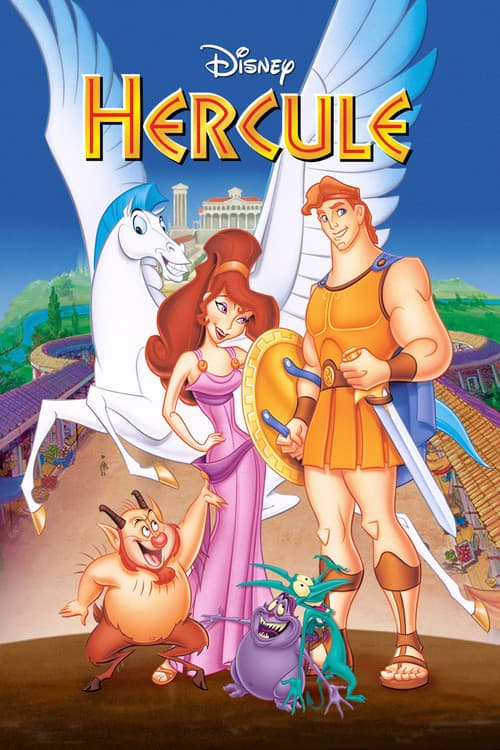
Bestowed with superhuman strength, a young mortal named Hercules sets out to prove himself a hero in the eyes of his father, the great god Zeus. Along with his friends Pegasus, a flying horse, and Phil, a personal trainer, Hercules is tricked by the hilarious, hotheaded villain Hades, who's plotting to take over Mount Olympus!
About this title
- Format
- Feature film
- Year
- 1997
- Runtime
- 1h 31m
- Countries
- United States of America
- Original language
- EN
- Studios
- Walt Disney Feature Animation
Content barometer
- Violence3/5Notable
- Fear4/5Intense
- Sexuality2/5Mild
- Language1/5Mild
- Narrative complexity1/5Accessible
- Adult themes0/5None
Watch-outs
- Death
- Ethnic or racial stereotypes
- Violence
Values conveyed
- Courage
- Compassion
- Forgiveness
- friendship
- perseverance
- identity