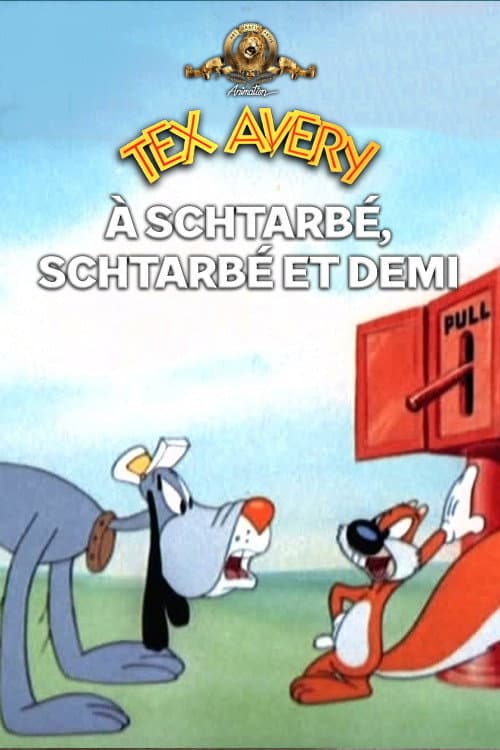
Happy-Go-Nutty
Does this age rating seem accurate to you?
Detailed parental analysis
Happy-Go-Nutty is a fast-paced animated comedy short with deliberately absurd humour, typical of American cartoons from the 1940s. The plot follows Screwy Squirrel, a squirrel escaping from a psychiatric asylum to wreak chaos around him. The film appears to target a young audience, but its content and comedic devices are better suited to a discerning adult or teenage viewer.
Violence
Violence is the almost exclusive driving force of the cartoon, present repeatedly and consistently throughout the seven minutes of the film. The gags string together hammer blows, cliff falls, explosions and burlesque dismemberments, including a sequence where a character's nose detaches to be struck separately. This violence is stylised according to the slapstick codes of the era, but its accumulation and systematic nature distinguish it from more restrained cartoons of the same genre. It is driven by no narrative purpose: it is an end in itself, without consequence or lesson. For a young child, the repetition of these gags without moral framework can normalise brutality as a source of pure entertainment.
Discrimination
The film contains a blackface gag, that is, a caricatural representation with blackened face inherited from an American racist tradition. This type of content led to the removal of the sequence in television broadcasts and modern streaming versions. Its presence in the original version is a documented historical fact, but it remains an unambiguous racial caricature, without critical distance or contextualisation. The secondary character Meathead is moreover presented as stupid unequivocally, his very name being an insult, which constitutes a form of mockery of people with reduced intellectual capacities. These elements deserve to be named explicitly if the film is viewed in its uncensored version.
Underlying Values
The main character possesses no sympathetic qualities: he is cruel, manipulative and derives satisfaction from the suffering of others. The narrative offers no moral counterweight, no consequence, no arc of redemption. Cruelty is presented as amusing and gratifying, never questioned. Furthermore, the narrative setting of the psychiatric asylum, named Moron Manor, treats mental illness as a comedic device, which reflects the representations of the era but remains problematic to present without commentary to a young audience.
Social Themes
The representation of mental illness and psychiatric internment as comedic backdrop is a social issue in its own right. The film does not seek to interrogate these institutions: it uses them as a pretext for anarchy. For a teenager, this can be an opportunity for discussion about how certain eras treated psychological difference, and what the humour of a society reveals about its blind spots.
Strengths
The film possesses a frenetic visual energy and inventiveness in the stringing together of gags that testify to the expertise of American animation studios in the golden age. For an adult or teenager interested in the history of the cartoon, it constitutes a document on the codes and moral limits of popular animation in the 1940s, including in what is shocking about them. Its value is more historical and analytical than entertaining in the contemporary sense of the term.
Age recommendation and discussion points
This cartoon is not suitable for young children: its repeated violent content, its discriminatory caricatures and its complete absence of moral framework reserve it for an audience of at least 12 years old, and only in a context of supervised and commented viewing. For a teenager or adult, it can become a useful support for discussion on the evolution of representations in popular media, on what the humour of an era says about its prejudices, and on the difference between narrative violence and gratuitous violence.
Synopsis
Screwy Squirrel escapes from the nut house and leads the guard dog on a long and ridiculous chase.
About this title
- Format
- Short film
- Year
- 1944
- Runtime
- 7m
- Countries
- United States of America
- Original language
- EN
- Directed by
- Tex Avery
- Main cast
- Wally Maher, Dick Nelson
- Studios
- Metro-Goldwyn-Mayer, MGM Cartoon Studio
Content barometer
- Violence4/5Strong
- Fear2/5A few scenes
- Sexuality0/5None
- Language1/5Mild
- Narrative complexity0/5Simple
- Adult themes0/5None
Watch-outs
- Violence
- Ethnic or racial stereotypes
- Abuse
Values conveyed
- humor
- creativity
- fantasy