

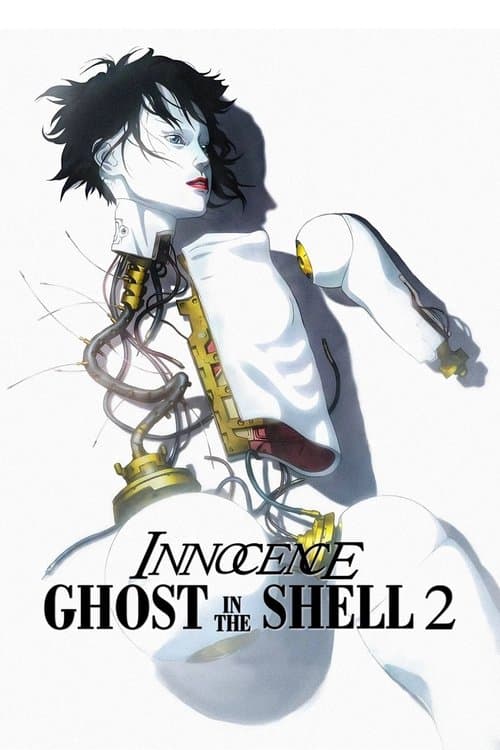
Ghost in the Shell 2: Innocence
イノセンス
Does this age rating seem accurate to you?
Detailed parental analysis
Ghost in the Shell 2: Innocence is a science-fiction animated film with a contemplative and weighty atmosphere, visually dense and philosophically demanding. The plot follows a cyborg inspector tasked with investigating a series of murders committed by female androids, an investigation that leads him to question the boundaries between humanity, machine and consciousness. The film is aimed at an adult or mature teenage audience, and constitutes a work of difficult access for anyone lacking a certain intellectual and emotional maturity.
Sex and Nudity
The question of sexual exploitation lies at the very heart of the narrative: the plot revolves around gynoids designed as sexual companions, and the film progressively reveals that the consciousnesses of young girls have been implanted into these androids against their will. This treatment is not voyeuristic but constitutes an explicit moral critique of creating potentially sentient beings solely for sexual use. Scenes show female cyborgs undressing mechanically and their bodies disassembling or exploding. The nudity is functional to the purpose, not eroticised, but the underlying thematic remains heavy and demands genuine maturity to be received without disturbance or confusion.
Violence
Violence is present from the opening and returns at regular intervals throughout the film. It includes bodies riddled with bullets with blood sprayed, missing heads and limbs, gaping abdominal wounds and androids whose bodies explode mechanically. The visual intensity is high for an animated film and far exceeds what one would typically expect from a PG-13 classification (protection from age 13 in the United States). It is not gratuitous in the strict sense: it serves a genuine dramatic tension and the coldness of these sequences reinforces the commentary on dehumanisation. But for an unprepared adolescent, the brutality of the images remains striking.
Discrimination
Human female characters are virtually absent from the film, and the few female figures represented are androids without their own agency, instrumentalised as sexual objects, who kill or destroy themselves. The narrative signals this as a constitutive injustice of the plot rather than as an accepted norm, which distinguishes critique from valorisation. Nevertheless, the near total absence of active women in the diegesis is striking and merits discussion with an adolescent: the film addresses the exploitation of female bodies without truly giving voice to women.
Underlying Values
The film is structured around serious philosophical questions about consciousness, identity and what constitutes humanity in an increasingly artificial world. It poses a clear critique of the commodification of sentient beings and the temptation to create entities endowed with suffering in order to satisfy human desires. These themes are treated with genuine intellectual ambition, through dense dialogue drawing on Descartes, cybernetics and philosophy of the body. This is a strength of the film and simultaneously its principal limit of reception: the philosophical discourse is often opaque, formulated as a series of learned quotations rather than organically integrated into the narrative.
Substances
Several characters smoke throughout the film, in a register that belongs to the aesthetic code of film noir rather than explicit valorisation. No substance is presented in a glorifying manner, but the repeated presence of tobacco is visible and constant.
Language
The film contains profanity and insults in English in its original version, including terms such as 'bitch', 'shit' or 'asshole'. These elements remain occasional and do not constitute the dominant register of the film, whose general tone is rather grave and philosophical than vulgar.
Strengths
Ghost in the Shell 2: Innocence is a work of rare visual and intellectual ambition in animated cinema. Its artistic direction constructs a coherent and oppressive world, where aesthetics directly serves the commentary on the confusion between organic and mechanical. The film poses with genuine rigour questions that remain of burning topicality: what defines consciousness, what moral responsibility does the creation of a potentially sentient being entail, and how far can technology be used to objectify others. For a curious and mature adolescent, or for an adult who facilitates discussion, it is an exceptionally rich starting point for addressing philosophy of mind, ethics of artificial intelligence and critique of the exploitation of bodies. This is a difficult film, not a work of entertainment.
Age recommendation and discussion points
The film is not suitable before the age of 16, and even then only on condition of adult support for the younger end of this range. The themes of sexual exploitation of androids with implanted consciousness, repeated graphic violence and the philosophical density of the material make it an experience that demands genuine maturity. Two angles to explore after viewing: from what point onwards does an artificial being deserve to be protected as a person, and how does the film interrogate our tendency to create vulnerable beings to satisfy our needs without questioning what they feel.
Synopsis
Cyborg detective Batou is assigned to investigate a series of murders committed by gynoids—doll-like cyborgs, which all malfunctioned, killed, then self-destructed afterwards. The brains of the gynoids initialize in order to protect their manufacturer's software, but in one gynoid, which Batou himself neutralized, one file remains: a voice speaking the phrase "Help me."
About this title
- Format
- Feature film
- Year
- 2004
- Runtime
- 1h 40m
- Countries
- Japan
- Original language
- JA
- Directed by
- Mamoru Oshii
- Main cast
- Atsuko Tanaka, Akio Otsuka, Koichi Yamadera, Tamio Ohki, Yutaka Nakano, Hiroaki Hirata, Masaki Terasoma, Sumi Mutoh, Yuzuru Fujimoto, Sukekiyo Kameyama
- Studios
- Bandai Visual, Production I.G, dentsu, ITNDDTD, Kodansha, Studio Ghibli
Content barometer
- Violence4/5Strong
- Fear3/5Notable tension
- Sexuality3/5Moderate
- Language2/5Moderate
- Narrative complexity3/5Complex
- Adult themes2/5Present
Watch-outs
- Death
- Gender stereotypes
- Violence
- Sexuality
Values conveyed
- Acceptance of difference
- Autonomy
- truth
- loyalty
- courage