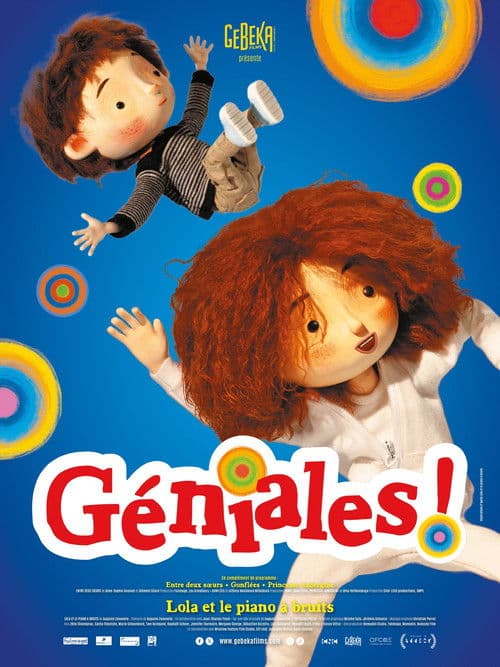
Géniales !
Does this age rating seem accurate to you?
Detailed parental analysis
Brilliant! is a programme of animated short films with a gentle, poetic and luminous atmosphere, designed for young children and their families. Each story features a little girl confronted in her everyday life with a brother or sister living with a disability, exploring how family love and ingenuity can transcend obstacles. The film is primarily aimed at children from 5 or 6 years old, with accessibility designed for families affected by neurodiversity or disability.
Underlying Values
The film constructs a coherent and affirmative moral framework: disability is addressed not as a tragedy or burden, but as a reality that enriches the sibling bond and calls for creativity. The little heroines are not defined by their sacrifice but by their ingenuity and courage, which gives the narrative an emancipatory tone rather than a pitiful one. Family solidarity is presented as an active force, and difference as a starting point for inventing solutions rather than an obstacle to overcome. This framework of values is coherent and unambiguous, which makes the film particularly clear for young children without obscuring the emotional complexity of the situation.
Social Themes
Disability is at the heart of the programme: motor paralysis in one story, autism spectrum disorders in another. The treatment is educational without being didactic, meaning it shows without explaining heavily, and lets situations speak for themselves. Neurodiversity is presented as a form of different intelligence rather than as a deficit, which constitutes a notable narrative choice and potentially very useful for families living this reality. An isolated criticism notes that the treatment could have gone further in representing the voice of disabled children themselves, which is an interesting angle for discussion to explore with older children.
Parental and Family Portrayals
Adult figures are discreet in these narratives centred on the sibling bond, which is not a sign of dysfunctional absence but a narrative choice that positions children as actors. The autonomy of the little heroines is valued, and the family framework appears stable and caring in the background. There is no toxic or problematic parental representation to report.
Strengths
The programme stands out for a visual and narrative gentleness that does not exclude emotional depth: the situations are delicate, the stakes real, without the film seeking to provoke easy tears or to instrumentalise suffering. The quality of animation, praised at Annecy, reinforces the impression of care lavished on each story. The brevity of the format, approximately 52 minutes in total, is a genuine asset for maintaining the attention of very young children. What is most precious here is the film's ability to make visible a reality lived by many families without ever crushing it under the weight of pathos, which is difficult to achieve and rather rare in children's animation.
Age recommendation and discussion points
The film is suitable from 6 years old, with viewing possible from 5 years old in the presence of an adult for children familiar with the subject. Two angles for discussion emerge naturally after viewing: ask the child how he or she thinks the little heroines feel, and explore together what it means to help someone without doing things in their place, a distinction that the film illustrates with great accuracy.
About this title
- Format
- Feature film
- Year
- 2025
- Runtime
- 53m
- Original language
- FR
Content barometer
- Violence0/5None
- Fear1/5Mild
- Sexuality0/5None
- Language0/5None
- Narrative complexity0/5Simple
- Adult themes0/5None
Values conveyed
- Courage
- Acceptance of difference
- Perseverance
- Compassion
- Autonomy
- friendship
- creativity
- kindness
- resourcefulness