
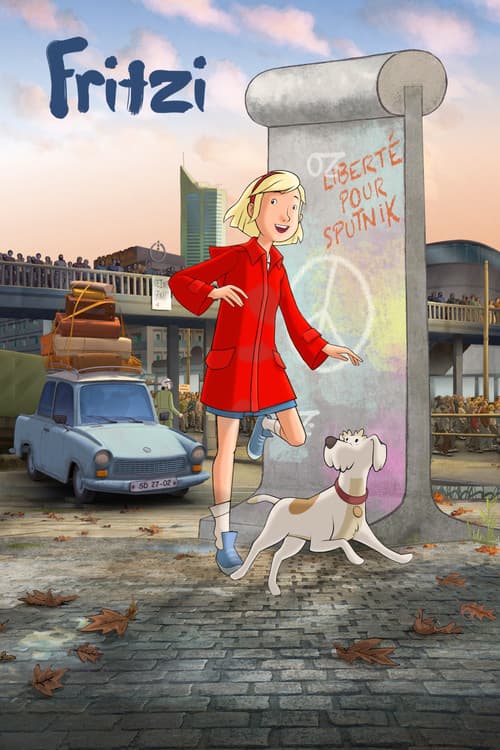
Fritzi: A Revolutionary Tale
Fritzi – Eine Wendewundergeschichte
Does this age rating seem accurate to you?
Detailed parental analysis
Fritzi is an animated film with a tense and moving atmosphere, rooted in a precise historical moment: the fall of the Berlin Wall in 1989. The plot follows a young girl who sets out to search for her missing friend and finds herself swept up in the whirlwind of events that will transform East Germany. The film is aimed at children from 9-10 years old and upwards, with an explicit educational dimension concerning freedom and civic resistance.
Social Themes
The film is entirely constructed around the political reality of the German Democratic Republic (GDR) in the late 1980s: Stasi surveillance (the state secret police), militarised borders, suppression of demonstrations, forced exile. These elements are not mere backdrop but the driving force of the narrative. The tension at the border, armed guards, the fear of being shot, surveillance by a Stasi agent are treated with sufficient realism for the film to be a genuine introduction to what it means to live under an authoritarian regime. It is precisely this historical density that gives the film its educational value, but also what may weigh on younger viewers.
Violence
Violence is present in the form of tension and threat rather than spectacle. A man is shot off-screen at the beginning of the film, which immediately establishes the gravity of the context without visual indulgence. Protesters are jostled, struck and their placards torn away by law enforcement. A soldier fires into the air during a capture scene at the border. These sequences are brief but effective: they do not seek to shock but to make the reality of repression tangible. Violence is never glorified; it serves a moral and historical understanding.
Underlying Values
The film clearly advocates for freedom of expression, civic courage and solidarity in the face of oppression. Non-violent protest is shown as a foundational act of real change, which makes it a strong but nuanced political message: the film does not simplify the fear or danger that dissent represents under an authoritarian regime. The friendship between the two protagonists is the emotional thread, and it is treated with sincerity, without excessive sentimentality. These values are coherent and raise no particular moral concern, but they merit discussion with the child so as not to remain at the level of abstract lesson.
Parental and Family Portrayals
Parental figures are present but in the background, which places Fritzi in a position of autonomy and initiative unusual for her age. This narrative configuration is classic in adventure stories for children, but it takes on particular resonance here: the absence or powerlessness of adults also reflects the reality of a system in which families were separated and individuals isolated before the state.
Substances
A drunk man appears briefly in a street scene, bottle in hand. The presence is incidental and carries no endorsement of any kind.
Strengths
Fritzi achieves something quite rare: making a complex historical episode accessible to a young audience without draining it of substance. The narrative maintains genuine narrative tension whilst remaining anchored in the perspective of a child, which allows for immediate identification. The reconstruction of the atmosphere of the dying GDR, with its grey streets, uniforms and borders, gives the film a visual and emotional coherence that goes beyond mere animated documentary. The character of Fritzi is well constructed: courageous without being invincible, frightened without being paralysed. The film thus offers a concrete and sensitive entry point into notions such as freedom, fear of the state and the power of numbers, which can nourish genuine conversation.
Age recommendation and discussion points
The film is suitable from 9 years old, with parental accompaniment recommended for 9-11 year-olds due to scenes of tension at the border and death evoked from the opening. From 12 years old, it can be viewed independently. Two discussion angles to prioritise after viewing: what does it mean not to have the right to leave, and why did thousands of people choose to protest despite the fear of being arrested or injured.
Synopsis
September 1989 in the GDR. With the change of the general mood in the country, the life of 12-year-old FRITZI changes as well. Her best friend Sophie has fled with her mother through Hungary to West Germany and the only thing Fritzi has left is Sophie's little dog Sputnik. But Fritzi misses Sophie just as much as her little four-legged friend does. Therefore, she decides to bring Sputnik to Sophie. But there is only one way to get there: over the strictly guarded border. A very dangerous adventure for a 12-year-old girl and a small dog...
About this title
- Format
- Feature film
- Year
- 2019
- Runtime
- 1h 30m
- Countries
- Germany, France, Austria, Czech Republic
- Original language
- DE
- Directed by
- Ralf Kukula, Matthias Bruhn
- Main cast
- Naomi Hadad, Ben Hadad, Jördis Triebel, Jonas Schmidt-Foß, Katharina Lopinski, Winfried Glatzeder, Peter Flechtner, Amelie Sophie von Redecke, Jan Treviño Kräling
- Studios
- TrickStudio Lutterbeck, MAUR film, Artémis Productions, Doghouse Films, KiKA, WDR, ARTE, NDR, MDR, Balance Film
Content barometer
- Violence2/5Moderate
- Fear3/5Notable tension
- Sexuality0/5None
- Language0/5None
- Narrative complexity2/5Moderate
- Adult themes1/5Mild