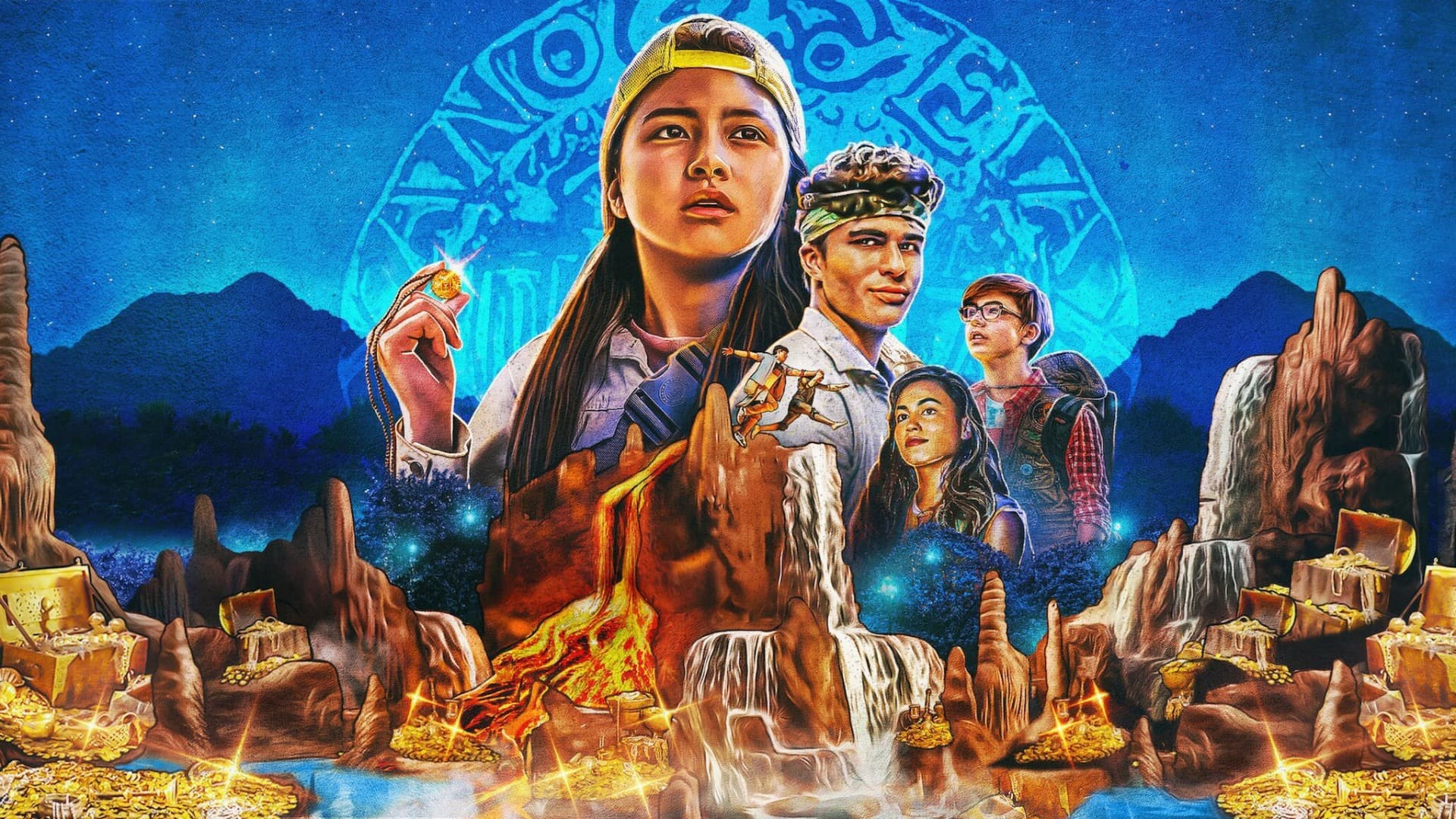

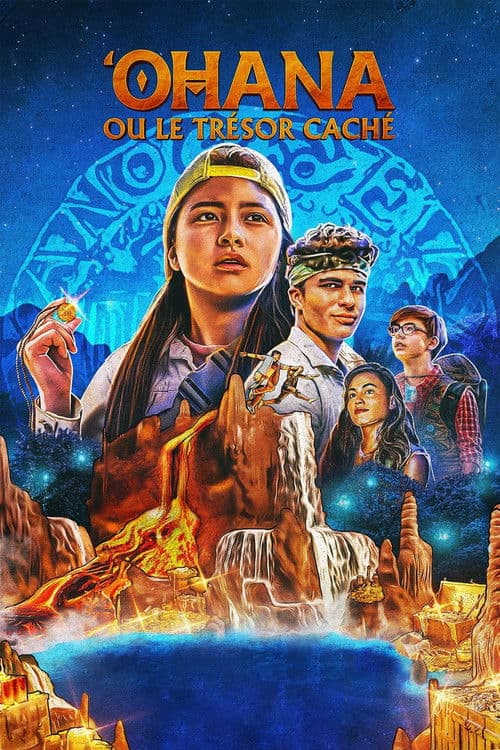
Finding ʻOhana
Does this age rating seem accurate to you?
Detailed parental analysis
Finding 'Ohana is a family adventure driven by cheerful energy, blending cave exploration and Hawaii's natural landscapes with a quest for hidden treasure. The plot follows two New York siblings who rediscover their Hawaiian roots whilst attempting to decipher the journal of an adventurous ancestor, drawing their friends into an underground expedition fraught with traps. The film is primarily aimed at children aged 9-10 and pre-adolescents, with an atmosphere that references 1980s adventure films.
Violence
The film consistently accumulates physical perils: lava pits, steep cliffs, collapsing ceilings, falling rocks, turbulent waterfalls. One character nearly drowns and must be revived, and a venomous spider bite leaves a visually represented infected wound. These sequences are tense and fast-paced, without gore or interpersonal violence, but their accumulation can create genuine anxiety in younger viewers. The presence of the 'nightmarchers', Hawaiian ghost warriors presented as potentially lethal, adds a fantastical dimension that may frighten children under eight. Narratively, all these obstacles serve character progression and are never gratuitous.
Underlying Values
The film's central message is clear and repeated: family belonging and connection to cultural roots are infinitely more valuable than material wealth, even when the family faces financial hardship. This message is structural and honest, without being excessively preachy. By contrast, the approach to adventure and problem-solving values autonomy, courage and cooperation over individual achievement. The treasure itself undergoes a reinterpretation of value that merits discussion with the child.
Language
Raw childish language is well present: terms related to buttocks (buttface, butthead, bunghole), 'crap', 'ass', 'suck', 'balls' used as an exclamation, 'hell' and 'God' in non-religious contexts. This level of language is realistic for children of this age and stays within genre boundaries, but parents sensitive to this register will want to be forewarned. No genuinely crude adult language.
Parental and Family Portrayals
The grandfather plays a central and moving role: his heart attack in front of his granddaughter, followed by hospitalisation, is a scene of realistic distress that may affect children with elderly grandparents. Family is the emotional engine of the narrative, and tensions between the New York generation and Hawaiian heritage constitute a solid dramatic axis. Parental figures are present and loving, without being idealised.
Discrimination
A crush dynamic between the protagonist and a boy whose attitude she explicitly describes as 'sexist' is woven into the narrative. The film does not validate this attitude, since the girl names it clearly, but it sustains the romance nonetheless. This is a dynamic visible enough to warrant discussion about what one accepts from a boy one finds attractive, and about the difference between recognising a flaw and normalising it.
Social Themes
Hawaiian culture lies at the heart of the film, presented with care through language, ancestral narratives and relationship to the land. Without veering into didacticism, the film conveys genuine attention to traditions and family memory as forms of non-material wealth. It is a concrete entry point for discussing with a child the relationship between identity, heritage and sense of belonging.
Strengths
The film functions as a sincere love letter to Hawaiian culture, without tourist condescension or superficial exoticism. The underground exploration sequences are well constructed, clear and sufficiently tense to hold a pre-adolescent's attention. The dialogue between brother and sister rings true, with credible sibling friction that evolves naturally. The reinterpretation of the notion of treasure at the film's end is narratively honest and gives the film real emotional backbone, beyond mere adventure film.
Age recommendation and discussion points
The film is suitable from age 9 for the vast majority of children; for a child more sensitive to frightening scenes or to illness affecting a close relative, it is better to wait until 10-11 years old. Two discussion angles naturally present themselves after viewing: what is a real treasure, and can one continue to appreciate someone who behaves badly towards others?
Synopsis
Two Brooklyn siblings' summer in a rural Oahu town takes an exciting turn when a journal pointing to long-lost treasure sets them on an adventure, leading them to reconnect with their Hawaiian heritage.
About this title
- Format
- Feature film
- Year
- 2021
- Runtime
- 2h 3m
- Countries
- United States of America
- Original language
- EN
- Directed by
- Jude Weng
- Main cast
- X Mayo, Kyndra Sanchez, Alex Aiono, Kea Peahu, Lindsay Watson, Owen Vaccaro, Kelly Hu, Branscombe Richmond, Chris Parnell, Marc Evan Jackson
- Studios
- Ian Bryce Productions
Content barometer
- Violence3/5Notable
- Fear3/5Notable tension
- Sexuality0/5None
- Language2/5Moderate
- Narrative complexity2/5Moderate
- Adult themes0/5None
Watch-outs
- Death
- Strong language
- Gender stereotypes
Values conveyed
- Courage
- Perseverance
- Autonomy
- family
- friendship
- cultural identity