Fantasia
Does this age rating seem accurate to you?
Detailed parental analysis
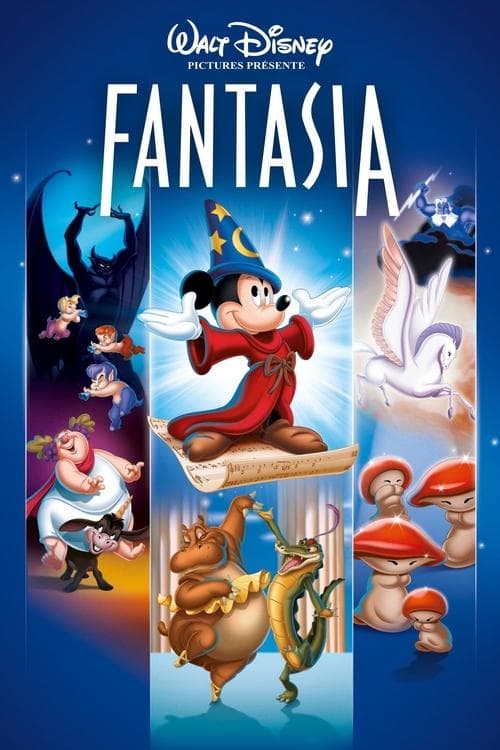
Fantasia is a classic animated film with a contrasting atmosphere, alternating between contemplative moments and frankly unsettling sequences, all without a single line of dialogue. It does not tell a single story but rather offers a succession of eight visual animated segments set to works of classical music, ranging from Bach to Stravinski via Beethoven. The film presents itself as family entertainment for all ages, but its two-hour length, its absence of verbal narration, and the intensity of certain sequences make it better suited to school-age children and adults than to very young children.
Violence
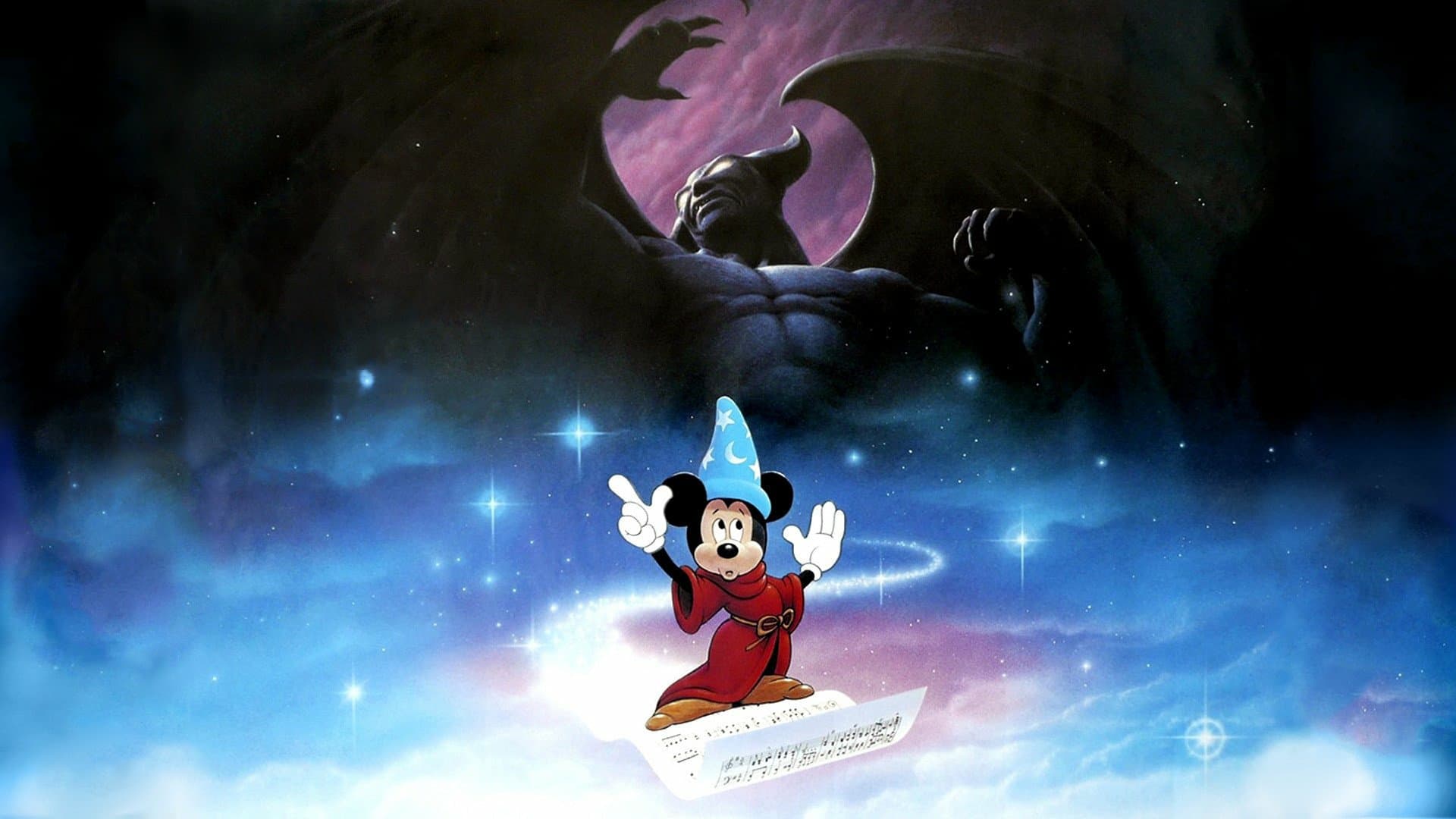
Two segments concentrate the bulk of challenging content. In The Rite of Spring, a Tyrannosaurus attacks and kills a Stegosaurus in direct combat, with visual and sonic intensity that young children may find traumatising. In The Sorcerer's Apprentice, Mickey chops a living broomstick to pieces with an axe, a scene that blends humour and violence against an animate being in a way sufficiently ambiguous to disturb the more sensitive. The final sequence depicting Night on Bald Mountain summons the demon Chernabog, a monumental figure with demonic wings and yellow eyes who governs an army of skeletons and spectres rising from their tombs, in a visually and musically oppressive crescendo. This sequence is the most frightening in the film for young children: it lasts several minutes, without irony or comic distance. Violence remains broadly narratively justified and no scene is gratuitous, but its intensity in these passages is real.
Underlying Values
The segment of The Sorcerer's Apprentice carries the film's most explicit moral message: Mickey exceeds his master's authority by using magic without permission, unleashes uncontrollable chaos, and must be rescued by the sorcerer himself. The film leaves no ambiguity about the lesson: overconfidence and transgression of authority have consequences. This message of obedience to authority is conveyed without nuance, which merits discussion with a child: disobedience poses a real problem here not because it is inherently wrong, but because Mickey acts without mastering the necessary skills. The film is furthermore steeped in a strong relationship with classical music as cultural heritage, implicitly transmitting a hierarchy of taste between great music and popular entertainment.
Substances
Bacchus, the god of wine, is portrayed as a sympathetic and comic character whose intoxication forms the central humorous device of his segment. He stumbles, hiccoughs and loses his faculties, without the film judging this behaviour negatively. Alcohol is thus associated with celebration, pleasure and conviviality, without any cautionary note. For a child aged 6 to 10, this is a point worth raising.
Sex and Nudity
The Pastoral Symphony segment features centaurettes with partially stylised bosoms and cherubs depicted nude from behind. The portrayal is far from explicit and fits within an aesthetic inspired by Graeco-Roman mythology. This remains visually unremarkable for most school-age children, but parents of very young children may be surprised by the obviousness of the stylisation.
Discrimination
A black centaurette serving the other characters, represented according to the caricatural codes of the Afro-American domestic slave figure, was removed from later releases of the film for what it constituted: a racist caricature, known as 'Aunt Jemima', which is never questioned in the original narrative. This figure is no longer visible in versions shown today, but its removal bears witness to a problematic legacy that merits mention to adolescents, particularly to illustrate how foundational works can carry indefensible representations that the era normalised.
Social Themes
The Rite of Spring is presented as a reconstruction of the history of Earth from its formation through to the extinction of the dinosaurs, with imagery of natural chaos, lava, mass extinctions and climate violence. This segment can naturally open discussion about the history of life, the disappearance of species and, depending on the child's age, about current ecological issues by analogy.
Strengths
Fantasia represents one of the most ambitious attempts in animation history to marry image and music organically rather than illustratively. Each segment offers a distinct visual language: geometric abstraction for Bach, cosmic ballet for Tchaikovsky, dark expressionism for Mussorgsky. For a curious child, it is a vivid and sensory introduction to the classical repertoire, capable of creating lasting emotional associations with works they would not have spontaneously listened to. The educational value is genuine: the film teaches you to listen to music differently, to read an animated image as a language, and offers points of entry into Greek mythology, imaginary palaeontology or simply contemplation. The Chernabog sequence from Night on Bald Mountain is moreover one of the greatest achievements of expressionist animation ever produced, possessing a visual power rarely equalled.
Age recommendation and discussion points
The film is not recommended for children under 6 years of age owing to sequences of animal violence, the demon Chernabog and the sonic intensity of several passages. From 6 to 8 years of age, supervised viewing is recommended, with the possibility of skipping or downplaying the most intense segments. To discuss after the film: why was Mickey wrong to use magic without permission, and is disobedience always a bad idea or only when one is not yet ready? For older children, the question of what has been removed from the film and why can open a useful conversation about the perspective that classic works held towards certain groups of people.
Synopsis
Walt Disney's timeless masterpiece is an extravaganza of sight and sound! See the music come to life, hear the pictures burst into song and experience the excitement that is Fantasia over and over again.
About this title
- Format
- Feature film
- Year
- 1940
- Runtime
- 2h 5m
- Countries
- United States of America
- Original language
- EN
- Directed by
- Bill Roberts, Paul Satterfield, Wilfred Jackson, Ben Sharpsteen, James Algar, T. Hee, Hamilton Luske, Samuel Armstrong, Jim Handley, Norman Ferguson, David Hand, Ford Beebe Jr.
- Main cast
- Deems Taylor, Walt Disney, Julietta Novis, Leopold Stokowski
- Studios
- Walt Disney Productions