

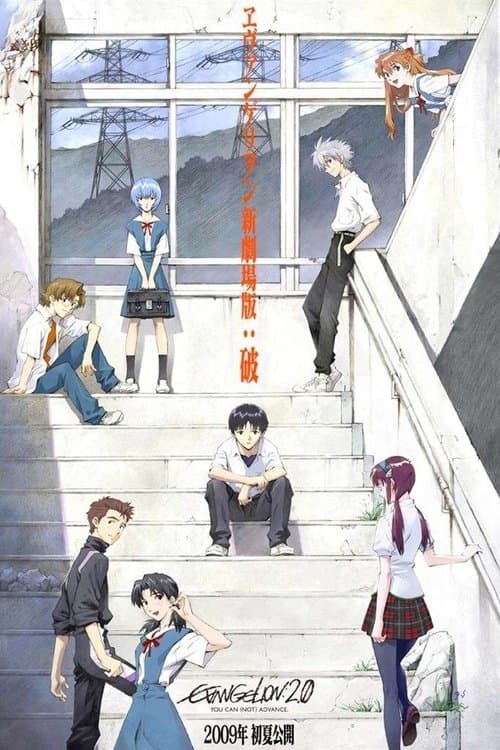
Evangelion: 2.0 You Can (Not) Advance
ヱヴァンゲリヲン新劇場版:破
Does this age rating seem accurate to you?
Detailed parental analysis
Evangelion 2.0 is a science fiction animated film with a dark, oppressive and emotionally charged atmosphere, constantly oscillating between spectacular action and painful introspection. The plot follows Shinji, a teenager forced to pilot a giant robot to protect humanity from monstrous entities, whilst trying to find his place amongst broken figures and a crumbling world. The film is primarily intended for teenagers and adults, ideally already familiar with the Evangelion universe, as it requires a certain emotional and narrative maturity to be fully grasped.
Violence
Violence is intense, repetitive and presented through a visual language that never seeks to diminish it. Battles between giant robots and Angels are accompanied by red fluids projected in quantity, a mechanical unit that literally devours another in a particularly brutal sequence, and images of viscerally physical destruction. This violence is not gratuitous in its narrative purpose: it serves to illustrate the psychological cost of war, the protagonist's helplessness against forces beyond his control, and the sacrificial dimension of combat. Yet the visual intensity is high, with moments frankly gory for an animated film, and the viewer is deliberately made uncomfortable, particularly when Shinji is forced to watch a machine he does not control destroy another unit. It is a violence that questions as much as it impresses, but it remains deeply distressing.
Parental and Family Portrayals
The parental figure is at the heart of the film and profoundly dysfunctional. Shinji's father is cold, distant, manipulative, and uses his son as an instrument in a mission whose true stakes he never discloses. His mother is physically absent but spectral and omnipresent in the narrative, her death forming an open wound that structures the entire psychology of the protagonist. Other adult figures are either failing or themselves traumatised. This deliberately broken family and institutional landscape is powerful narrative material, but it deserves to be discussed with a child or adolescent so that it does not remain simply overwhelming or anxiety-inducing.
Underlying Values
The film explicitly values the courage to act despite fear and the sacrifice consented to protect a loved one, with Shinji making in the final section a decisive choice that illustrates this shift towards commitment. But the narrative also poses more uncomfortable questions about obedience to opaque authority, about the instrumentalisation of individuals by institutions that conceal the truth from them, and about the boundary between devotion and alienation. These tensions are not resolved, which gives the work its richness but requires a viewer capable of holding together several contradictory moral readings.
Sex and Nudity
The film contains several scenes involving nudity, without explicit sexual content but with a sometimes troubling dimension. A decontamination scene shows characters forced to undress, and another features a female character seen from behind during a call. The suits worn by the pilots are very tight and accentuate the bodies, with notable visual attention paid to Asuka's silhouette. These elements do not constitute pornographic content but their accumulation, coupled with the adolescent age of the characters depicted, is a real point of concern for parents.
Social Themes
The film deploys in the background a reflection on permanent emergency, the militarisation of children and the control exercised by secret institutions over individuals who are unaware of the true stakes of their mission. This dimension is never didactic but runs constantly through the narrative, and can fuel genuine discussion about the trust placed in institutions, the meaning of collective sacrifice, and what it means to fight for a cause one has not chosen.
Strengths
The film achieves a rare emotional quality in animation, carried by writing that refuses easy resolutions and treats its adolescent characters with unusually adult seriousness. The character of Shinji gains coherence and depth compared to his television incarnations, and his arc towards active engagement is handled with genuine sensitivity. The visual atmosphere, both grand and claustrophobic, constantly reinforces the inner state of the characters rather than simply illustrating the action. For an adolescent ready to engage with it, this is a work that opens important conversations about responsibility, suffering, the relationship to authority and the definition of courage.
Age recommendation and discussion points
The film is not suitable below 13 years of age, and genuinely comfortable viewing rather presumes 15 years old, given how much the psychological themes, visual violence and failing parental representations can weigh without a framework for discussion. After viewing, two angles merit being opened with the child: what it means to obey an authority that conceals from you what it is truly doing to you, and why the courage of the main character consists not in the absence of fear, but in acting despite it.
Synopsis
Under constant attack by monstrous creatures called Angels that seek to eradicate humankind, U.N. Special Agency NERV introduces two new EVA pilots to help defend the city of Tokyo-3: the mysterious Makinami Mari Illustrous and the intense Asuka Langley Shikinami. Meanwhile, Gendo Ikari and SEELE proceed with a secret project that involves both Rei and Shinji.
About this title
- Format
- Feature film
- Year
- 2009
- Runtime
- 1h 52m
- Countries
- Japan
- Original language
- JA
- Studios
- khara
Content barometer
- Violence4/5Strong
- Fear4/5Intense
- Sexuality2/5Mild
- Language1/5Mild
- Narrative complexity3/5Complex
- Adult themes0/5None
Values conveyed
- Courage
- Perseverance
- teamwork
- resilience
- sacrifice