

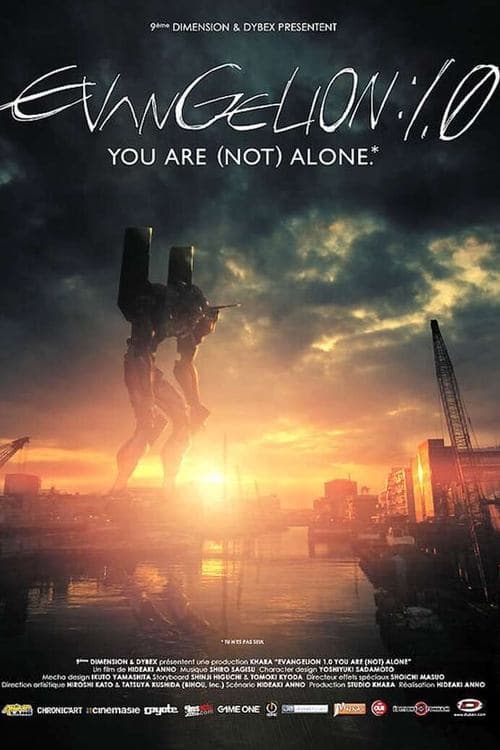
Evangelion: 1.0 You Are (Not) Alone
ヱヴァンゲリヲン新劇場版:序
Does this age rating seem accurate to you?
Detailed parental analysis
Evangelion: 1.0 is an animated film with a dense, oppressive and profoundly melancholic atmosphere, the first instalment in a series of feature films revisiting the universe of the Neon Genesis Evangelion franchise. The plot follows an adolescent recruited to pilot a colossal bio-mechanical robot in order to combat monstrous entities that threaten humanity, in a world already ravaged by a past catastrophe. The film is aimed at mature teenagers and adults, and is in no way accessible entertainment for a general audience.
Underlying Values
The heart of the film is a reflection on responsibility that one bears unwillingly. The protagonist, Shinji, is an anxious adolescent who does not want to fight and who resolves to do so only under the combined pressure of guilt, paternal abandonment and the gaze of others. His recurring phrase, 'I must not run away', is not a call to positive courage: it is the verbalisation of an internalised injunction that crushes the individual for the benefit of an institution. The film does not adjudicate between willing sacrifice and disguised exploitation, and that is precisely what makes it a valuable subject for discussion. This moral ambivalence is intentional and structuring, but it requires guidance so as not to be passively absorbed as a lesson in stoicism.
Violence
Violence is present, intense in sequences, and visually emphatic. Battles between bio-robots and creatures see limbs torn off, bodies pierced, blood sprayed in substantial quantities, including when an organism literally explodes across an entire building. One scene shows one of the bio-mechanical units experiencing an uncontrollable crisis, violently ramming itself against a wall until forcibly immobilised, which goes beyond the register of spectacular combat to touch upon something more disturbing. The violence is not gratuitous in the aesthetic sense: it serves to show that these battles have a physical and psychological cost. It nonetheless remains striking for a young viewer.
Parental and Family Portrayals
The paternal figure is central and profoundly dysfunctional. Shinji's father is cold, distant, manipulative and has only called upon his son in the absence of any other viable option. The relationship between them is a painful knot that the film neither resolves nor seeks to beautify. The father's emotional absence is presented as a constitutive wound of the protagonist, the direct source of his inability to assert himself. This is an honest and realistic treatment of a toxic family dynamic, but a child who has themselves experienced abandonment or parental coldness may be deeply affected by it.
Social Themes
The film stands within a tradition of science fiction that uses global catastrophe as a setting to interrogate relations between the individual and the military-bureaucratic institution. The organisation directing operations treats adolescent pilots as resources, not as people. This context of defensive warfare, where children are at the front because adults cannot pilot the machines, implicitly raises questions about consent, the exploitation of the young and the legitimacy of imposed sacrifice. The film does not lay it out as a moral lesson, but the parent can seize upon it as a point of entry.
Strengths
The film is an ambitious animated work that takes seriously the psychology of its main character. Where many combat robot narratives content themselves with spectacle, this one builds its plot around the fragile interiority of an adolescent incapable of desiring his own heroisation. The writing resists easy resolutions and secondary characters have a genuine presence, including in their own solitude. For a teenager capable of engaging with a narrative without immediate catharsis, the film offers rare material: it shows that psychological distress and collective responsibility can coexist without resolving themselves, which is closer to reality than most genre fiction.
Age recommendation and discussion points
The film is not suitable before age 13 due to its visual violence and psychological density, and it is genuinely comfortable from age 15 onwards for an adolescent with sufficient emotional maturity. After viewing, two questions merit being asked: does Shinji truly choose to fight, or is he compelled to do so, and what is the difference between courage and resignation? And more personally: do you have the right to refuse a responsibility you were not asked to accept?
Synopsis
After the Second Impact, Tokyo-3 is being attacked by giant monsters called Angels that seek to eradicate humankind. The child Shinji’s objective is to fight the Angels by piloting one of the mysterious Evangelion mecha units. A remake of the first six episodes of GAINAX’s famous 1996 anime series. The film was retitled “Evangelion: 1.01” for its DVD release and “Evangelion: 1.11” for a release with additional scenes.
About this title
- Format
- Feature film
- Year
- 2007
- Runtime
- 1h 41m
- Countries
- Japan
- Original language
- JA
- Studios
- khara
Content barometer
- Violence4/5Strong
- Fear4/5Intense
- Sexuality1/5Allusions
- Language1/5Mild
- Narrative complexity3/5Complex
- Adult themes0/5None
Watch-outs
- Death
- Abuse
- Violence
Values conveyed
- Perseverance
- courage
- teamwork
- resilience