

Earth
Does this age rating seem accurate to you?
Detailed parental analysis
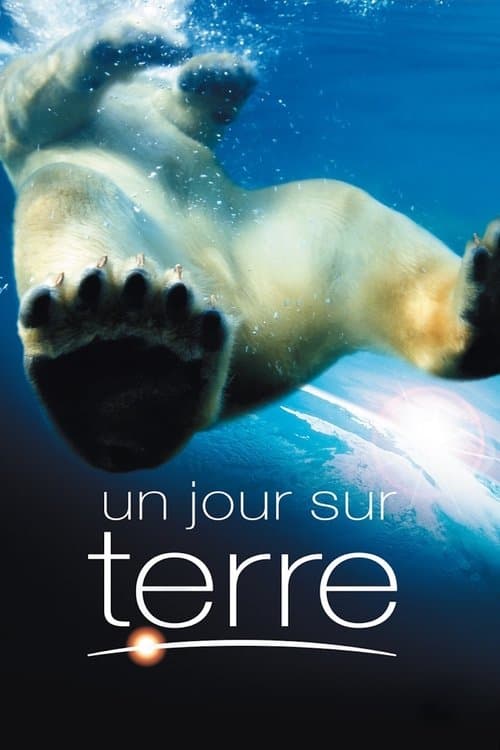
One Day on Earth is a contemplative and visually sumptuous documentary that follows an entire year on the planet, through the lens of three animal families: a polar bear family, a herd of elephants, and a humpback whale with her calf. The atmosphere oscillates between wonder and melancholy, carried by warm narration but tinged with ecological urgency. The film primarily targets school-age children and their parents, but its formal beauty makes it accessible to all ages, with significant reservations for the very young.
Violence
The film contains several predation sequences which, whilst never descending into explicit gore, are nonetheless intense. A wolf catches a caribou in full flight, a great white shark leaps from the water to seize a seal, lions attack elephants at nightfall. The carnage itself is not shown in detail, but the tension of the hunt, the capture and implicit death are clearly legible to a child. These scenes serve a genuine narrative purpose: they illustrate the reality of the natural cycle and are neither gratuitous nor aestheticised for the sake of spectacle. Nevertheless, their accumulation over the course of the film may weigh on sensitive children, particularly those who quickly become attached to animals presented as characters.
Social Themes
Climate change is the invisible thread running through the film, made concrete through the melting ice that condemns polar bears, the drying up of water sources that exhausts elephants, and the fragility of marine ecosystems. The message is clear and repeated: natural balances are threatened, and the survival of these species depends on human decisions. This ecological framing is presented with gravity but without hysterical catastrophism, making it a solid entry point for a first conversation about the environment with a child. It should be noted, however, that the film offers no concrete solutions, which may leave a sense of helplessness in younger viewers.
Underlying Values
The anthropomorphic narration is the film's most questionable structural choice: animals are systematically presented as loving parents, courageous children, families united against adversity. This interpretive framework facilitates emotional identification, but it projects onto the animal world human categories that merit questioning with the child. Furthermore, the film strongly valorises perseverance and courage in the face of obstacles, through survival narratives that function as genuine story arcs. Collective responsibility towards the planet is posited as a moral given, without nuance or debate, which is consistent with the film's intention but calls for discussion about the actual complexity of environmental issues.
Strengths
The cinematography is of exceptional quality: certain sequences, notably the caribou migrations, the whale dives or the northern lights, reach a level of formal beauty rare in mainstream wildlife documentary. The editing constructs genuine dramaturgy from images of the real world, with a sense of rhythm that holds a child's attention without ever sacrificing contemplation. The educational value is genuine: the film shows species and ecosystems that most children would never otherwise encounter, and it does so with sufficient scientific precision to nourish curiosity. On an emotional level, the film is honest: it does not shield the child from the reality of animal death and suffering, which can be a quality as much as a challenge depending on the age and sensitivity of the viewer.
Age recommendation and discussion points
The film is not recommended before age 6 due to predation scenes and animal death by exhaustion, which can generate lasting anxiety in very young children. From age 7 onwards, it becomes a valuable discussion tool, provided the parent is present to support difficult moments. Two angles of conversation naturally emerge after viewing: why are animals presented as families that resemble us, and what does this change about the way we look at them? And faced with the sense of helplessness that the film may provoke regarding climate change, what can a child actually do, at their own scale?
Synopsis
An epic story of adventure, starring some of the most magnificent and courageous creatures alive, awaits you in EARTH. Disneynature brings you a remarkable story of three animal families on a journey across our planet – polar bears, elephants and humpback whales.
Where to watch
Availability checked on Apr 29, 2026
About this title
- Format
- Feature film
- Year
- 2007
- Runtime
- 1h 30m
- Countries
- France, United Kingdom
- Original language
- EN
- Directed by
- Alastair Fothergill, Mark Linfield
- Main cast
- Patrick Stewart, Constantino Romero, James Earl Jones, Ken Watanabe, Ulrich Tukur, Anggun
- Studios
- Disneynature, Gaumont, BBC Studios Natural History Unit
Content barometer
- Violence2/5Moderate
- Fear3/5Notable tension
- Sexuality0/5None
- Language0/5None
- Narrative complexity2/5Moderate
- Adult themes0/5None
Values conveyed
- Courage
- Perseverance
- Compassion
- nature
- family
- survival
- wonder