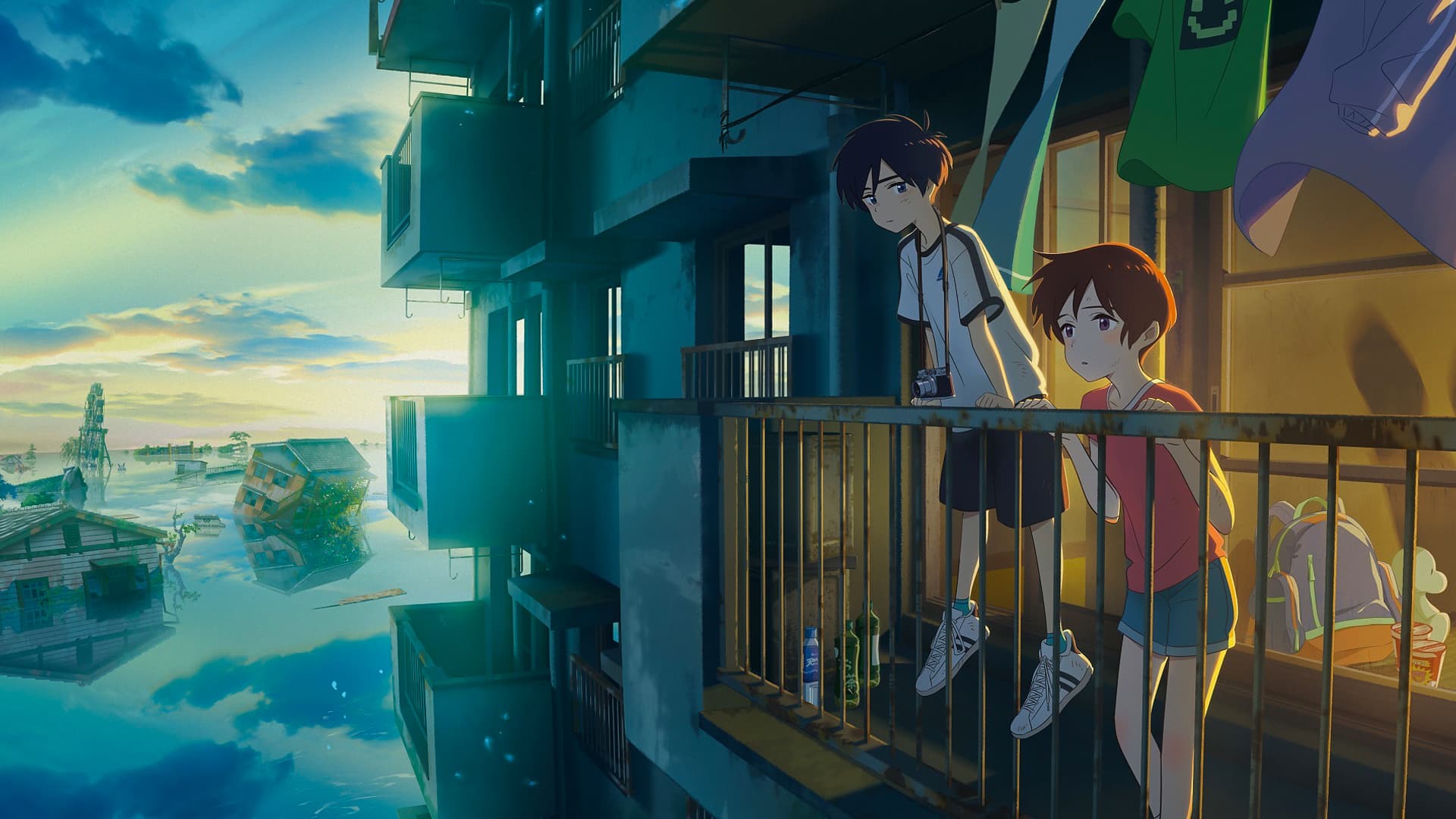


Drifting Home
雨を告げる漂流団地
Does this age rating seem accurate to you?
Detailed parental analysis
Wandering Walls is a contemplative and emotionally dense animated film, carried by a melancholic atmosphere tinged with dreamlike qualities. The plot follows two children who find themselves transported, along with a group of classmates, onto a building drifting adrift above a sea of clouds, and whose journey becomes the stage for inner work on grief and reconciliation. The film primarily targets an adolescent audience, though accompanied children from the age of 10 can access it with the right guidance.
Underlying Values
The film structures its entire narrative around the five stages of grief, treated with rare honesty for an animated film. It offers no easy consoling answer: loss is painful here, irreversible, and inner reconstruction demands time and acknowledgement. The theme of reconciliation between the two protagonists, whose friendship shattered under the weight of grief and silence, forms the true moral arc of the film. The central value is not resilience as a posture, but acceptance as a lived internal process, which makes it particularly rich material for discussion.
Parental and Family Portrayals
The most striking parental figure is that of the father, presented in flashback as violent and unstable: he is seen aggressively grabbing the mother, and when the child attempts to intervene, she is pushed to the ground. The scene is brief but unvarnished, and it grounds one of the protagonists' traumatic past in a reality of domestic abuse. The grandfather, by contrast, embodies a central and benevolent affective model, whose death is the triggering event of the entire narrative. His representation in funereal flashbacks, including his deathbed, is treated with restraint but without evasion.
Violence
Physical violence is present at several levels. Scenes of immediate peril, with children clinging to railings above the void, buildings collapsing and colliding with one another, maintain sustained tension. A fall onto glass is shown with visible bleeding at the knee, not graphic but sufficiently realistic to leave an impression. The domestic violence scene in flashback is the most emotionally difficult, not for its visual intensity but for what it implies: a child exposed to conjugal violence and put in danger whilst attempting to protect her mother. All of these moments serve a clear narrative purpose and do not amount to gratuitousness.
Social Themes
The scheduled demolition of the building that serves as the film's central setting carries within it a subtle reflection on the disappearance of childhood places, urbanisation, and the loss of memory it brings about. The building is not merely a fantastical backdrop: it carries collective and affective memory that adults seem ready to erase without regard. This subtext remains discrete but gives the film a dimension that transcends individual psychology alone.
Substances
An adult character smokes briefly in one scene. The act is neither highlighted nor commented upon, and carries no particular narrative weight. This is the only occurrence of its kind in the film.
Language
The two protagonists argue verbally and physically at one point in the narrative, insulting each other and pulling hair. The register remains within the bounds of childlike realism and serves the arc of reconciliation. Nothing shocking, but the scene illustrates with some force the way in which untreated grief can turn into interpersonal conflict.
Strengths
The film offers a remarkably restrained and just treatment of childhood grief, never tipping into moralising pedagogy nor superficial sentimentalism. The narrative construction, which makes the fantastical journey a mirror of an inner journey, works with coherence: each element of the external narrative finds an echo in the emotional development of the characters. The animation attends to atmospheres and silences as much as to action, which makes it a rare film in its capacity to leave space for the viewer to feel. For an adolescent who has experienced or is experiencing grief, or who knows conflicts in friendship linked to loss, the film can provide precious support, including for putting words to emotional states that are difficult to verbalise.
Age recommendation and discussion points
The film is accessible from age 10 when watched with an adult, but it finds its natural audience in adolescents from age 12 onwards, sufficiently equipped to receive its themes without being overwhelmed. Two angles of discussion deserve to be opened after viewing: ask the child why, in his or her view, the two friends argued rather than supporting each other in the face of grief, and explore together what it means to let go of someone or something one loved, whether a person or a place.
Synopsis
One fateful summer, a group of elementary school kids set adrift on an abandoned apartment building must look within themselves to find a way back home.
About this title
- Format
- Feature film
- Year
- 2022
- Runtime
- 2h
- Countries
- Japan
- Original language
- JA
- Directed by
- Hiroyasu Ishida
- Main cast
- Mutsumi Tamura, Asami Seto, Ayumu Murase, Daiki Yamashita, Yumiko Kobayashi, Inori Minase, Kana Hanazawa, Bin Shimada, Rikako Aikawa, Nana Mizuki
- Studios
- Studio Colorido, Twin Engine
Content barometer
- Violence3/5Notable
- Fear3/5Notable tension
- Sexuality0/5None
- Language1/5Mild
- Narrative complexity2/5Moderate
- Adult themes1/5Mild
Values conveyed
- Friendship
- Acceptance of difference
- Forgiveness
- courage
- resilience
- teamwork