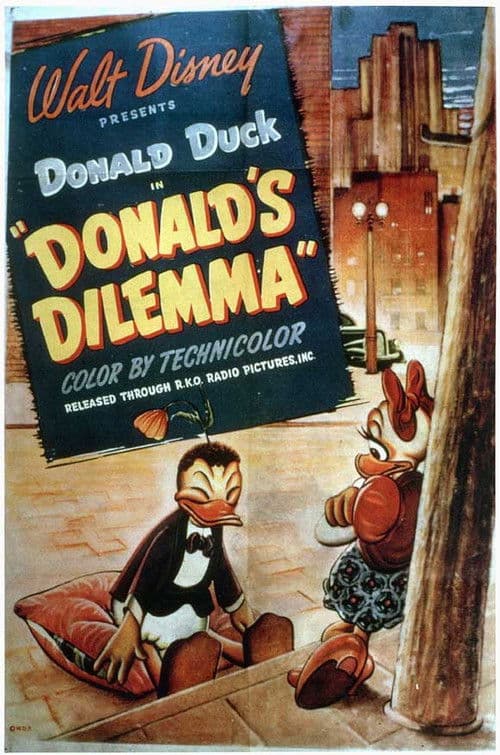
Donald's Dilemma
Does this age rating seem accurate to you?
Detailed parental analysis
A Disney animated short with a light and colourful appearance, 'Donald's Dilemma' conceals surprisingly dark content beneath its familiar cartoon wrapper. The plot revolves around Daisy attempting to regain Donald's affection after an accident has transformed his character. The film is presented as entertainment for young children, but its actual content is aimed more at an informed audience.
Violence
The most striking scene in the film shows Daisy pointing a gun at her temple, surrounded by an arsenal of means of self-harm: a noose, a knife, poison, a grenade and a bomb are laid out prominently on her table. This sequence is constructed as comic relief, which makes the treatment even more problematic: suicide is presented as a humorous punchline rather than genuine distress. The association between iconography of voluntary death and cartoon register intended for children constitutes a strong parental warning signal, regardless of any artistic intention. This is not violence inflicted from without but rather self-destruction staged as a gag, which is difficult to defuse in conversation with a young child.
Social Themes
The film addresses depression, insomnia, refusal to eat and suicidal ideation directly, grouped together in a portrait of psychological distress attributed to Daisy following the loss of her romantic relationship. These elements are not treated with narrative depth, but they are visually present and sufficiently explicit to trouble a child who notices them. Most television broadcasts aimed at children have removed these sequences, which confirms that the original content exceeds the limits of family-friendly material.
Underlying Values
The plot's resolution rests on a logic of romantic possession: Daisy regains Donald's affection by appealing to his jealousy and his instinct to possess her. The structural message is that romantic love amounts to a form of exclusivity and control, and that a partner's extreme distress can function as leverage for winning them back. No character challenges this dynamic, which is presented as natural and satisfying. This is a useful angle for discussion with a pre-teenager or teenager capable of analysing the romantic relationship depicted.
Strengths
The film has no noteworthy narrative or educational qualities to report. It belongs to the series of studio shorts from the 1940s, some of which carry period motifs now become problematic. Its value is essentially documentary for an adult or film history student wishing to understand post-war representation standards in animated cinema. For ordinary parent-child conversation, it offers insufficient positive ground to balance what it demands be defused.
Age recommendation and discussion points
This short film is not suitable for children without preparation, and not recommended at all under 12 years of age. For a pre-teenager or teenager, viewing can be an opportunity for serious discussion on two points: why a scene of attempted suicide can be presented as funny, and what that says about the way difficult emotions were (and sometimes still are) trivialised by entertainment; and what the film implicitly says about jealousy and possession as foundations of a romantic relationship.
Synopsis
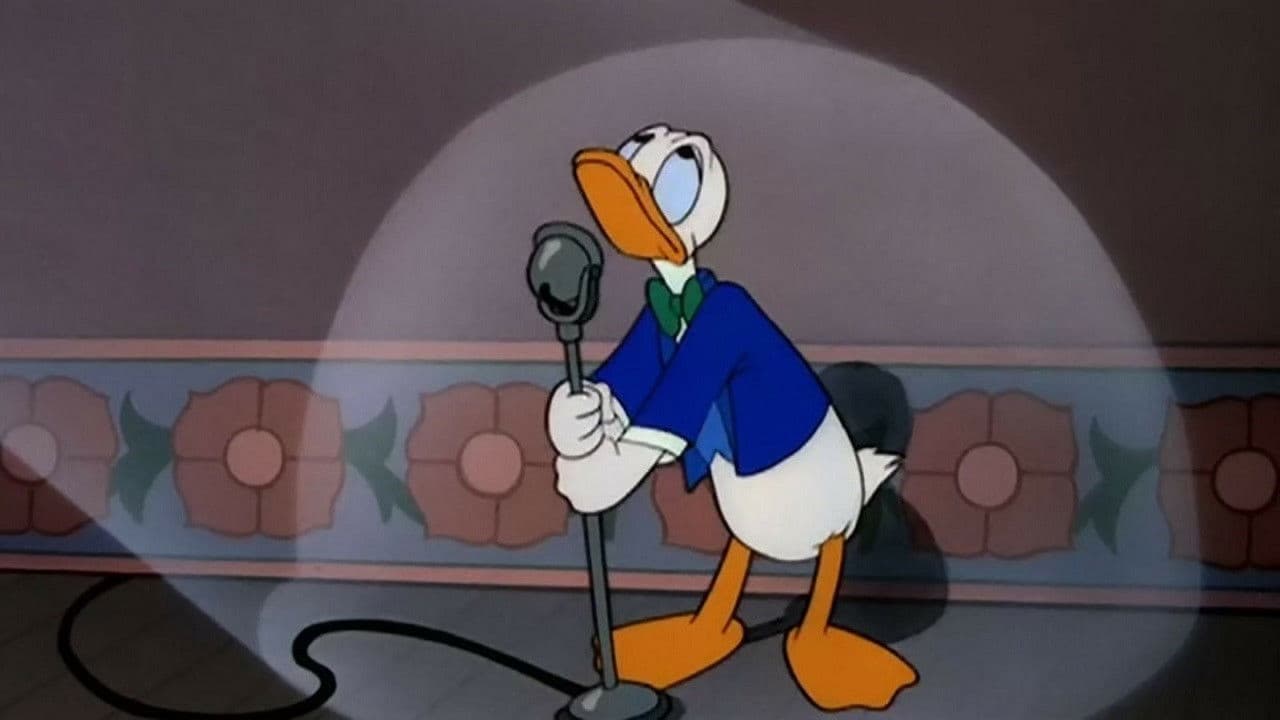
Donald and Daisy are walking when he is hit by a flowerpot. He's convinced he's a famous singer, and he croons divinely, but does not recognize Daisy. He in fact does become famous. Daisy is devastated by her inability to get over him and sees a psychiatrist. He tells her she has to choose between the world having Donald, or her getting him back. She picks herself, and drops another flowerpot, which restores him.
About this title
- Format
- Short film
- Year
- 1947
- Runtime
- 7m
- Countries
- United States of America
- Original language
- EN
- Directed by
- Jack King
- Main cast
- Clarence Nash, Gloria Blondell, George Magrill, Richard Conte, Ken Darby
- Studios
- Walt Disney Productions
Content barometer
- Violence3/5Notable
- Fear2/5A few scenes
- Sexuality0/5None
- Language0/5None
- Narrative complexity0/5Simple
- Adult themes0/5None
Watch-outs
- Suicide
- Gender stereotypes
Values conveyed
- love
- reconciliation
- perseverance