
Dilili in Paris
Does this age rating seem accurate to you?
Detailed parental analysis
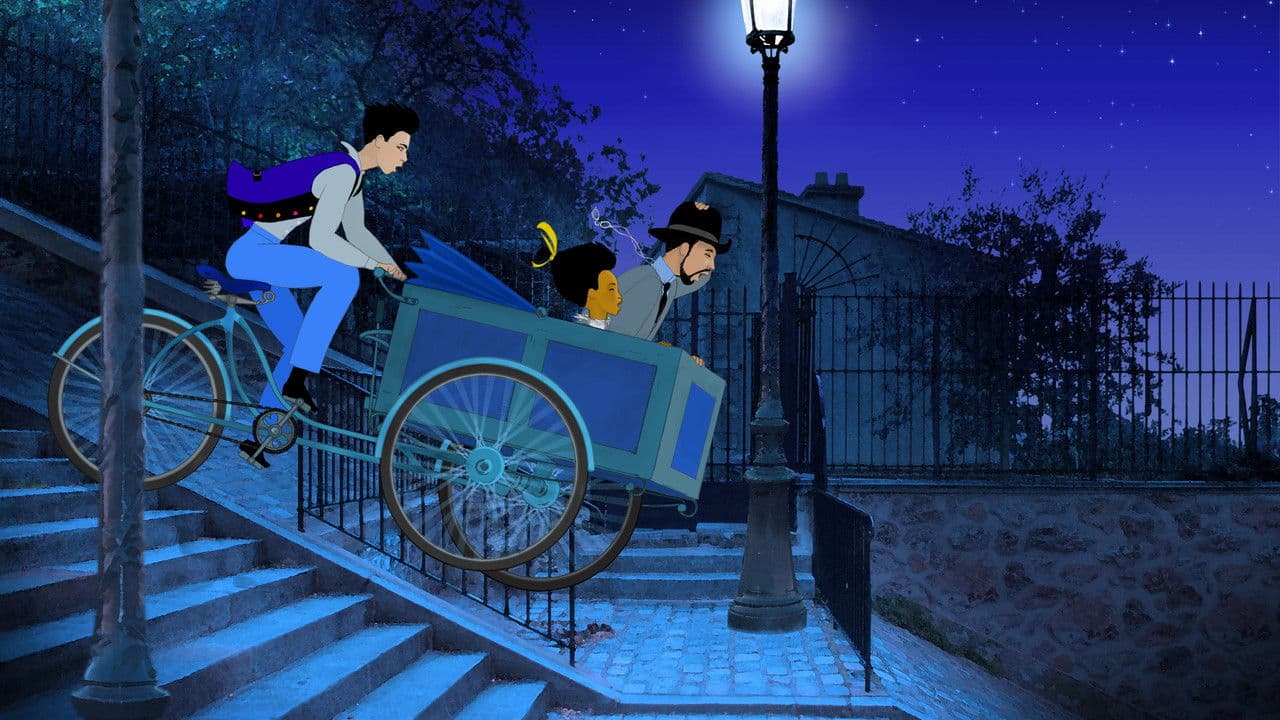
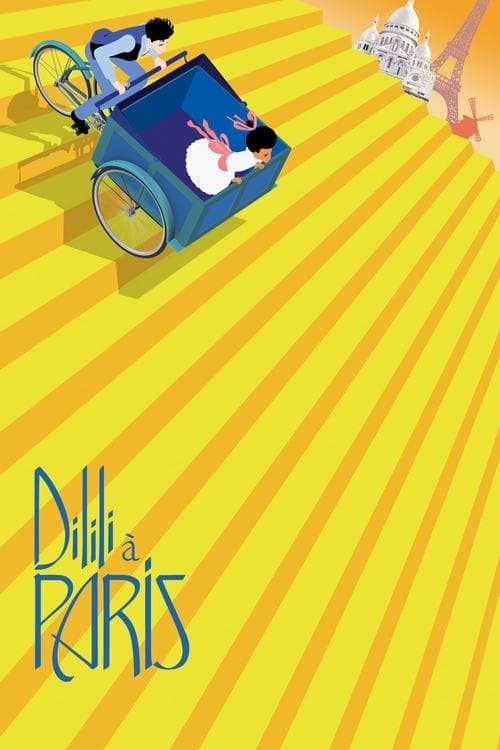
Dilili in Paris is an animated film with an atmosphere that is both luminous and unsettling, steeped in an aestheticised recreation of Belle Époque Paris. The plot follows Dilili, a young Kanak girl from New Caledonia, who investigates mysterious abductions of girls in the capital alongside a delivery man. The film targets children from around 7-8 years old, but its central theme of confinement and forced submission makes it more suitable for somewhat older children.
Violence
The heart of the film rests on the abduction and enslavement of young girls by a group of men called the Male Masters, who force them to crawl, to submit and to cover themselves entirely in black fabric. These scenes, whilst not bloody, carry a genuine oppressive charge: domination is shown frontally and repeatedly. One scene also involves a bite from a rabid dog, resulting in the animal's death. The violence is not graphic but it is ideologically dense, which can disturb young or sensitive children. The narrative purpose is clearly denunciatory, which gives these images a pedagogical function, but this does not make them harmless nonetheless.
Discrimination
The film explicitly and centrally depicts masculine domination as an organised system, embodied by the Male Masters. This treatment is not a discreet stereotype but an assumed narrative driver, presented as a threat to be fought. Furthermore, the representation of Dilili as a Kanak child displayed in a colonial pavilion at the film's beginning raises the question of a colonial gaze upon non-European peoples, without the film treating it with great critical depth. Finally, the choice to cover the victims in black fabric evoking the full veil has sparked legitimate debate about a possible stigmatising association with Islam: the film does not make this link explicitly, but the image is sufficiently charged to warrant discussion with a child.
Underlying Values
The film consistently defends the idea that curiosity, courage and solidarity between individuals from different backgrounds allow resistance to oppression. The figure of Dilili embodies a form of autonomy and perseverance in the face of an adult world that does not always take her seriously. The narrative also implicitly values culture and knowledge as tools of emancipation, through numerous encounters with historical and artistic figures. The moral structure is clear and unambiguous: domination is an evil, freedom and respect for others are goods.
Social Themes
The film engages in reflection on patriarchy and the condition of women, transposed into a historical setting but with a resolutely contemporary intention. Colonisation also surfaces, notably in the initial staging of Dilili as an object of ethnographic display, without the film making it a central subject. These dimensions give the film an unusual thematic density for an animated film aimed at young audiences, and open useful discussions about history and power relations.
Sex and Nudity
Dilili appears bare-chested in a scene of colonial display at the film's beginning, presented as a critical look at how colonised peoples were exhibited. The nudity is brief, non-sexualised, and carries a documentary and denunciatory intention. There is no other sexual or suggestive content in the film.
Strengths
The film constructs a visually sumptuous Belle Époque Paris, with an artistic direction that integrates period photographs into animated settings, creating an original and memorable visual texture. The gallery of historical figures encountered by Dilili, from Marie Curie to Toulouse-Lautrec, functions as a vivid invitation to the history of arts and sciences, never falling into the trap of a lecture. The writing gives a mixed-race and colonised child the role of active and intelligent protagonist in an investigative narrative, which is narratively sound. The film has the rare merit of treating serious subjects, domination, servitude, colonialism, with a clarity suited to young audiences without diluting them into insignificance.
Age recommendation and discussion points
The film is suitable from 8-9 years old for accompanied children, and rather from 10 years old for serene and independent viewing. Two angles of discussion are essential after viewing: why do the Male Masters want girls to crawl and obey, and what does this say about how some seek to control others? And also: what does it mean for a young girl to be displayed in a museum as if she were an object, and how does Dilili respond to this?
Synopsis
With the help of her delivery-boy friend, Dilili, a young Kanak, investigates a spate of mysterious kidnappings of young girls that is plaguing Belle Epoque Paris. In the course of her investigation she encounters a series of extraordinary characters, each of whom provides her with clues that will help her in her quest.
About this title
- Format
- Feature film
- Year
- 2018
- Runtime
- 1h 35m
- Countries
- Germany, Belgium, France
- Original language
- FR
- Directed by
- Michel Ocelot
- Main cast
- Elisabeth Duda, Liliane Rovère, Prunelle Charles-Ambron, Thissa d'Avila Bensalah, Enzo Ratsito, Natalie Dessay, Isabelle Guiard, Swan Mirabeau, Léa Powe, Karim M'Ribah
- Studios
- Nord-Ouest Films, Studio O, ARTE France Cinéma, Wild Bunch, Artémis Productions, Senator Film, Mac Guff Ligne, Mars Films
Content barometer
- Violence3/5Notable
- Fear3/5Notable tension
- Sexuality1/5Allusions
- Language0/5None
- Narrative complexity1/5Accessible
- Adult themes0/5None
Watch-outs
- Abuse
Values conveyed
- Courage
- Acceptance of difference
- Perseverance
- Autonomy
- friendship
- curiosity
- helpfulness