

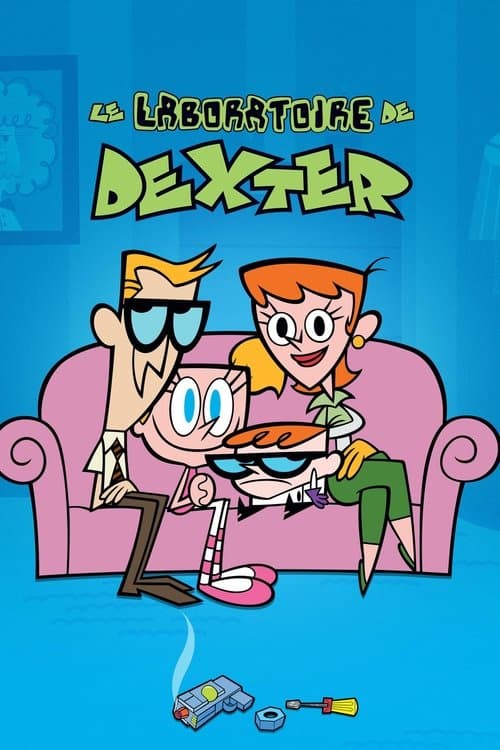
Dexter's Laboratory
Does this age rating seem accurate to you?
Detailed parental analysis
Dexter's Laboratory is a fast-paced animated comedy series driven by absurd humour and unbridled energy. Each short episode revolves around a young genius who hides a secret laboratory in his bedroom, constantly disrupted by his unpredictable and intrusive older sister. The series targets school-age children with a resolutely light tone, though the content warrants some caution for younger viewers.
Violence
Violence is present repeatedly and serves as one of the series' main comedic devices. Characters hit, collide with, and blow each other up through gadgets and inventions that go wrong, following a cartoon logic inherited from Tom and Jerry. The intensity remains visual and non-graphic, but the frequency is sustained and violence is clearly played for laughs, never questioned or associated with real consequences. One episode pushes this further with a scene of a beheaded piñata in a role-playing game context, which stands somewhat apart from the usual register. For a child under 6 years old, the pace and repetition of these situations may normalise the use of force as a mode of interaction.
Parental and Family Portrayals
Dexter's parents are a recurring but essentially decorative figure: cheerful, loving, and completely blind to their son's activities and their children's behaviour. This pattern is a narrative convention of cartoon storytelling, but it sends a clear structural message: adults see nothing, children do as they please. It is not inherently problematic, but it is a concrete angle worth discussing with the child, particularly to distinguish what belongs to comedic device from what would be acceptable in real life.
Underlying Values
The series strongly values intelligence and intellectual achievement through Dexter's character, but often treats it as a source of arrogance and isolation rather than as a simple virtue. The sibling dynamic between Dexter and Dee Dee oscillates between frustration, destruction, and, more rarely, complicity. The resort to physical and verbal violence to resolve conflict is recurrent on both sides, without the narrative offering an alternative or critical perspective on these choices. Dexter's individualism, his displayed disdain for those around him, and his obsession with control constitute an ambiguous model, amusing on screen but worth naming with the child.
Language
The verbal register is regularly informal, with frequent use of words like 'stupid' and 'idiot' in exchanges between characters. A minor swear word appears in at least one episode. This is not heavy profanity, but the repetition of these phrases in a comedic register easily normalises them for a young child who absorbs the turns of phrase without filter.
Substances
A few sporadic elements merit noting: a waitress smokes in one episode, customers drink beer in the same context, and Dexter places a cigar in Dee Dee's mouth in another scene. These moments are incidental to the overall series, but their presence in a cartoon aimed at children makes them visible to parental oversight. None of these elements is portrayed as an attractive or valued practice, but they exist.
Strengths
The series possesses genuine narrative inventiveness within its short format: episodes construct absurd situations with coherent internal logic and effective plot twists. The humour works on multiple levels, allowing parents to watch without becoming bored. Dexter's character, despite his flaws, embodies a scientific curiosity and passion for creation that can resonate positively with children drawn to science, invention, and problem-solving. The sibling dynamic, however chaotic, carries a recognisable emotional truth about relationships between brothers and sisters.
Age recommendation and discussion points
The series is suitable from age 7 onwards for comfortable viewing, and may be considered from age 6 with a parent available to contextualise the situations. Two discussion angles are worth pursuing after viewing: ask the child why Dexter and Dee Dee always settle their disagreements through fighting or shouting rather than in other ways, and ask what he or she thinks about the fact that the parents never see anything that happens.
Synopsis
Dexter, a boy-genius with a secret laboratory, constantly battles his sister Dee Dee, who always gains access despite his best efforts to keep her out, as well as his arch-rival and neighbor, Mandark.
About this title
- Format
- TV series
- Year
- 1996
- Runtime
- 7m
- Countries
- United States of America
- Original language
- EN
- Directed by
- Genndy Tartakovsky
- Main cast
- Candi Milo, Kat Cressida, Jeff Bennett, Kath Soucie, Eddie Deezen
- Studios
- Hanna-Barbera Cartoons, Cartoon Network Studios
Content barometer
- Violence3/5Notable
- Fear1/5Mild
- Sexuality0/5None
- Language2/5Moderate
- Narrative complexity1/5Accessible
- Adult themes1/5Mild
Watch-outs
- Alcohol
- Strong language
- Violence
Values conveyed
- Perseverance
- creativity
- curiosity
- family
- ingenuity