

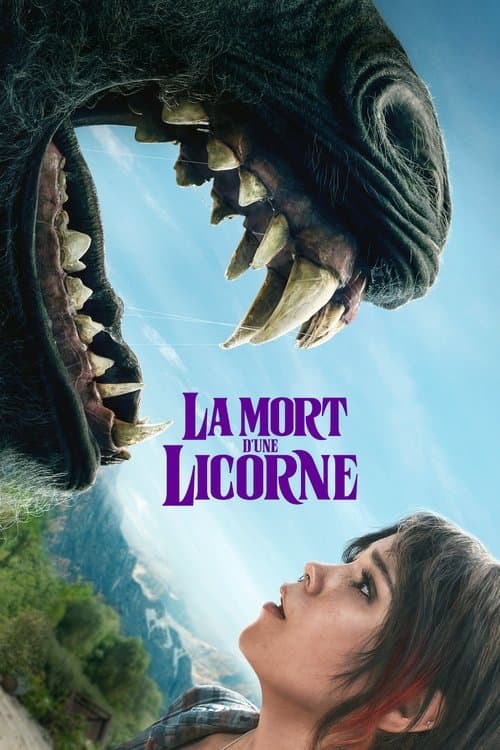
Death of a Unicorn
Does this age rating seem accurate to you?
Detailed parental analysis
Death of a Unicorn is a horror comedy with a dark and sarcastic atmosphere, blending unapologetic gore with biting social satire. The plot follows a father and daughter who, after hitting a unicorn on the road, are drawn into the schemes of a family of pharmaceutical billionaires determined to exploit the creature's magical powers. The film is unambiguously aimed at adult and older teenage audiences, and its misleading title should not deceive parents: it bears no resemblance to a family fable.
Violence
Violence is the film's dominant register, intense and deliberately shocking. It features visceral dismemberments, characters disembowelled with exposed organs, a skull slowly crushed, and impalements piercing bodies with blood spray. This violence is not gratuitous in a purely spectacular sense: it is functional to the logic of revenge that structures the narrative, with the unicorn's abusers progressively punished by the creature they exploited. That said, the visual execution is extreme and relentless, without distancing or softening. For even a seasoned adolescent viewer, the accumulation of gore can be difficult to absorb, especially as the film oscillates between dark humour and frank horror without always managing to balance the two.
Underlying Values
The film constructs an explicit satire of corporate greed and pharmaceutical ethics, portraying a family of billionaires willing to transform a magical creature into a revenue-generating product. Narrative justice operates entirely through the unicorn's revenge: the exploiters are killed, not judged, not reformed. This choice reveals something about the worldview conveyed, one in which institutions are powerless and only retributive violence settles accounts. By contrast, the daughter embodies an ethic of integrity: she informs herself before acting, refuses complicity and speaks the truth. The film explicitly values this stance, which offers genuine scope for discussion. The father-daughter reconciliation, though late and painful, asserts that parental love can coexist with grave mistakes, without erasing them.
Parental and Family Portrayals
The father is presented as a man who has sacrificed his relationship with his daughter for professional and material ambitions. His arc is one of awakening and a final sacrifice that partially redeems his choices. This dysfunctional yet redemptive parental portrait constitutes one of the film's most substantive emotional threads and can feed direct conversation with a teenager about adult priorities, parental guilt and the possibility of reconciliation despite genuine wrongs.
Social Themes
Criticism of the pharmaceutical industry is explicit and central. The film draws a transparent analogy with real families who have profited from health crises, and shows how profit logic can lead to treating a living resource, human or otherwise, as a mere asset to be extracted. This satirical dimension is among the film's most intellectually sound, even if it is delivered with a degree of caricature that limits nuance.
Substances
A character snorts unicorn horn powder in a scene that explicitly mimics cocaine use. The scene is presented with satirical distance, but the gestures and framing faithfully reproduce on-screen drug codes. Other characters vape and smoke. These elements remain anchored in the logic of satirising the excesses of the ultra-wealthy, but their visual presence is direct and unvarnished.
Language
The film contains a high volume of profanity, with around twenty occurrences of the strongest word in the English language and numerous scatological expressions. The register is consistent with the claimed adult comedy tone, but constitutes a clear marker of a film not intended for children or young teenagers.
Discrimination
The antagonist billionaire family is treated as a monolithic caricature, without genuine psychological nuance. This representation stems from deliberate satirical choice rather than unwitting bias, but it reduces the critical exercise to convenient manichaeism where wealth alone designates villains. An inquisitive teenager may be prompted to wonder whether this simplification reinforces reflection or instead short-circuits it.
Strengths
The film offers an original central idea and its blend of registers, horror, dark comedy, social satire, testifies to ambition beyond simple genre filmmaking. The father-daughter dynamic is written with an emotional sincerity that stands out against the surrounding brutality, and this is where the film finds its true depth. The pharmaceutical satire is sufficiently precise in its targets to constitute a genuine pedagogical entry point on contemporary issues. However, the tonal balance remains unstable: the film never truly chooses between gore farce and constructed social critique, and this hesitation limits its reach in both registers.
Age recommendation and discussion points
This film is unsuitable for under-16s due to sustained gory violence, explicit drug references and unfiltered brutality. From age 16 onwards, with a teenager already familiar with horror-comedy registers, it can become an interesting discussion tool on two fronts: firstly, what the satire actually says about pharmaceutical ethics and profit logic applied to living things; secondly, why the narrative chooses revenge rather than justice as a response to exploitation, and what this choice reveals about our collective relationship to reparation.
Synopsis
A father and daughter accidentally hit and kill a unicorn while en route to a weekend retreat, where his billionaire boss seeks to exploit the creature’s miraculous curative properties.
Where to watch
Availability checked on Apr 06, 2026
About this title
- Format
- Feature film
- Year
- 2025
- Runtime
- 1h 47m
- Countries
- United States of America
- Original language
- EN
- Directed by
- Alex Scharfman
- Main cast
- Paul Rudd, Jenna Ortega, Will Poulter, Richard E. Grant, Téa Leoni, Sunita Mani, Steve Park, Anthony Carrigan, Jessica Hynes, David Pasquesi
- Studios
- A24, Square Peg, Secret Engine, Ley Line Entertainment, Monoceros Media
Content barometer
- Violence5/5Very strong
- Fear3/5Notable tension
- Sexuality0/5None
- Language4/5Strong
- Narrative complexity3/5Complex
- Adult themes3/5Marked
Watch-outs
- Death
- Drugs
- Strong language
- Violence