

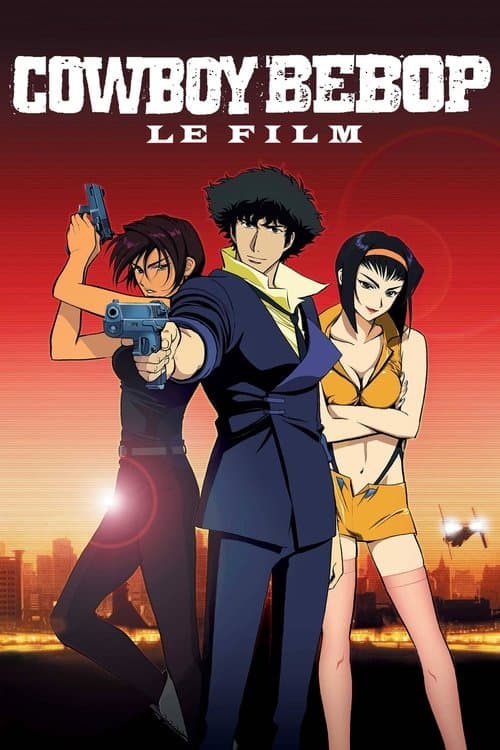
Cowboy Bebop: The Movie
カウボーイビバップ 天国の扉
Does this age rating seem accurate to you?
Detailed parental analysis
Cowboy Bebop: The Movie is a science-fiction animated feature with a dark, tense and resolutely adult atmosphere, steeped in a film noir aesthetic enhanced by jazz and frenetic action. The plot follows a team of bounty hunters attempting to thwart a bioterrorist attack threatening a human colony on Mars. The film is unambiguously aimed at a discerning teenage and adult audience, ideally those already familiar with the animated series from which it is drawn, as it presumes prior knowledge of the characters and their universe.
Violence
Violence is the most prominent element of the film and runs throughout the narrative relentlessly. Gunfire is frequent, realistic in its treatment and lethal, including a monorail chase sequence in which an innocent bystander is shot in the head. A knife-stabbing scene in the back is particularly brutal, with visible blood and bloodied broken glasses. A large-scale tanker explosion shows dead and wounded victims at the scene. The violence is not entirely gratuitous: it serves genuine narrative tension and the film does not make a spectacle of it, yet its intensity and realism render it unsuitable for under-thirteens and problematic even for some younger teenagers.
Underlying Values
The film constructs its characters around an assumed moral ambiguity. The bounty hunters are heroes operating outside any institution, guided by money as much as by a diffuse sense of good, and the narrative does not seek to idealise their precarious situation. The main character carries a troubled past and inner conflict that distance him from the archetypal hero without making him a nihilistic antihero. The question posed at the end of the credits, 'Do you live in the real world?', opens a philosophical reflection on the boundary between illusion and reality, between chosen life and lived life. It is one of the most explicitly animation films addressing the existential dimension of a developing teenager.
Substances
Tobacco is present recurrently throughout the film, with several characters smoking regularly and this never being flagged as problematic. Alcohol is likewise consumed without moral commentary. These uses contribute to the deliberately adult aesthetic of the film and are neither condemned nor explicitly valorised, yet they integrate into a marginal lifestyle tableau that normalises them de facto.
Sex and Nudity
Partial nudity is limited to a scene where the side of a female character's breast is briefly visible during wound treatment. More concerning is a scene in which the antagonist cuts a woman's shirt with his knife, in a threatening register with sexual connotations. The clothing of certain female characters is moreover revealing and used strategically in the framing. The overall content remains far from explicit but warrants mention for parents of younger teenagers.
Social Themes
The film deals in the background with bioterrorism and threat to an entire civilian population, in the context of an interplanetary colonial society marked by inequality. Without being didactic, the narrative implicitly raises questions about the vulnerability of social structures and what marginal individuals can or cannot accomplish in the face of systemic threats. These themes remain in the background but offer solid ground for discussion with a curious teenager.
Strengths
The film possesses remarkable narrative density and narrative coherence for an animated feature derived from a series. The character writing is subtle, their psychology complex yet accessible, and the rhythm effectively alternates between tense action sequences and melancholic respites. The jazz-funk soundtrack constitutes a cultural object in its own right, and the film offers a fine gateway to discussion on the moral ambiguity of heroic figures, on the relationship between past and identity, and on solitude as a narrative condition. It is one of the rare large-format animated films that treats its adult characters with genuine seriousness without ever lapsing into heavy-handedness.
Age recommendation and discussion points
The film is not recommended before age 13 due to realistic violence and certain scenes of strong emotional charge, and can be watched with ease from age 15 onwards. With a teenager, two discussion angles naturally emerge: why morally imperfect characters can nevertheless be figures of strong attachment, and what the film's final question means about 'living in the real world'.
Synopsis
The year is 2071. Following a terrorist bombing, a deadly virus is released on the populace of Mars and the government has issued the largest bounty in history, for the capture of whoever is behind it. The bounty hunter crew of the spaceship Bebop; Spike, Faye, Jet and Ed, take the case with hopes of cashing in the bounty. However, the mystery surrounding the man responsible, Vincent, goes deeper than they ever imagined, and they aren't the only ones hunting him.
Where to watch
Availability checked on Apr 03, 2026
About this title
- Format
- Feature film
- Year
- 2001
- Runtime
- 1h 56m
- Countries
- Japan
- Original language
- JA
- Directed by
- Shinichiro Watanabe
- Main cast
- Koichi Yamadera, Unsho Ishizuka, Aoi Tada, Ai Kobayashi, Megumi Hayashibara, Mickey Curtis, Tsutomu Isobe, Jin Hirao, Renji Ishibashi, Miki Nagasawa
- Studios
- TriStar Pictures, Bandai Visual, Destination Films, SUNRISE, Emotion, BONES
Content barometer
- Violence4/5Strong
- Fear3/5Notable tension
- Sexuality2/5Mild
- Language1/5Mild
- Narrative complexity2/5Moderate
- Adult themes3/5Marked
Values conveyed
- Friendship
- Loyalty
- courage
- teamwork