
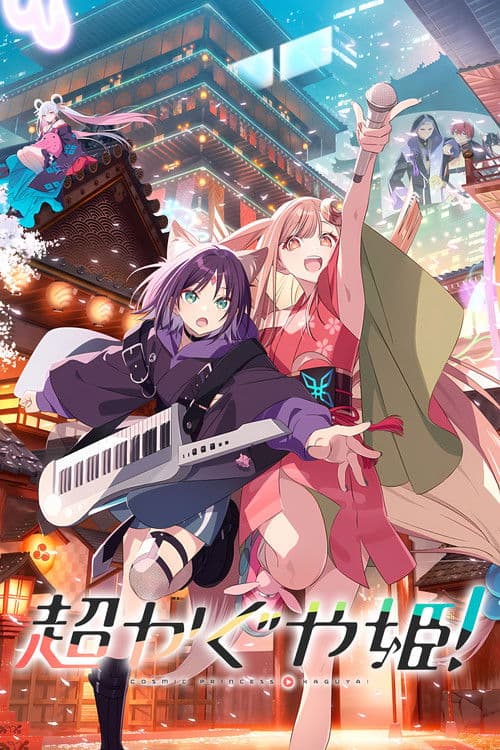
Cosmic Princess Kaguya!
超かぐや姫!
Does this age rating seem accurate to you?
Detailed parental analysis
Kaguya, Princess of the Cosmos is a fantastical adventure animation film with a tone that blends the energy of an action video game, the melancholy of a separation tale and the wonder of a friendship narrative. The story follows Iroha, a solitary teenager, who forms a bond with a mysterious entity named Kaguya in a virtual world, before fighting to prevent them from being separated forever. The film is clearly aimed at a pre-teen and teenage audience, with a narrative complexity in the second half that far exceeds the grasp of younger children.
Underlying Values
The narrative builds consistently an ethic of female friendship, perseverance and solidarity between two young girls who are initially opposites in every way. These values are not applied superficially: they form the real engine of the plot and determine its outcome. In parallel, the film strongly values Iroha's autonomy and self-determination, who chose to live alone after her father's death and who questions her relationship with her mother. This message of radical independence is positive in its intention but deserves to be discussed with a child or young teenager: it constructs individual freedom as a response to grief and family distance, without fully exploring the emotional costs of this position.
Parental and Family Portrayals
The parental figure is structurally absent or distant in this film. Iroha's father is dead before the story begins, and her grief weighs on the entire narrative like a silent wound never fully addressed. The relationship with her mother is presented as complicated, even questioned by the protagonist herself. The film offers no reassuring or reliable parental figure, which may resonate differently depending on the family situation of the child watching it. This is not an irresponsible treatment, but it is an angle worth anticipating before watching with a child who has experienced bereavement or family separation.
Violence
Violence unfolds primarily in a virtual video game world, with sword fights, arrow shots, building explosions and destruction of digital characters. The aesthetic is stylised, without realistic gore. One scene stands out, however: an amputation of a character's limb, accompanied by black blood, followed by deaths through disintegration. This passage is visually striking even though it remains within a fantastical register. Overall, it remains calibrated for the genre and is never gratuitous: violence serves the dramatic stakes of the narrative. For a child under 8 or 9 years old, the amputation scene may nonetheless be disturbing.
Language
The film contains a handful of slightly coarse expressions in both language versions, including equivalents of 'darn', 'mild profanity' or 'go to hell'. The level of crude language remains low and is contextually justified in moments of tension or frustration. This is not a major point of concern, but it is useful to flag for parents who are sensitive to this for young children.
Sex and Nudity
A minor character appears briefly in an outfit revealing pronounced cleavage. The scene is isolated, without narrative emphasis. This is not a cause for concern.
Strengths
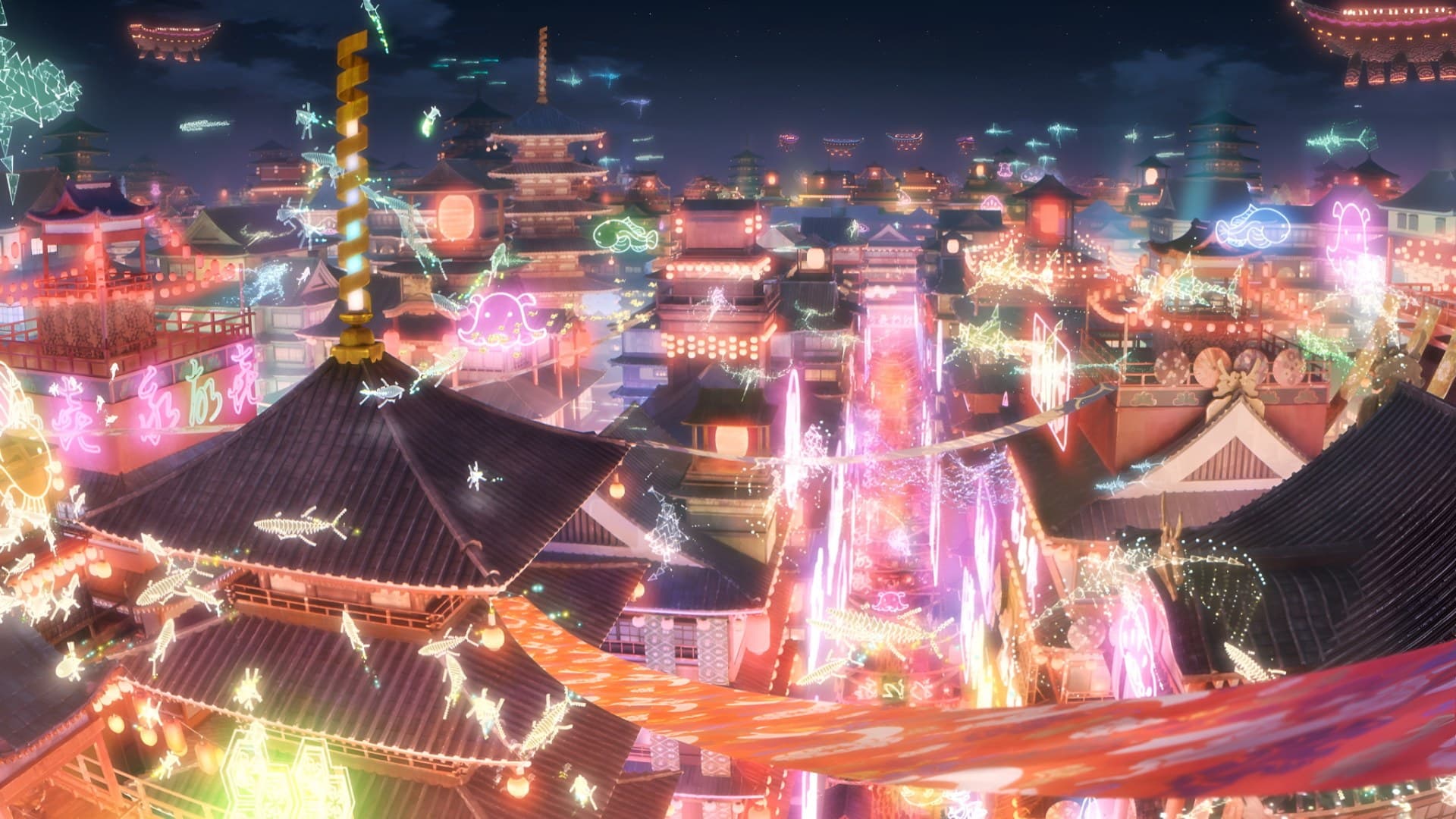
The film offers musical and visual sequences of real generosity, with animation whose energy effectively supports moments of tension as well as moments of contained emotion. The central relationship between Iroha and Kaguya is written with a sincerity that avoids the usual pitfalls of the genre: friendship is earned here, tested, never guaranteed. The second half of the film, whilst sometimes confusing in its mechanisms of time travel and dual identities, takes real narrative risks that set it apart from an ordinary adventure production. The ambiguity of the ending, perceived by some as happy and by others as melancholic, is an asset for anyone seeking to open a conversation about what a true happy ending means. The running time of two hours and twenty minutes is, however, something to consider seriously: the film delivers on its visual and emotional promises but requires a sustained capacity for attention that children below 10 years old will probably not have.
Age recommendation and discussion points
The film is suitable from 9 or 10 years old for accompanied viewing, and fully appropriate from 11 or 12 years old for independent viewing. Two angles of discussion are particularly worthwhile after viewing: ask the child what they think of Iroha's choice to live alone and distance herself from her family, to explore together the difference between independence and isolation; and question their reading of the ending to find out whether they perceive it as a true happy ending, which opens a reflection on grief, loss and what one is willing to accept for someone you love to be free.
Synopsis
Iroha's life gets knocked off its orbit when Kaguya, a carefree runaway from the Moon, moves in and convinces her to perform in a virtual world together.
About this title
- Format
- Feature film
- Year
- 2026
- Runtime
- 2h 23m
- Countries
- Japan
- Original language
- JA
- Directed by
- Shingo Yamashita
- Main cast
- Yuko Natsuyoshi, Anna Nagase, Saori Hayami, Miyu Irino, Yuma Uchida, Yoshitsugu Matsuoka, Yoshino Aoyama, Konomi Kohara, Rie Kugimiya, Fairouz Ai
- Studios
- Studio Colorido, Studio Chromato, Twin Engine
Content barometer
- Violence2/5Moderate
- Fear3/5Notable tension
- Sexuality1/5Allusions
- Language1/5Mild
- Narrative complexity2/5Moderate
- Adult themes0/5None
Values conveyed
- Friendship
- Perseverance
- Autonomy
- creativity
- reconciliation