

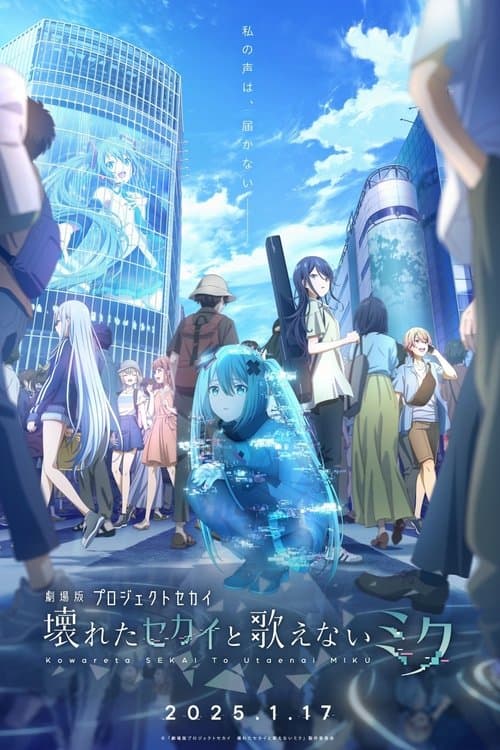
COLORFUL STAGE! The Movie: A Miku Who Can't Sing
劇場版プロジェクトセカイ 壊れたセカイと歌えないミク
Does this age rating seem accurate to you?
Detailed parental analysis
A Japanese animated film with an emotionally dense atmosphere, blending dreamlike sequences in a digital world with intimate moments of sometimes unsettling sincerity, this feature drawn from the universe of the mobile game Project SEKAI follows a group of teenage musicians confronted by a virtual entity unable to sing, whose survival depends on their artistic and human commitment. The target audience is primarily adolescents familiar with the franchise, but the film addresses sufficiently weighty universal themes, notably depression and suicidal ideation, to merit parental attention regardless of that familiarity.
Underlying Values
The film constructs its central message around the idea that failure does not invalidate the pursuit of a dream, and that music can serve as a bridge between individuals isolated in their suffering. These values are carried with narrative consistency: the story does not state them as slogans, it passes them through the characters by way of doubts, renunciations and mistakes they own. Collective perseverance takes precedence over individual performance, and solidarity among group members is shown as a vector of healing as much as of creation. This constitutes solid ground for discussion about what it truly means to support someone in difficulty.
Social Themes
Depression, isolation and suicidal ideation occupy a central narrative place, not an incidental one. A character explicitly considers ending their life, and the film treats this subject with a certain gravity, neither trivialising it nor always providing the interpretative keys necessary for a young viewer going through their own dark period. Parents have reported that some children found in this film a direct echo of their own difficulties, which is at once the film's strength and an argument for watching and discussing it together. The digital world also serves as a metaphor for inner psychological states, a device that can enrich emotional understanding or, conversely, blur the perception of reality for younger viewers.
Violence
The violence present in the film is essentially symbolic and spectacular in nature, anchored in sequences of digital world destruction: collapses, explosions, characters swept away or buried, digital entities absorbed by threatening darkness. These scenes can be visually intense and generate anxiety in younger or sensitive children when confronted with representations of catastrophe. There are also gestures of everyday destruction, a smashed telephone, objects thrown, which signal overflowing emotional states rather than gratuitous violence. The narrative purpose of these elements is clear: they translate inner distress, not a taste for brutality.
Sex and Nudity
Several female characters are dressed in very short skirts, in keeping with the visual codes of the musical franchise from which the film is derived. This aesthetic is recurrent and affects several characters, without the film making it a narrative issue. For a pre-adolescent child, this merits being mentioned in advance without dramatising its significance, especially as sexualisation remains limited to the vestimentary register and is accompanied by no scene of a suggestive nature.
Language
The film contains a few slightly vulgar or informal expressions, without language constituting a major problem. Occurrences remain occasional and do not define the film's overall register.
Strengths
The film succeeds in addressing adolescent mental health without condescension or excessive simplification, allowing characters to fail, doubt and recover at a pace that respects the complexity of these experiences. The metaphor of the digital world as inner space is deployed with sufficient consistency for the dreamlike sequences to carry real emotional weight. For adolescents familiar with Project SEKAI, this is a narrative extension that deepens already beloved characters, with dramatic ambition above the average of video game adaptations. For others, the film functions less well as a standalone narrative, but the themes it raises remain capable of sustaining genuine conversation between parents and children about isolation, artistic creation as release and the value of mutual support.
Age recommendation and discussion points
The film is not recommended before age 10, and parental accompaniment remains advisable until 12 or 13 years old owing to themes of depression and suicidal ideation that need to be contextualised. After viewing, two angles merit being opened with the child or adolescent: how to recognise that someone around them is truly suffering, and what art or music can or cannot do alone in the face of profound distress.
Synopsis
Ichika is a high school musician who can enter a mysterious place called “SEKAI,” where she and her friends express their innermost emotions through music alongside Hatsune Miku. One day after giving a live performance, Ichika meets a new Miku that she has never seen before. No matter how hard this new Miku tries to sing, she struggles connecting with the hearts of her listeners. Miku must rely on the help of others to find a way to sing again.
Where to watch
Availability checked on Apr 26, 2026
About this title
- Format
- Feature film
- Year
- 2025
- Runtime
- 1h 45m
- Countries
- Japan
- Original language
- JA
- Directed by
- Hiroyuki Hata
- Main cast
- Saki Fujita, Asami Shimoda, Yuu Asakawa, Meiko Haigou, Naoto Fuuga, Ruriko Noguchi, Karin Isobe, Reina Ueda, Yuki Nakashima, Yui Ogura
- Studios
- P.A.WORKS, CyberAgent, Colorful Palette, Crypton Future Media, SEGA, Shochiku
Content barometer
- Violence2/5Moderate
- Fear3/5Notable tension
- Sexuality1/5Allusions
- Language1/5Mild
- Narrative complexity3/5Complex
- Adult themes0/5None
Values conveyed
- Friendship
- Perseverance
- support
- creativity