Carol & the End of the World
Does this age rating seem accurate to you?
Detailed parental analysis
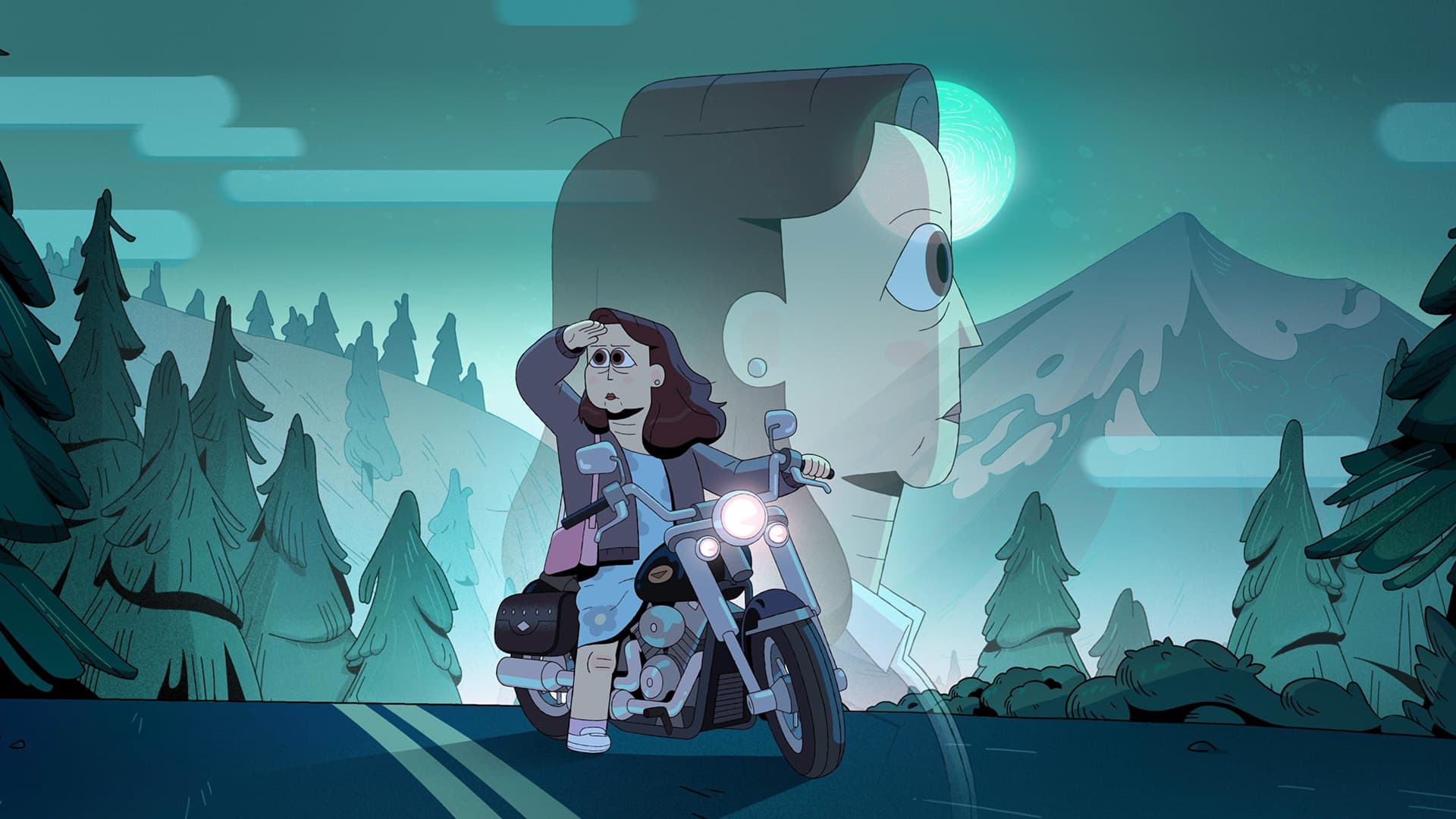
Carol and the End of the World is an adult animated series with a melancholic and contemplative tone, characterised by an atmosphere of deliberate slowness and inward reflection. The story follows Carol, an ordinary and unassuming woman, who seeks meaning in her daily life while a rogue planet is on the verge of colliding with Earth within a few months. The intended audience is explicitly adult, with the official Adult Content classification (17 years and above) confirming this unambiguously.
Sex and Nudity
Nudity is the most immediately visible element. Carol's parents appear systematically naked on screen, with prolonged and repeated nudity in every scene featuring them, without being eroticised but equally without being visually inconsequential. A male character is depicted naked whilst jogging, with his body fully visible at every stride. A sexual encounter takes place off-screen, signified by a black screen following an overnight liaison. These elements do not constitute pornographic content, but their accumulation and recurrence make this a film clearly unsuitable for children and young adolescents.
Underlying Values
The narrative constructs a sincere reflection on the ordinary as a legitimate life choice. Carol is not a heroine, does not seek to be one, and the series values without irony the fact of finding meaning in simple connections and unglamorous work. Faced with imminent apocalypse, the majority of characters choose excess or transgression, and Carol chooses routine and community. This positioning is rare and deserves to be discussed with an adolescent in search of meaning: the value of an ordinary life, the rejection of heroic performance, the legitimacy of calm and withdrawal are serious moral propositions, even if they may seem disconcerting.
Social Themes
The imminent apocalypse is not treated as a disaster film but as a social revealer. The series observes how individuals and entire societies react to a certain and approaching end: abandonment of norms, mass hedonism, latent or actual violence, or conversely communal withdrawal. A sequence inspired by a real hostage-taking at sea introduces fleeting geopolitical tension, without actual violence, but sufficiently present to ground the narrative in world reality. This prism makes it possible to initiate a conversation about what gives value to social life and its ordinary rules.
Substances
Alcohol is present regularly, with beer, wine and champagne appearing in several festive or unwinding contexts. One scene shows Carol slightly drunk whilst she is looking after a child, a situation presented without dramatisation. Consumption is not explicitly valorised as a model but it is normalised within the framework of a world nearing its end, which contextualises it without absolving it.
Parental and Family Portrayals
Carol's parents are present and affectionate, but their permanent nudity constitutes a highly atypical parental representation which may disconcert or make one uncomfortable, regardless of any symbolic reading. They function as benevolent secondary characters, without major narrative dysfunction, but their visual treatment alone is sufficient to render the film unsuitable for family viewing with children or young adolescents.
Violence
Violence is marginal and without graphic character. The armed piracy sequence is inspired by a real news story but shows no actual violence, treated rather on a register of controlled tension. A threat involving a firearm is presented in semi-absurd fashion, without violent outcome. The film is not a violent film and this theme calls for no particular vigilance beyond the whole.
Strengths
The series offers emotionally honest writing on soft depression, existential emptiness and the difficulty of feeling legitimate in a world that values intensity. Its slow pace is a coherent choice aligned with its subject matter, not a manufacturing flaw. The representation of Carol, a discreet character without a spectacular arc of transformation, is a narrative rarity: the series refuses to transform its heroine into someone else in order to make her more satisfying to watch. For an adult or sensitive older adolescent attuned to these questions, this honesty can be deeply resonant. The overall melancholy is treated without self-indulgence or romanticisation.
Age recommendation and discussion points
The film is reserved for adults and older adolescents, not before 16 years old given the recurring nudity and resolutely adult tone, and rather recommended from 17 years old for fully peaceful viewing. With a sufficiently mature adolescent, two angles of discussion naturally impose themselves: why does the film's society choose excess in the face of the end of the world, and what does this choice tell us about our own ways of assigning value to ordinary things? One can also interrogate together what the film says about depression and the feeling of being out of step, without this necessarily being dark.
Synopsis
As a planetary apocalypse looms, a woman struggling to embrace end-times chaos searches for meaning in her last months on Earth.
Where to watch
Availability checked on Apr 03, 2026
About this title
- Format
- TV series
- Year
- 2023
- Countries
- Canada, United States of America
- Original language
- EN
- Directed by
- Dan Guterman
- Main cast
- Martha Kelly
- Studios
- Bardel Entertainment
Content barometer
- Violence1/5Mild
- Fear2/5A few scenes
- Sexuality3/5Moderate
- Language1/5Mild
- Narrative complexity1/5Accessible
- Adult themes2/5Present
Watch-outs
- Alcohol
- Adult themes
Values conveyed
- Friendship
- Autonomy
- search for meaning
- authenticity
- solidarity
- self-acceptance