
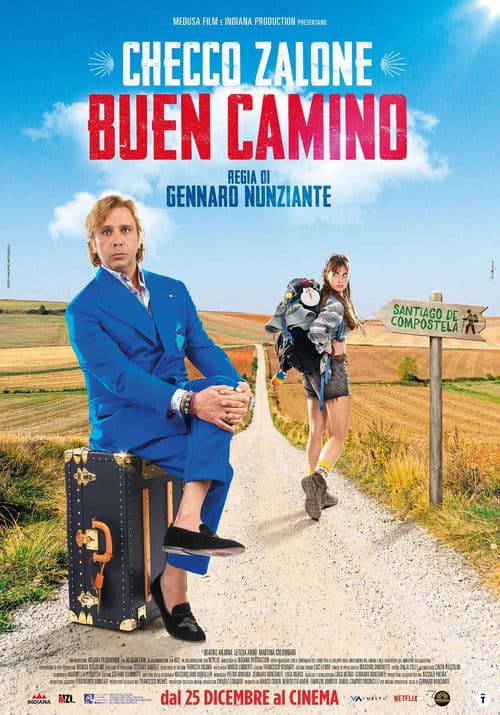
Buen Camino
Does this age rating seem accurate to you?
Detailed parental analysis
Buen Camino is a warm and light-hearted family dramedy, driven by physical humour and genuine sensitivity. The plot follows a father and daughter who undertake the pilgrimage to Santiago de Compostela together, hoping to repair a bond damaged by years of emotional distance. The film targets a multigenerational family audience, with particular resonance for families experiencing tension between parents and adolescent children.
Parental and Family Portrayals
The dramatic heart of the film rests entirely on the father-daughter relationship and its gradual reconstruction. The father is presented as a man who has substituted money for presence, treating family bonds as economic transactions rather than emotional commitments. This portrait is deliberately unflattering in the first part of the narrative, and it is the pilgrimage that allows him to access genuine vulnerability and responsibility. The dynamic is handled with sufficient nuance to avoid caricature, and the film resists artificially resolving years of hurt in a few scenes. This is the richest theme to discuss with a child or adolescent after viewing.
Underlying Values
The film constructs an implicit but clear critique of material wealth as a substitute for emotional commitment. It values vulnerability, shared physical effort, and the authenticity of relationships over time. The pilgrimage functions as a space of symbolic stripping away: without comfort or social role to play, the characters must confront what they truly are to one another. This structure of values is coherent and carried consistently, even if the treatment remains accessible and does not seek to deeply unsettle the viewer.
Discrimination
Philippine domestic staff appear in the film without being individualised or given their own interiority. They serve as a social backdrop that reinforces the portrait of an affluent milieu, but their narrative erasure reproduces a real invisibility. This is an angle worth flagging to adolescents sensitive to representation, not because the film dwells on it, but precisely because it does not register it.
Language
The film includes humour centred on bodily functions, notably flatulence and belching, used as a recurring comic device. This register is harmless but may irritate some parents. There is also some sexual humour and a scene of simulated kissing, without the content becoming suggestive or problematic for a young audience.
Strengths
The film draws real effectiveness from its geographical setting: the Camino de Santiago imposes a slow, physically demanding progression that naturally structures the characters' development and lends their reconciliation a credibility that few films of this kind achieve. The idea of placing two characters in prolonged and uncomfortable effort to force them to talk is narratively sound. The physical humour, even if conventional, intelligently lightens moments of emotional tension without defusing them. For families who have themselves experienced periods of emotional distance, the film can function as a gentle, non-accusatory mirror.
Age recommendation and discussion points
The film is suitable from age nine or ten onwards, and gains resonance with adolescents who already have an awareness of family tensions. Two angles of discussion deserve to be opened after viewing: first, to what extent can money or gifts truly replace presence, and what does one feel when a parent acts this way? Second, does walking together suffice to repair something, or are words also necessary?
Synopsis
Checco's life is a comfortable and luxurious one, and it couldn't be otherwise, considering he's the only son of Eugenio Zalone, a wealthy sofa manufacturer. Stranded by the pool in his luxurious villas, with an unspecified number of Filipinos serving him, a very young Mexican model as a girlfriend, and vacationing on his yacht with friends who share his passion for not wanting to work; it seems like a truly enviable life, considering he lacks nothing, absolutely nothing. Actually, no. Something is missing. It's his underage daughter, Cristal, named after the famous French sparkling wine, who has suddenly disappeared without a trace. Urgently summoned to Rome by his ex-wife, Linda, he finds himself facing the responsibilities of fatherhood for the first time, trying to find the girl—a very complicated task, considering he knows absolutely nothing about Cristal and her life.
About this title
- Format
- Feature film
- Year
- 2025
- Runtime
- 1h 30m
- Countries
- Italy
- Original language
- IT
- Directed by
- Gennaro Nunziante
- Main cast
- Checco Zalone, Beatriz Arjona, Letizia Arnò, Martina Colombari, Hossein Taheri, Alfonso Santagata, Mariana Rodríguez, Cecilia Gragnani, Beatrice Abbro, Maurizio Bousso
- Studios
- Indiana Production, Medusa Film
Content barometer
- Violence0/5None
- Fear0/5None
- Sexuality1/5Allusions
- Language1/5Mild
- Narrative complexity1/5Accessible
- Adult themes0/5None
Values conveyed
- Perseverance
- Forgiveness
- family reconciliation
- humility
- self-improvement
- letting go
- solidarity
- inner journey