Beauty and the Beast
Does this age rating seem accurate to you?
Detailed parental analysis
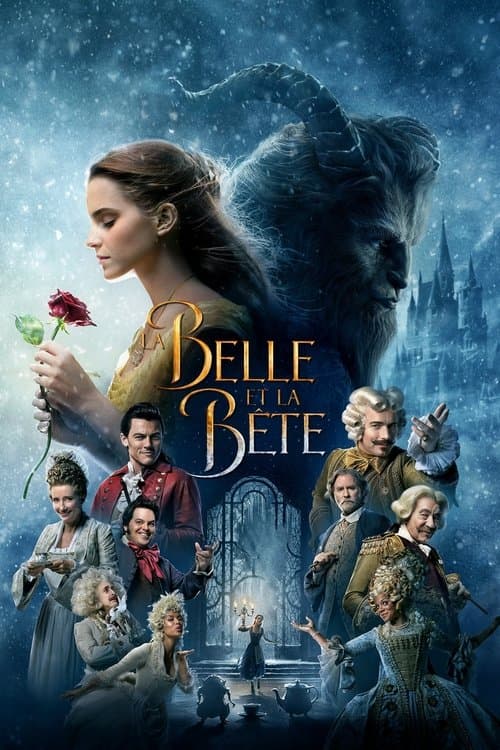
Beauty and the Beast is a musical fairy tale with a sumptuous and romantic atmosphere, blending scenes of adventure and moments of intense emotion within a baroque fairy-tale setting. The plot follows Belle, an independent young woman imprisoned in an enchanted castle, who learns to see beyond appearances by discovering the hidden humanity of a prince transformed into a terrifying beast. The film is aimed primarily at children aged 8 and above as well as pre-adolescents, but contains several sequences dark enough to warrant the attention of parents with younger children.
Violence
Violence is present on several occasions and with genuine intensity for a family tale. The wolf attack is particularly realistic: the animals wound the characters and the scene is not softened. The final battle between the armed villagers and the castle's enchanted servants constitutes a prolonged and muscular confrontation. Gaston's death, shot down by bullets and then thrown into the void, is shown without ambiguity. These sequences have coherent narrative purpose and are not gratuitous, but their intensity far exceeds what one would expect from a fairy tale intended as all-audience entertainment for young children.
Parental and Family Portrayals
The film accords significant emotional weight to parental figures, and not solely in a reassuring register. The sequence revealing Belle's past shows her mother dying of the plague, her face marked by black spots, abandoned by her husband to protect him from contagion. This is a scene of slow and realistic death that has profoundly affected many children, more so than the action scenes. Belle's father is in turn a loving but powerless figure, whose imprisonment triggers his daughter's sacrifice. These depictions offer rich material for discussing with a child questions of loss, grief and courage in the face of helplessness.
Underlying Values
The film's central message rests on the primacy of inner beauty over physical appearance, illustrated consistently throughout the narrative. Belle systematically refuses the social conformism imposed upon her by the village, beginning with Gaston's insistent advances, a figure representing the charming but hollow man. The film also values access to knowledge as emancipation: Belle reads, invents, teaches the other village girls despite community reluctance. These values are carried with narrative consistency and constitute concrete entry points for discussing with a child notions of autonomy, judgement and resistance to peer pressure.
Discrimination
The character of Lumière embodies the stereotype of the charming and seductive Frenchman, flirting openly with the chambermaid throughout the film. The caricature is benevolent but real, and sits within a comedic register that never questions the stereotype it deploys. Also worth noting is the figure of Gaston, whose behaviour towards Belle amounts to explicit harassment: he imposes himself despite her repeated refusals, seizes her skirts, and the film initially treats him as a comic rival before revealing him as a true antagonist.
Substances
Alcohol is present without ostentation but on a repeated basis: beer consumed in the tavern by villagers in a festive context, wine and champagne served at the castle ball. These occurrences are never explicitly valorised nor associated with problematic behaviour, but their accumulation merits noting for parents of young children.
Language
The film contains some mild insults and occasional use of terms such as 'damnation' or 'idiot'. Nothing severe by the standards of the genre, but the register is at times unnecessarily rough for a very young child.
Strengths
The film is a visually generous adaptation of the classic tale, with elaborate art direction and a musical score that reprises and enriches the themes of the original animated version. The narration takes time to substantiate the psychology of the characters, notably by giving the Beast a painful past that explains his internalised violence without excusing it. Belle is a rare female character in the fairy-tale register: curious, inventive, who resists social pressure not through defiance but through conviction. The scene of the two main characters' past, added in relation to the animated version, enriches the emotional dimension of their relationship. For a curious or reading child, the film can also open onto the question of what difference represents and the regard society casts upon what is foreign to it.
Age recommendation and discussion points
The film is suitable from age 8 onwards, with parental accompaniment recommended until ages 10-11 due to scenes of death and the wolf attack. Two angles are worth exploring after viewing: why does Belle choose to stay when she could have left, and what does this say about the difference between freely given sacrifice and resignation? And faced with Gaston's behaviour, why are her repeated refusals not heard, and how does one recognise someone who does not respect others' boundaries?
Synopsis
A live-action adaptation of Disney's version of the classic tale of a cursed prince and a beautiful young woman who helps him break the spell.
About this title
- Format
- Feature film
- Year
- 2017
- Runtime
- 2h 9m
- Countries
- United States of America
- Original language
- EN
- Directed by
- Bill Condon
- Main cast
- Emma Watson, Dan Stevens, Luke Evans, Kevin Kline, Emma Thompson, Ewan McGregor, Josh Gad, Hattie Morahan, Haydn Gwynne, Gerard Horan
- Studios
- Walt Disney Pictures, Mandeville Films
Content barometer
- Violence3/5Notable
- Fear3/5Notable tension
- Sexuality1/5Allusions
- Language1/5Mild
- Narrative complexity2/5Moderate
- Adult themes1/5Mild
Values conveyed
- Acceptance of difference
- Compassion
- Autonomy
- Forgiveness
- courage
- empathy
- love
- reading