
Azur & Asmar: The Princes' Quest
Does this age rating seem accurate to you?
Detailed parental analysis
Azur and Asmar is an animated film with epic scope and sumptuous aesthetic, steeped in a universe inspired by the tales of One Thousand and One Nights. The plot follows two boys raised together as brothers, separated by the social brutality of their era, who reunite as adults in a shared quest across a distant land to free an imprisoned fairy. The film targets audiences from 7-8 years old, but its narrative richness and themes speak equally to adults and children.
Underlying Values
The narrative is structured around a firm conviction: brotherhood and mutual esteem between individuals of different cultures are possible, even in a world marked by mistrust and prejudice. This conviction is not imposed through speeches but embodied in the relationship between the two protagonists and in the way each learns from the other's universe. The film also values the autonomy of female characters, generosity as an active virtue, and perseverance in the face of obstacles. There is no ambiguous message here: the values conveyed are solid and coherent throughout.
Social Themes
The question of migration and cultural otherness lies at the heart of the film: Azur, a blonde-haired, blue-eyed child, becomes a stranger and suspect in a country where his physical features inspire superstitious fear. This reversal of perspective is one of the film's most effective narrative devices for helping a child understand what it means to be perceived as the other. Poverty, begging and social exclusion are shown without flinching, with a restraint that avoids both misery-mongering and sugar-coating. These subjects are present enough to warrant a conversation after viewing.
Parental and Family Portrayals
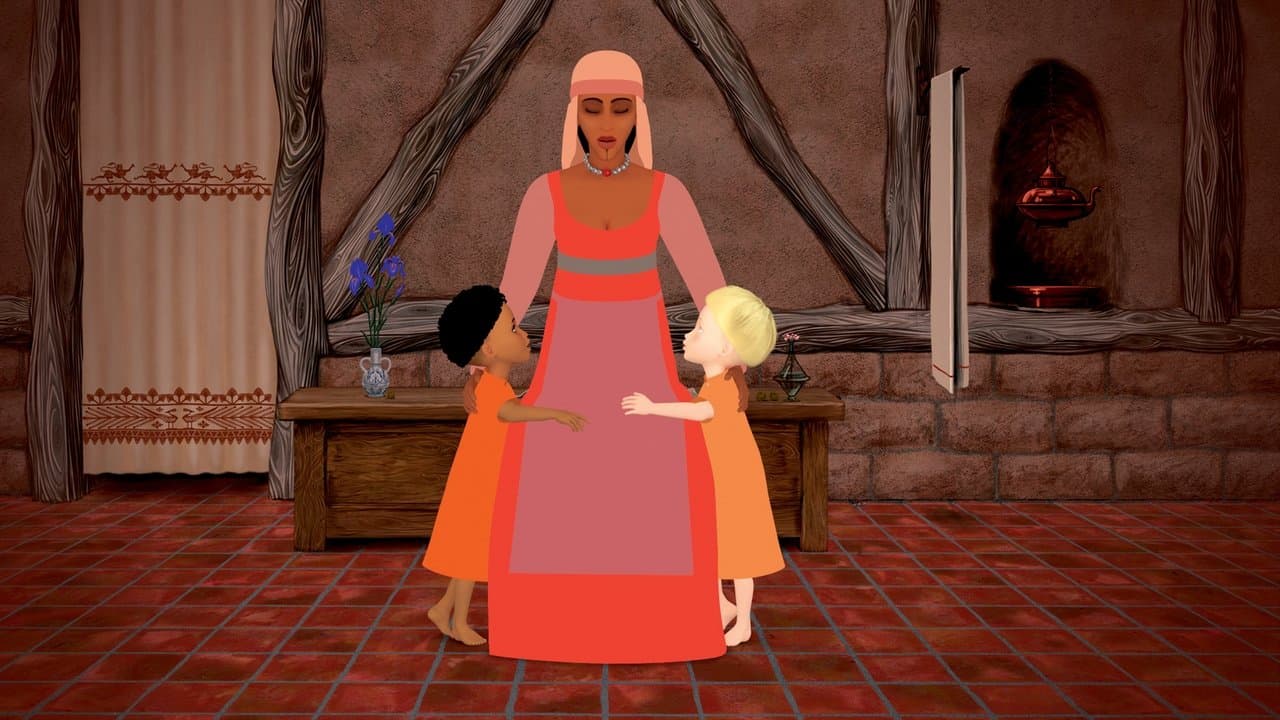
Azur's father is an authoritarian and cold figure whose brutality is explicitly depicted: he violently separates the two children and dismisses the nanny without consideration. This character embodies a form of cultural and social rigidity that the narrative clearly designates as a moral failing. In contrast, the substitute maternal figure, Asmar's nanny, represents warmth, unconditional love and cultural transmission. The film does not seek to balance these portrayals artificially: the father is the negative example, the nanny is the model. This polarity is strong and may prompt discussion about what it means to be a good or bad parent.
Violence
Violence is present but restrained. A scene with brigands and sabres is visible on screen, and a main character is mortally wounded before being rescued. The father's brutality during the children's separation is emotionally intense, without being graphic. These moments all serve the narrative progression and are not gratuitous or spectacularised violence. For younger or more sensitive children, the character's wounding and the violence of the separation may be striking and warrant being anticipated.
Discrimination
The film explicitly depicts mechanisms of discrimination based on physical appearance and cultural origin, in both directions: Asmar is despised in Azur's homeland, and Azur is rejected in Asmar's country. This symmetrical treatment is not accidental: it aims to show the arbitrariness of all identity prejudice. The parental figures are stereotyped in their emotional functions, but this stereotype is more a tool for narrative clarity for young audiences than an asserted ideological representation.
Strengths
The film is visually distinctive: its graphic treatment, inspired by medieval illuminations and Islamic art, constitutes in itself a rare aesthetic initiation for a young viewer. The narration is paced, demanding without being opaque, and never treats children as an audience incapable of complexity. The emotional dimension is calibrated with precision: difficult moments exist, but they fit within an arc that moves towards reconciliation and repair. The film also conveys familiarity with the cultural forms of the Arab-Berber world, its tales, its beliefs, its spaces, in a way that enriches without ever caricaturing.
Age recommendation and discussion points
The film is not recommended for children under 7 due to some scenes of violence and the emotional brutality of the separation. From 7-8 years old, it is fully suitable and can be watched with ease. Two angles of discussion to open after viewing: ask the child how they experienced the moment when Azur becomes the rejected stranger in an unfamiliar country, and what this evokes about their own way of looking at those who are different from them; also explore why the father is presented as a cold figure and what kind of parent the child would have preferred in his place.
Synopsis
Raised on tales of a Djinn fairy princess, Azur, a young Frenchman goes to North Africa in search of the sprite, only to discover that his close childhood friend, Asmar, an Arab youth whose mother raised both boys also seeks the genie.
Where to watch
Availability checked on Apr 03, 2026
About this title
- Format
- Feature film
- Year
- 2006
- Runtime
- 1h 39m
- Countries
- Belgium, France, Italy, Spain
- Original language
- FR
- Directed by
- Michel Ocelot
- Main cast
- Cyril Mourali, Rayan Mahjoub, Karim M'Ribah, Abdelsselem ben Amar, Hiam Abbass, Patrick Timsit, Fatma ben Khell, Thissa d'Avila Bensalah, Sofia Boutella, Olivier Claverie
- Studios
- Nord-Ouest Films, Studio O, Mac Guff Ligne, France 3 Cinéma, Artémis Productions, Intuition Films, Lucky Red, Zahorí Media, Auvergne-Rhône-Alpes Cinéma
Content barometer
- Violence2/5Moderate
- Fear2/5A few scenes
- Sexuality0/5None
- Language0/5None
- Narrative complexity1/5Accessible
- Adult themes0/5None
Watch-outs
- Death
- Gender stereotypes
Values conveyed
- Courage
- Acceptance of difference
- Autonomy
- friendship
- brotherhood
- tolerance
- self-surpassing
- intercultural dialogue
- reconciliation
- identity quest