

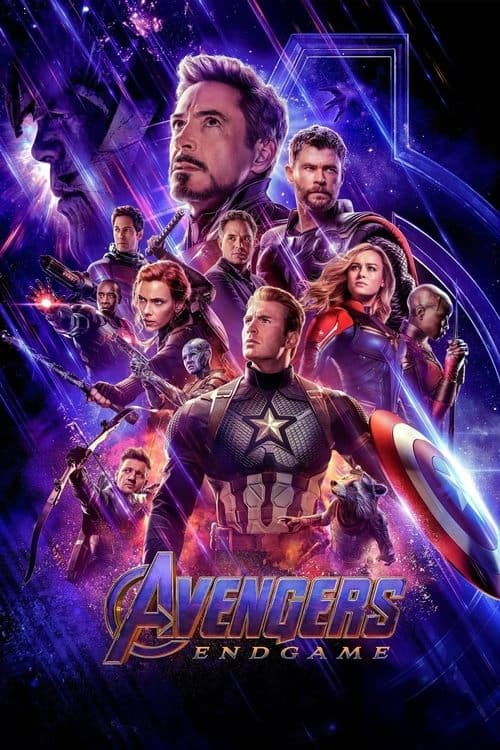
Avengers: Endgame
Does this age rating seem accurate to you?
Detailed parental analysis
Avengers: Endgame is a superhero film with a dark and epic atmosphere, driven by an emotional tension rare for the genre. The plot follows a group of heroes who attempt, five years after a global catastrophe, to find a way to reverse the course of events and save what can still be salvaged. The film is primarily aimed at teenagers and adults, particularly those already familiar with the Marvel universe, but its emotional intensity and violence make it a film to watch with guidance for younger viewers.
Violence
Violence is omnipresent and sustained throughout the film. Combat scenes blend hand-to-hand confrontations, massive explosions, extraterrestrial creatures killed in large numbers and spectacular energy blasts. Certain scenes reach a more marked intensity: a character is pierced from behind and dies on screen, another returns from combat covered in blood, and a blade-weapon combat scene is accompanied by visible blood on a dying character's throat. This violence remains largely in service of the narrative, rooted in a logic of sacrifice and dramatic stakes rather than gratuitous or self-indulgent. It nonetheless remains intense and repeated, and may strongly impress sensitive children or pre-adolescents.
Underlying Values
The film constructs its narrative around willing sacrifice as a supreme value: several characters choose to give their lives for the collective good, without external constraint. Solidarity, perseverance in the face of failure and the ability to move beyond one's own ego for the sake of the group are constant narrative drivers. As a counterpoint, the film takes care to show that the meaning of these sacrifices is rooted in concrete personal bonds, love, family, friendship, and not in abstract ideology. This humanistic framing gives the narrative real moral depth, and offers excellent points of entry for discussion with a teenager about what gives value to collective action.
Substances
Alcohol is treated in an explicit and prolonged narrative manner. One of the main characters descends into alcohol as a coping mechanism in response to unresolved guilt and depression, and this spiral is visible throughout the film. The treatment is not glamorous: the character is shown in a state of physical and emotional deterioration, which clearly signals the destructive effects of self-medication through alcohol. However, the seriousness of this arc is not always consistent with the sometimes comedic register in which it is treated, which can send an ambiguous message about the legitimacy of this form of distress. A point to address explicitly with teenagers.
Language
The film contains a notable number of expletives for a production of this format: roughly a dozen instances of informal to vulgar register, including several uses of words with strong connotations. Nothing that falls outside the American PG-13 framework, but sufficiently present to be noticed by younger children.
Parental and Family Portrayals
Family bonds, and particularly parental ones, play a structuring role in the film. Several characters find in their role as parent or in their family attachments the primary motivation for their most decisive choices. These representations are broadly positive and central to the film's message: family is presented as an anchor of meaning, not as an obstacle or burden.
Strengths
Avengers: Endgame achieves what few superhero films seriously attempt: making emotion the true engine of the narrative rather than spectacle. The narrative construction across three hours holds together thanks to writing that invests in the personal arcs of its characters, accumulated across several films, and pays them at a high price. The treatment of grief, survivor's guilt and sacrifice gives the film an emotional density unusual for the genre, and several scenes reach a sincerity that moves both adults and teenagers. It is also a strong generational object of cultural transmission, which allows parents who have followed the franchise to share a common experience with their children.
Age recommendation and discussion points
The film is not recommended for children under 12 due to repeated violence and emotional intensity, notably the deaths of beloved characters which may provoke a strong grief reaction. For ages 13 and up, it can be watched with ease, preferably with an adult available to discuss it afterwards. Two angles of discussion are particularly worthwhile: why certain characters choose to sacrifice everything, and what this reveals about what they truly value; and how the film represents depression and alcohol as a response to guilt, distinguishing what is shown from what is valorised.
Synopsis
After the devastating events of Avengers: Infinity War, the universe is in ruins due to the efforts of the Mad Titan, Thanos. With the help of remaining allies, the Avengers must assemble once more in order to undo Thanos' actions and restore order to the universe once and for all, no matter what consequences may be in store.
Where to watch
Availability checked on Apr 16, 2026
About this title
- Format
- Feature film
- Year
- 2019
- Runtime
- 3h 1m
- Countries
- United States of America
- Original language
- EN
- Directed by
- Anthony Russo, Joe Russo
- Main cast
- Robert Downey Jr., Chris Evans, Mark Ruffalo, Chris Hemsworth, Scarlett Johansson, Jeremy Renner, Josh Brolin, Don Cheadle, Paul Rudd, Benedict Cumberbatch
- Studios
- Marvel Studios