

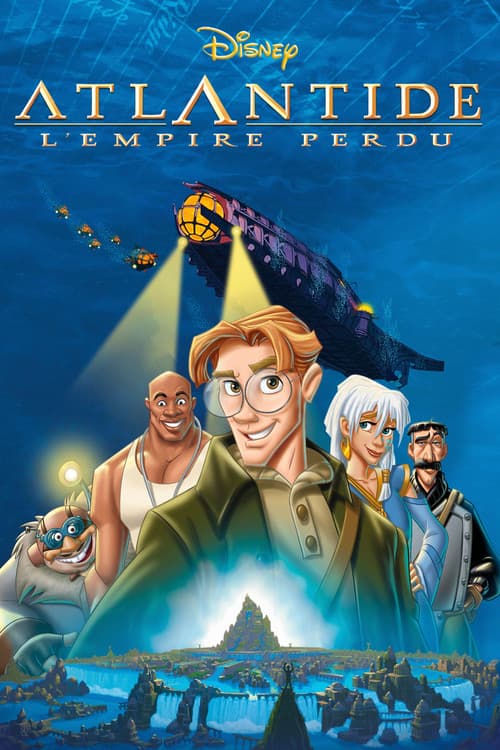
Atlantis: The Lost Empire
Atlantis: The Lost Empire
Your feedback improves this guide
Your feedback highlights guides that need a second look and keeps the rating trustworthy.
Does this age rating seem accurate to you?
Sign in to vote
Watch-outs
What this film brings
Content barometer
Violence
3/5
Notable
Fear
3/5
Notable tension
Sexuality
1/5
Allusions
Language
1/5
Mild
Narrative complexity
1/5
Accessible
Adult themes
0/5
None
Expert review
Atlantis: The Lost Empire is a 2001 Disney animated adventure film with a noticeably darker and more mature tone than most of the studio's productions, blending exploration, science-fiction and military action into a fast-paced narrative. The film includes several significant sensitive elements: intense action sequences featuring the large-scale destruction of a submarine with the mass death of its crew, a cold-blooded villain who mortally wounds another character on screen, and repeated armed combat with visually clear consequences. These intense moments are frequent in the second half of the film, and the themes of betrayal, sacrifice and cultural responsibility add emotional weight that calls for real maturity in younger viewers. Parents of young children are encouraged to preview the film, as its rapid pacing, repeated peril and unapologetic action sequences make it more suitable for children aged 10 and above, ideally watched together to open conversations about trust, sacrifice and protecting others.
Synopsis
A young linguist named Milo Thatch joins an intrepid group of explorers to find the mysterious lost continent of Atlantis.
Difficult scenes
In the prologue, a massive wave engulfs Atlantis as a young Princess Kida watches her mother being absorbed by a beam of light and vanishing into the sky forever. This abrupt and permanent separation, experienced through a child's eyes, may deeply affect younger viewers who are sensitive to parental loss. During the submarine journey, the enormous mechanical Leviathan attacks without warning and destroys the Ulysses in minutes, killing the vast majority of the crew. The sequence is depicted with frank visual intensity: explosions, implied drowning, and widespread chaos. The scale of the collective death is made explicit and may shock or distress children who do not expect this level of consequence in a Disney animated film. Commander Rourke, revealed as a traitor, deliberately and coldly mortally wounds the elderly King of Atlantis to force access to the crystal. This act of direct violence by a trusted authority figure against a helpless elder may be disturbing for children who had placed confidence in this character. Princess Kida is involuntarily absorbed into and transformed by the Heart of Atlantis, losing her apparent consciousness and identity as she becomes a glowing crystalline entity. This forced transformation and the distress surrounding it create a moment of strong psychological tension that may unsettle children sensitive to loss of control or bodily transformation.
Where to watch
No verified platform for the US market yet. We keep this section updated as availability changes.
Availability checked on Apr 01, 2026
About this title
- Format
- Feature film
- Year
- 2001
- Runtime
- 1h 35m
- Countries
- United States of America
- Original language
- EN
- Directed by
- Gary Trousdale, Kirk Wise
- Main cast
- Michael J. Fox, Cree Summer, James Garner, Claudia Christian, Corey Burton, Phil Morris, Jacqueline Obradors, Don Novello, Jim Varney, Florence Stanley
- Studios
- Walt Disney Pictures, Walt Disney Feature Animation
Content barometer
Violence
3/5
Notable
Fear
3/5
Notable tension
Sexuality
1/5
Allusions
Language
1/5
Mild
Narrative complexity
1/5
Accessible
Adult themes
0/5
None
Expert review
Atlantis: The Lost Empire is a 2001 Disney animated adventure film with a noticeably darker and more mature tone than most of the studio's productions, blending exploration, science-fiction and military action into a fast-paced narrative. The film includes several significant sensitive elements: intense action sequences featuring the large-scale destruction of a submarine with the mass death of its crew, a cold-blooded villain who mortally wounds another character on screen, and repeated armed combat with visually clear consequences. These intense moments are frequent in the second half of the film, and the themes of betrayal, sacrifice and cultural responsibility add emotional weight that calls for real maturity in younger viewers. Parents of young children are encouraged to preview the film, as its rapid pacing, repeated peril and unapologetic action sequences make it more suitable for children aged 10 and above, ideally watched together to open conversations about trust, sacrifice and protecting others.
Synopsis
A young linguist named Milo Thatch joins an intrepid group of explorers to find the mysterious lost continent of Atlantis.
Difficult scenes
In the prologue, a massive wave engulfs Atlantis as a young Princess Kida watches her mother being absorbed by a beam of light and vanishing into the sky forever. This abrupt and permanent separation, experienced through a child's eyes, may deeply affect younger viewers who are sensitive to parental loss. During the submarine journey, the enormous mechanical Leviathan attacks without warning and destroys the Ulysses in minutes, killing the vast majority of the crew. The sequence is depicted with frank visual intensity: explosions, implied drowning, and widespread chaos. The scale of the collective death is made explicit and may shock or distress children who do not expect this level of consequence in a Disney animated film. Commander Rourke, revealed as a traitor, deliberately and coldly mortally wounds the elderly King of Atlantis to force access to the crystal. This act of direct violence by a trusted authority figure against a helpless elder may be disturbing for children who had placed confidence in this character. Princess Kida is involuntarily absorbed into and transformed by the Heart of Atlantis, losing her apparent consciousness and identity as she becomes a glowing crystalline entity. This forced transformation and the distress surrounding it create a moment of strong psychological tension that may unsettle children sensitive to loss of control or bodily transformation.