
Apollo 10½: A Space Age Childhood
Does this age rating seem accurate to you?
Detailed parental analysis
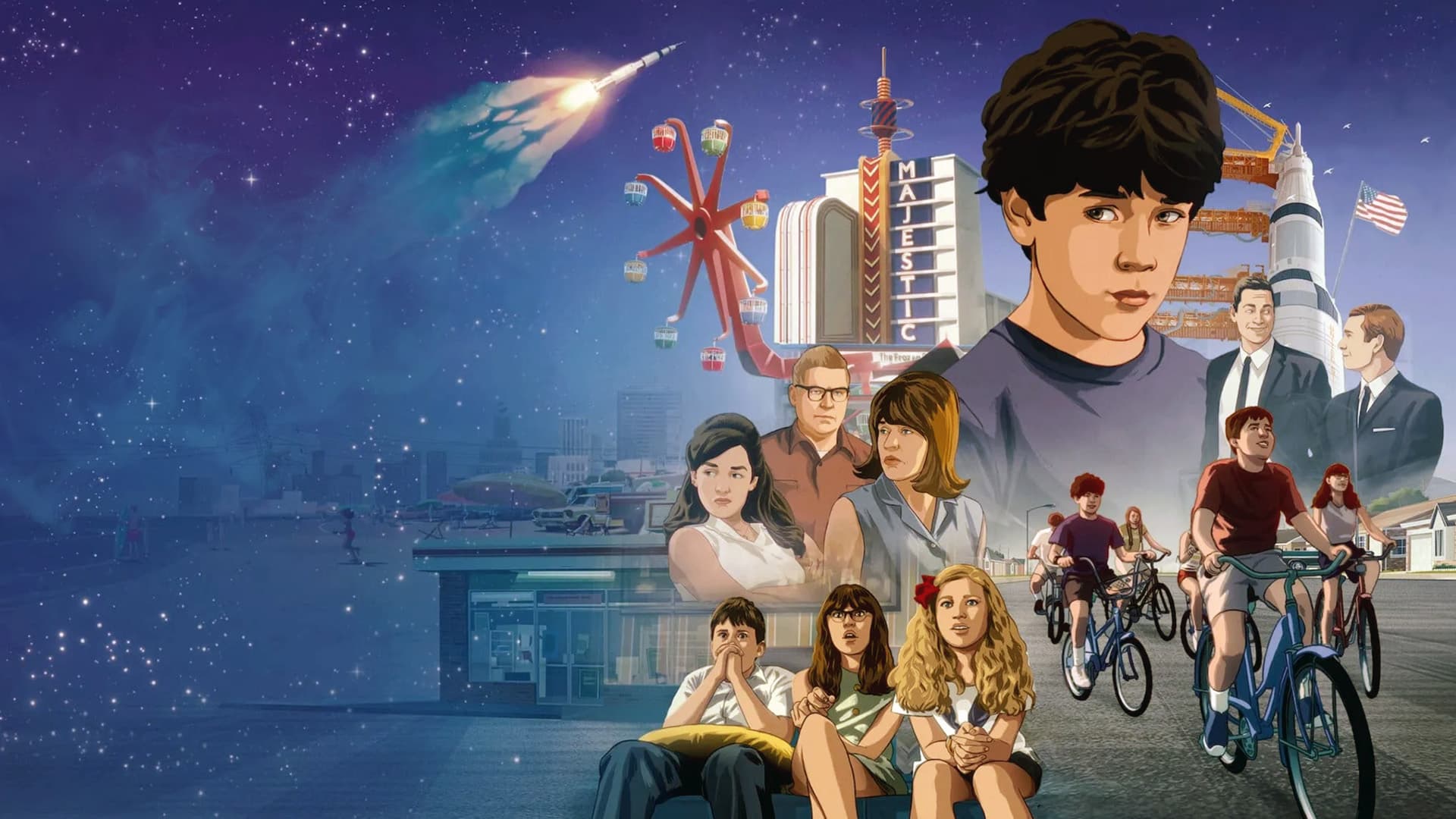
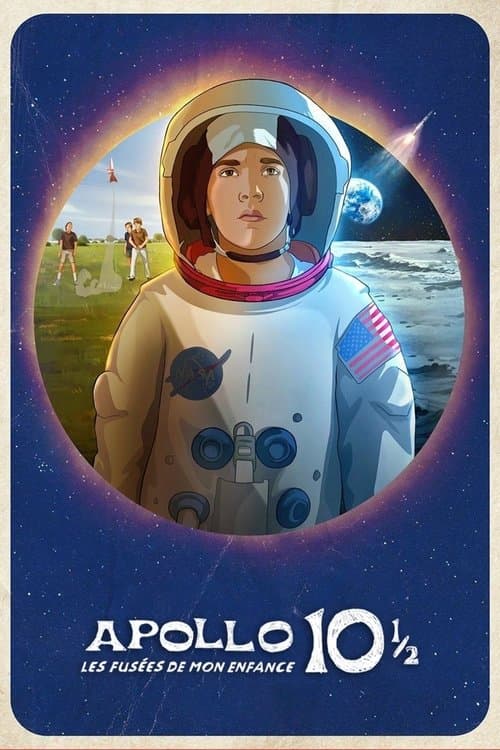
Apollo 10½: A Space Odyssey is a nostalgic and contemplative film that reconstructs 1960s America through the eyes of a ten-year-old boy growing up in Houston at the time of the Apollo 11 mission. The plot interweaves the everyday life of a large middle-class family with a fantasy in which the boy imagines having been secretly recruited by NASA to pilot a spacecraft capsule. The film is primarily aimed at adults who lived through this era or who wish to introduce it to others, but it may resonate with teenagers curious about history.
Substances
The consumption of tobacco and alcohol is omnipresent throughout the film, represented as an ordinary and normalised component of adult life in the 1960s. Adults smoke indoors, drink socially, and the father drinks beer whilst driving whilst letting his son hold the steering wheel, a scene presented with nostalgic lightness that calls for no warning within the narrative. LSD is mentioned in passing in relation to a Beatles album, without particular dramatisation. The issue here is not provocation but precisely this retroactive normalisation: the film assumes showing an era when these behaviours were not yet socially sanctioned, which makes it a useful point of discussion about the evolution of safety and public health standards.
Social Themes
The film is steeped in the historical context of the Cold War, the space race, and the Vietnam War. Television footage of soldiers in combat is shown, along with a brief depiction of Robert F. Kennedy following his assassination in 1968. The nuclear threat and civil defence drills at school are evoked as ordinary childhood anxieties of the era. These elements are not exploited dramatically but presented with documentary precision that can open rich conversations about twentieth-century American history.
Violence
The violence in this film is essentially that of its era, presented without filter. Children receive blows from a baseball bat or wooden spoon as corporal punishment, at school as at home, with the narrative not explicitly condemning these practices. A child's arm with a sharp object embedded in it and blood is shown during a game. These scenes, brief though they are, reflect a normalisation of educational brutality that is now illegal in most Western countries, and merit being named for young viewers.
Parental and Family Portrayals
The parents are depicted with overall benevolence but also a casualness characteristic of the era: the father drives whilst drinking, children play unsupervised in the street, and corporal punishments are presented as harmless. The large family functions as a warm and slightly chaotic cocoon, and the parents are far from being absent or malevolent figures. But their educational model is that of another era, which may lead a teenager to reflect on how parental standards have evolved.
Underlying Values
The film carries a form of collective nostalgia for an American optimism now gone, centred on the conviction that science and progress could solve all problems. This vision is presented with tenderness but also partial clarity: racial tensions, war, and inequalities surface without ever becoming the heart of the matter. The central value is that of family bond and intergenerational transmission, embodied in childhood memory as a place of meaning.
Discrimination
The film explicitly acknowledges, through the narrator's voice, the overwhelming white homogeneity of the neighbourhood, the school, and NASA as it existed at the time. This acknowledgement is honest but does not constitute a thorough reflection: the film does not deconstruct the systemic racism of 1960s America, it takes note of it with surface clarity. For teenagers, this is a useful opening towards discussion about what collective memory chooses to celebrate and what it tends to erase.
Strengths
The film succeeds in capturing the texture of childhood with rare memorial precision: street games, family rituals centred on the television, the popular culture of the era are evoked with a richness of detail that functions both as a historical document and as an invitation to reminiscence. The voiceover narration gives the film a melancholic softness that avoids the trap of naive idealisation without ever falling into cynical revisionism. For a young viewer curious about history, it is a vivid and sensory entry into a pivotal decade of the United States, far more embodied than anything a school textbook can offer.
Age recommendation and discussion points
The film is more suited to teenagers aged 13 and over, with adult accompaniment for the younger end of this range. It is not recommended below 12 years of age owing to images of normalised domestic violence, potentially distressing scenes, and the consumption of alcohol presented without critical distance. Two angles naturally lend themselves to discussion: why would behaviours shown as normal in this film be unacceptable today, and what does nostalgia for an era reveal about what a society chooses to remember whilst omitting certain of its realities.
Synopsis
A man narrates stories of his life as a 10-year-old boy in 1969 Houston, weaving tales of nostalgia with a fantastical account of a journey to the moon.
About this title
- Format
- Feature film
- Year
- 2022
- Runtime
- 1h 37m
- Countries
- United States of America, Netherlands
- Original language
- EN
- Directed by
- Richard Linklater
- Main cast
- Milo Coy, Jack Black, Lee Eddy, Bill Wise, Natalie L'Amoreaux, Josh Wiggins, Jessica Brynn Cohen, Sam Chipman, Danielle Guilbot, Zachary Levi
- Studios
- Detour Filmproduction, Submarine