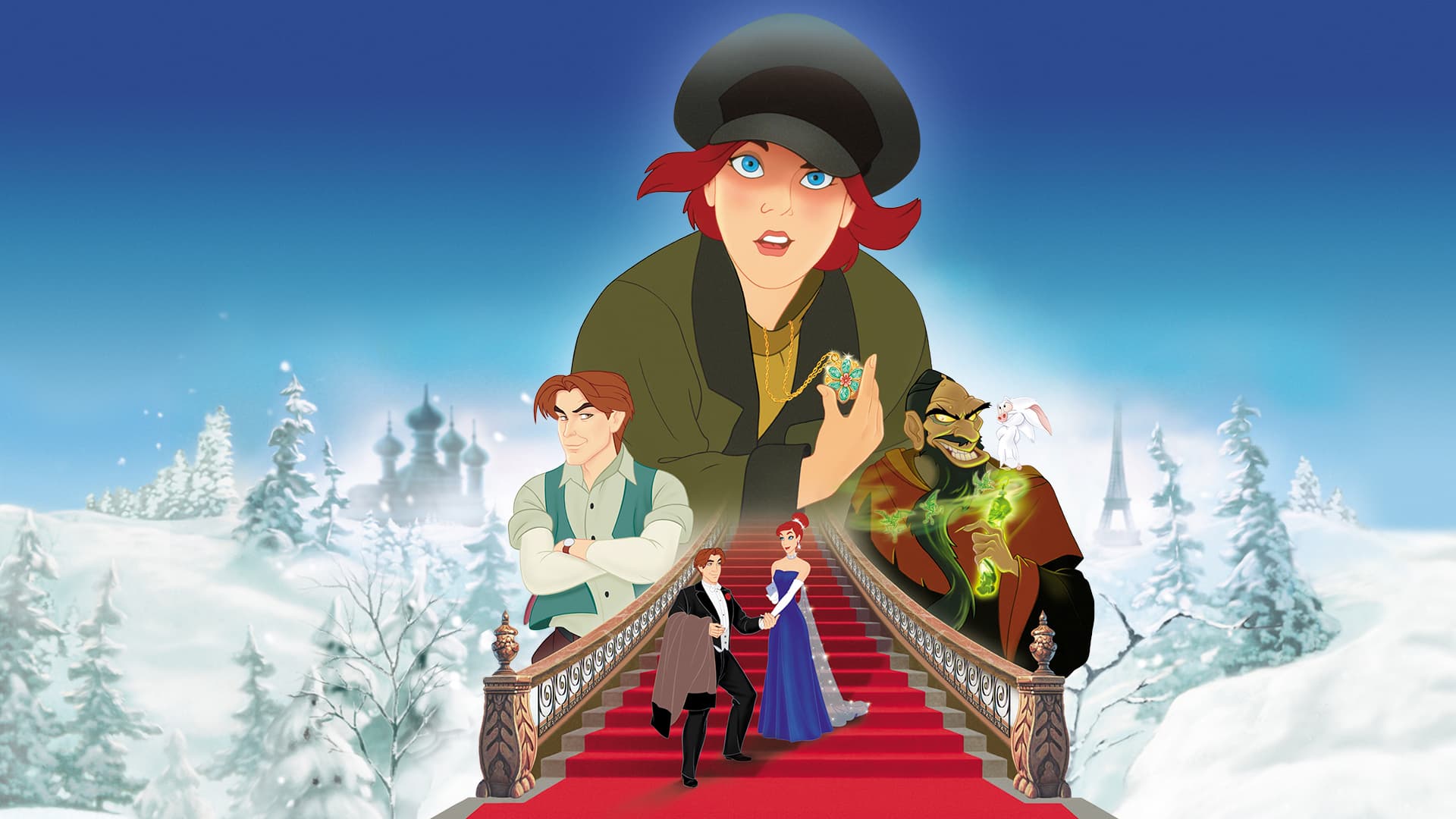

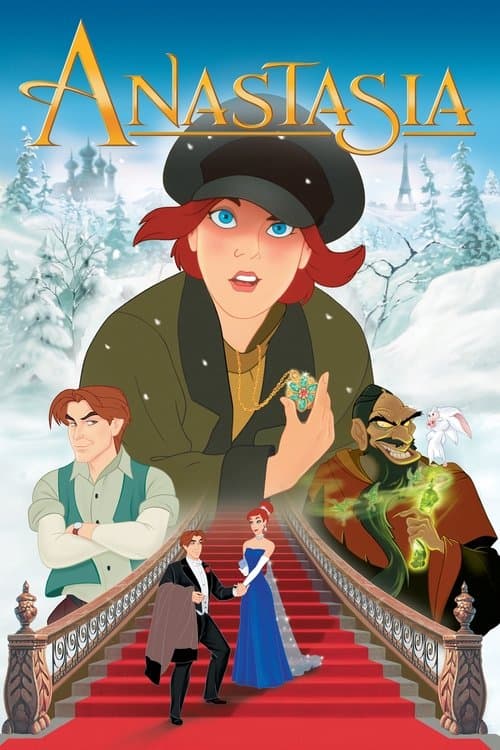
Anastasia
Does this age rating seem accurate to you?
Detailed parental analysis
Anastasia is an animated musical film with both adventurous and dark undertones, blending romance, action, and sometimes unsettling fantastical imagery. The story follows a young woman without memories who attempts to discover her origins by travelling to Paris, pursued by a supernatural enemy. The film targets school-age children and pre-adolescents, but contains elements sufficiently frightening to warrant case-by-case assessment depending on the child's sensitivity.
Violence
This is the most challenging aspect of the film for young viewers. Action sequences are numerous, intense, and driven by a sense of genuine danger: a palace fire, a train hurtling out of control at full speed, a collapsing bridge, a raging sea. The character of Rasputin, an undead figure whose body progressively decomposes throughout the film with limbs detaching, has a frankly macabre visual rendering that sensitive children may find traumatic. His song, built on imagery of darkness and curse, reinforces this anxiety-inducing register. The death of the royal family is evoked off-screen but its narrative weight is very much present. These elements serve a coherent dramatic structure and evil is ultimately defeated, which provides a satisfying resolution, but the path to reach it is visually and emotionally demanding.
Underlying Values
The film consistently affirms that deep identity takes precedence over rank or fortune: Anastasia freely chooses love over dynastic obligation, and Dimitri renounces a considerable financial reward through honesty. These are messages well integrated into the narrative. However, royalty and its visual attributes (crowns, palaces, ball gowns, luxurious Parisian life) are treated with an aesthetic fascination that enters into slight tension with this discourse. The film also simplifies history very significantly: Rasputin becomes the magical cause of the Russian Revolution, which erases all the actual political, social and economic context. For a child who will later encounter this period at school, this version may durably skew their understanding. This is a concrete point to address after viewing.
Parental and Family Portrayals
The emotional heart of the film rests on family absence. Anastasia is a traumatised orphan who remembers neither her parents nor her identity, and the entire plot is a quest to be reunited with her grandmother. Family is presented as fundamental anchoring, and reunion as an answer to identity void. This theme is treated with sincerity and may resonate strongly with children who themselves have questions about their origins or who experience complex family configurations.
Social Themes
The Russian Revolution of 1917 serves as the narrative backdrop, but is presented in a radically simplified and fantastical manner. Rasputin is depicted as the mystical instigator of the Romanovs' fall, which entirely obscures the real historical causes: social inequality, war, political collapse. For a child encountering this period at school, the image conveyed by the film deserves to be explicitly repositioned within its context.
Strengths
The film possesses genuine emotional generosity and an ability to treat grief, memory loss and the quest for belonging with a sincerity rare in the genre. The songs are melodically solid and narratively functional: they advance the story rather than suspend it. Anastasia is a heroine who defends herself, makes decisions, and owes her survival to no male saviour, which gives her an admirable character consistency. The film also knows how to alternate light humour and dramatic tension without losing its thread, and the romance builds progressively rather than mechanically.
Age recommendation and discussion points
The film is not recommended before age 7 due to Rasputin scenes and intense action sequences, and can be watched without concern from age 8 or 9 for children without particular sensitivity to horror. Two concrete discussion points after viewing: ask the child what they know about the Russian Revolution and why the Romanovs actually lost power, to correct the film's magical portrayal; and discuss with them Anastasia's final choice, in which she renounces a throne to follow her own desires, by asking what they would have done in her place.
Synopsis
Ten years after she was separated from her family, an eighteen-year-old orphan with vague memories of the past sets out to Paris in hopes of reuniting with her grandmother. She is accompanied by two con men, who intend to pass her off as the Grand Duchess Anastasia to the Dowager Empress for a reward.
About this title
- Format
- Feature film
- Year
- 1997
- Runtime
- 1h 30m
- Countries
- United States of America
- Original language
- EN
- Studios
- Fox Animation Studios, 20th Century Fox