
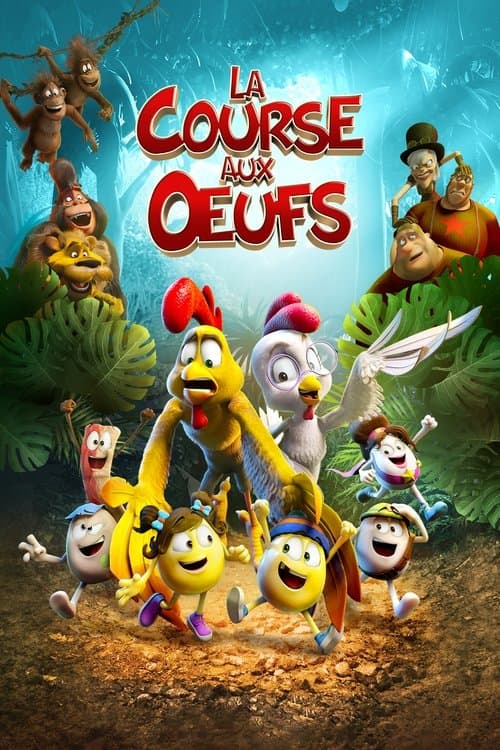
An Egg Rescue
Un rescate de huevitos
Does this age rating seem accurate to you?
Detailed parental analysis
The Egg Race is a Mexican animated comedy with a cheerful and whimsical tone, carried by a colourful visual universe and vibrant characters. The plot follows a group of eggs who must unite to escape a kidnapping and find their family again. The film targets young children, with some passages likely to disturb very small children.
Social Themes
The film builds its narrative around collective solidarity: isolated and vulnerable individuals become effective only when acting together. This message is clear, repeated and narratively embodied. As a counterpoint, the film tempers overprotective parenting by suggesting that teaching children to be careful and autonomous is better than placing them under a bell jar. This is an affirmed educational stance, which deserves to be discussed as a family, particularly with school-age children who can begin to internalise it concretely.
Underlying Values
The film builds its narrative around collective solidarity: isolated and vulnerable individuals become effective only when acting together. This message is clear, repeated and narratively embodied. As a counterpoint, the film tempers overprotective parenting by suggesting that teaching children to be careful and autonomous is better than placing them under a bell jar. This is an affirmed educational stance, which deserves to be discussed as a family, particularly with school-age children who can begin to internalise it concretely.
Parental and Family Portrayals
A parental character is explicitly shown destroying an object under the effect of anger, which generates fear in the child-characters. This scene is not inconsequential: it stages a form of uncontrolled paternal behaviour presented as frightening. The film does not legitimate this behaviour, but the representation may resonate with children exposed to angry adults in their daily lives. Parents should be alerted before viewing to prepare for a possible emotional reaction.
Violence
The central threat, being bitten or eaten, is carried repeatedly and constitutes the dramatic engine of the film. Passages through dark tunnels accompanied by unsettling sounds reinforce a tension that can be genuinely anxiety-inducing for very small children. Violence remains suggested and never graphic, and it is narratively justified by the characters' survival stakes, but its frequency and tone distinguish it from the purely benign register of cartoons for very young children.
Strengths
The film draws its main strength from its inventive visual universe: the egg-characters are designed with distinctive and endearing graphic personality, which encourages identification in young viewers. The choice to anchor the narrative in concrete Mexican social reality gives unusual depth to the genre, without weighing down the message. The educational message about autonomy and solidarity is woven into the plot organically rather than preached. On the other hand, a running time of one hour and thirty minutes exceeds what three to five-year-old children can sustain without losing engagement, which constitutes a concrete limitation for families with very young viewers.
Age recommendation and discussion points
The film is suitable from age 5 or 6 onwards for children who can cope easily with narrative tension and imperfect parental figures. Below this age, the anxiety-inducing passages and the film's length risk weighing heavily. Two useful angles for discussion after viewing: ask the child why the eggs cannot manage on their own and what this says about mutual aid, and together address the difference between a parent who shouts or loses their temper and a parent who shows trust.
Synopsis
Toto and his friends must rescue his egg children after they're taken away for a gourmet food event in Africa.
About this title
- Format
- Feature film
- Year
- 2021
- Runtime
- 1h 28m
- Countries
- Mexico
- Original language
- ES
- Directed by
- Gabriel Riva Palacio Alatriste, Rodolfo Riva Palacio Alatriste
- Main cast
- Bruno Bichir, Maite Perroni, Carlos Espejel, Angélica Vale, Dione Riva Palacio Santacruz, Oliver Díaz Barba, Mayra Rojas, Ariel Miramontes, Jesús Ochoa, Freddy Ortega
- Studios
- Huevocartoon Producciones, Videocine, EFICINE 189
Content barometer
- Violence2/5Moderate
- Fear3/5Notable tension
- Sexuality0/5None
- Language0/5None
- Narrative complexity1/5Accessible
- Adult themes0/5None
Values conveyed
- Courage
- Perseverance
- Autonomy
- family
- teamwork