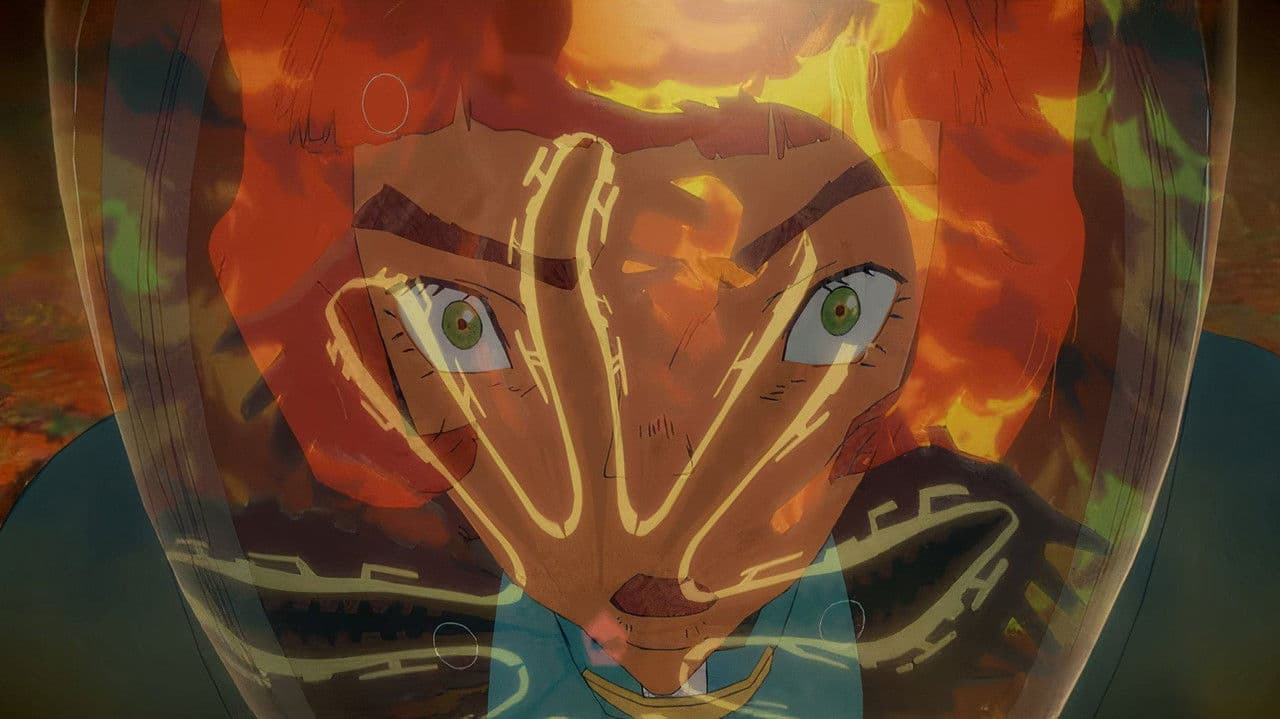


ALL YOU NEED IS KILL
Does this age rating seem accurate to you?
Detailed parental analysis
All You Need Is Kill is a military science-fiction film with a tense and repetitive atmosphere, oscillating between brutal war film and a narrative of emotional resilience. The plot follows a soldier trapped in a time loop that condemns her to relive the same battle against alien creatures indefinitely, dying with each cycle. The film is clearly aimed at a teenage and adult audience, with no concessions made for younger viewers.
Violence
Violence is the film's primary material and its presence is massive. The main character dies more than a hundred times over the course of the narrative, each death accompanied by visible injuries, animated blood and intense physical confrontations with alien creatures. Combat scenes include characters stabbed, slashed and crushed, with a visual rendering that makes no attempt to soften the impact. This repeated violence is not gratuitous in the strict sense: it is the narrative engine of the time loop and serves to illustrate the character's psychological exhaustion. Nevertheless, the accumulation of deaths and the brutality of the images constitute sustained exposure that is difficult for an unprepared young viewer to absorb.
Parental and Family Portrayals
The maternal figure is represented in a particularly dark way through Rita's past, whose mother is depicted as a drug-dependent woman, physically violent and even attempting to drown her own daughter. This sequence of child abuse is a narrative context element intended to explain the character's trauma, but it is explicit enough to mark a young viewer. The film does not treat this past lightly: it makes it the foundation of a healing arc, which gives it narrative purpose, but the representation itself remains harrowing.
Underlying Values
The film constructs a coherent discourse around perseverance in the face of repeated failure, overcoming isolation and the necessity of trusting others to resolve what one cannot face alone. The time loop functions as a metaphor for trauma: the character relives a painful situation endlessly until finding the key that allows escape from it, and this key comes through relationship with another. The film explicitly values solidarity and the capacity to release the weight of the past, which gives it genuine moral depth beyond the spectacle of action.
Social Themes
The film is part of a military science-fiction tradition that depicts total war against an alien threat. Without developing explicit political critique, it implicitly questions the human cost of combat, particularly through the repetition of deaths and the psychological wear it engenders. War is shown here as a traumatic experience rather than as a glorious adventure, which constitutes an interesting angle of interpretation to explore with a teenager.
Language
The film contains a moderate register of crude language, with occasional swearing and insults. Nothing exceptional for an action film aimed at teenagers, but the presence of these elements is real and regular.
Strengths
The film makes intelligent narrative use of the time loop device, employing it not as a simple video game mechanic but as a tool for psychological exploration. Repetition is experienced as suffering, and the narrative manages to maintain emotional tension despite the cyclical structure, which is a genuine writing challenge. The inversion of the main character, a female soldier at the centre of action and trauma, gives the film a texture different from usual war narratives. The emotional dimension, centred on healing from trauma and building a relationship of trust, brings a depth that transcends the framework of genre cinema.
Age recommendation and discussion points
The film is not recommended before age 14 due to repeated violence, serial deaths and explicit representation of child abuse. From age 14 onwards, it can be watched with an available adult to discuss it. Two angles of discussion are worth opening after viewing: why reliving an failure repeatedly can ultimately lead to liberation from it, and how the relationship with another is presented as the only possible exit from inner confinement.
Synopsis
When a massive alien flower known as "Darol" unexpectedly erupts in a deadly event, unleashing monstrous creatures that decimate the population of Japan, Rita is caught in the destruction—and killed. But then she wakes up again. And again. Caught in an endless time loop, Rita must navigate the trauma and repetition of death until she crosses paths with Keiji, a shy young man trapped in the same cycle. Together, they fight to break free from the loop and find meaning in the chaos around them.
About this title
- Format
- Feature film
- Year
- 2026
- Runtime
- 1h 26m
- Countries
- Japan
- Original language
- JA
- Directed by
- Kenichiro Akimoto
- Main cast
- Ai Mikami, Natsuki Hanae, Kana Hanazawa, Hiccorohee, Mo Chugakusei
- Studios
- STUDIO4℃, Warner Bros. Japan
Content barometer
- Violence4/5Strong
- Fear3/5Notable tension
- Sexuality0/5None
- Language2/5Moderate
- Narrative complexity1/5Accessible
- Adult themes2/5Present