

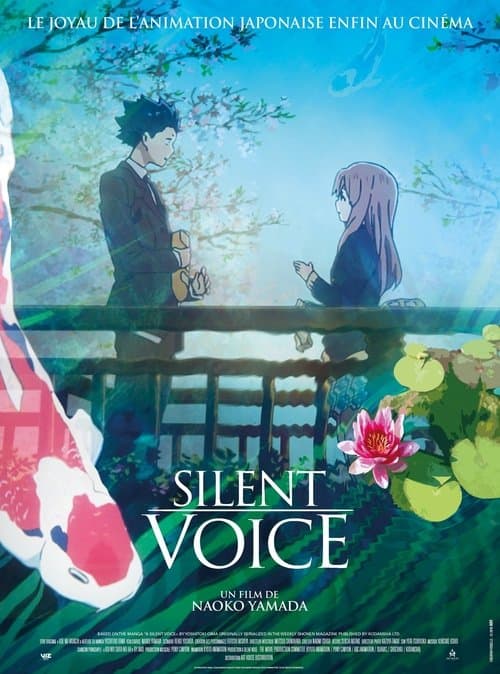


A Silent Voice: The Movie
映画 聲の形


A Silent Voice: The Movie
映画 聲の形
Your feedback improves this guide
Your feedback highlights guides that need a second look and keeps the rating trustworthy.
Does this age rating seem accurate to you?
Sign in to vote
Watch-outs
What this film brings
Content barometer
Violence
3/5
Notable
Fear
3/5
Notable tension
Sexuality
1/5
Allusions
Language
2/5
Moderate
Narrative complexity
3/5
Complex
Adult themes
1/5
Mild
Detailed parental analysis
ⓘ- Violence
- Underlying Values
- Social Themes
- Parental and Family Portrayals
- Language
- Substances
A Silent Voice is a Japanese animated film with a contemplative tone and emotionally intense atmosphere, oscillating between muted pain and fragile hope. The plot follows a former bully attempting to make amends with the deaf girl he tormented in primary school. The film is primarily aimed at teenagers and young adults, with no intention of appealing to a general audience.
Violence
The film depicts schoolyard bullying scenes experienced by the deaf protagonist with deliberate clarity: blows, shoving, repeated removal of hearing aids with visible blood, destruction of equipment. This violence is neither gratuitous nor aestheticised: it serves to anchor the protagonist's guilt and make the victim's trauma real and undeniable. The duration and precision of these sequences can nevertheless be difficult to watch, particularly for a child who has themselves experienced bullying. The film never legitimises the perpetrators' behaviour and shows the long-term consequences for everyone involved.
Underlying Values
The narrative is structured around redemption, guilt and the capacity to forgive oneself. The protagonist must learn that complete self-erasure is not a form of reparation, and that healing comes through self-acceptance as much as through acknowledging wrongdoing towards the other. This message is finely constructed and morally coherent: forgiveness is not presented as automatic or as an obligation for the victim, which is a rare and precious nuance in this type of story. The film also addresses collective cowardice and witness silence as a form of complicity, a subject directly usable in conversation.
Social Themes
Hearing disability is at the heart of the film and is treated seriously: sign language is present, the loneliness and exclusion experienced by a deaf person in a standard school environment are shown concretely. The film also addresses the mechanics of group bullying, the role of adults (teachers, parents) in normalising or perpetuating it, and the way perpetrators themselves can become targets once group balance is disrupted. These subjects give the film genuine value for discussion in a school or family setting.
Parental and Family Portrayals
Parental figures are present but unevenly represented. The protagonist's mother manages her family alone with resilient energy, and one scene shows she has physically borne responsibility for repairing her son's wrongs, at significant personal cost. The grandmother is evoked through her death and funeral scenes. The parents of other characters are less developed but their absence or ineffectiveness in addressing the bullying is implicitly significant.
Language
Crude language appears sporadically in dialogue between teenagers: a few insults and vulgar phrases without notable excess. This register is contextual and does not constitute a dominant feature of the film.
Substances
The presence is anecdotal: one character holds a chip as if smoking a cigarette, in a joking manner. No valorisation, no recurrence.
Strengths
A Silent Voice is one of the most accomplished animated films of recent years on an emotional level. The narration intelligently manages the temporality of trauma and how memory distorts perception of the present, notably through a subtle visual technique that signals the protagonist's psychological state without explicit commentary. Character writing is sufficiently complex to avoid manichaeism: neither the idealised victim nor the perpetrator reduced to his wrongdoing. The treatment of disability is respectful and well-researched. The film provokes deep empathy and genuine reflection on individual responsibility within group dynamics, making it a discussion tool of rare quality.
Age recommendation and discussion points
The film is not suitable before age 12 due to the intensity of bullying scenes and two suicide attempts depicted, and is recommended from age 14 onwards for comfortable viewing, accompanied by an adult available to discuss it. Two angles become clear after watching: how witness silence makes bullying possible, and what it truly means to apologise or forgive oneself.
Synopsis
Shouya Ishida starts bullying the new girl in class, Shouko Nishimiya, because she is deaf. But as the teasing continues, the rest of the class starts to turn on Shouya for his lack of compassion. When they leave elementary school, Shouko and Shouya do not speak to each other again... until an older, wiser Shouya, tormented by his past behaviour, decides he must see Shouko once more. He wants to atone for his sins, but is it already too late...?
Where to watch
No verified platform for the US market yet. We keep this section updated as availability changes.
Availability checked on Apr 01, 2026
About this title
- Format
- Feature film
- Year
- 2016
- Runtime
- 2h 10m
- Countries
- Japan
- Original language
- JA
- Studios
- Kyoto Animation, ABC Animation, Kodansha, Pony Canyon, Quaras, Shochiku
Content barometer
Violence
3/5
Notable
Fear
3/5
Notable tension
Sexuality
1/5
Allusions
Language
2/5
Moderate
Narrative complexity
3/5
Complex
Adult themes
1/5
Mild
Detailed parental analysis
ⓘ- Violence
- Underlying Values
- Social Themes
- Parental and Family Portrayals
- Language
- Substances
A Silent Voice is a Japanese animated film with a contemplative tone and emotionally intense atmosphere, oscillating between muted pain and fragile hope. The plot follows a former bully attempting to make amends with the deaf girl he tormented in primary school. The film is primarily aimed at teenagers and young adults, with no intention of appealing to a general audience.
Violence
The film depicts schoolyard bullying scenes experienced by the deaf protagonist with deliberate clarity: blows, shoving, repeated removal of hearing aids with visible blood, destruction of equipment. This violence is neither gratuitous nor aestheticised: it serves to anchor the protagonist's guilt and make the victim's trauma real and undeniable. The duration and precision of these sequences can nevertheless be difficult to watch, particularly for a child who has themselves experienced bullying. The film never legitimises the perpetrators' behaviour and shows the long-term consequences for everyone involved.
Underlying Values
The narrative is structured around redemption, guilt and the capacity to forgive oneself. The protagonist must learn that complete self-erasure is not a form of reparation, and that healing comes through self-acceptance as much as through acknowledging wrongdoing towards the other. This message is finely constructed and morally coherent: forgiveness is not presented as automatic or as an obligation for the victim, which is a rare and precious nuance in this type of story. The film also addresses collective cowardice and witness silence as a form of complicity, a subject directly usable in conversation.
Social Themes
Hearing disability is at the heart of the film and is treated seriously: sign language is present, the loneliness and exclusion experienced by a deaf person in a standard school environment are shown concretely. The film also addresses the mechanics of group bullying, the role of adults (teachers, parents) in normalising or perpetuating it, and the way perpetrators themselves can become targets once group balance is disrupted. These subjects give the film genuine value for discussion in a school or family setting.
Parental and Family Portrayals
Parental figures are present but unevenly represented. The protagonist's mother manages her family alone with resilient energy, and one scene shows she has physically borne responsibility for repairing her son's wrongs, at significant personal cost. The grandmother is evoked through her death and funeral scenes. The parents of other characters are less developed but their absence or ineffectiveness in addressing the bullying is implicitly significant.
Language
Crude language appears sporadically in dialogue between teenagers: a few insults and vulgar phrases without notable excess. This register is contextual and does not constitute a dominant feature of the film.
Substances
The presence is anecdotal: one character holds a chip as if smoking a cigarette, in a joking manner. No valorisation, no recurrence.
Strengths
A Silent Voice is one of the most accomplished animated films of recent years on an emotional level. The narration intelligently manages the temporality of trauma and how memory distorts perception of the present, notably through a subtle visual technique that signals the protagonist's psychological state without explicit commentary. Character writing is sufficiently complex to avoid manichaeism: neither the idealised victim nor the perpetrator reduced to his wrongdoing. The treatment of disability is respectful and well-researched. The film provokes deep empathy and genuine reflection on individual responsibility within group dynamics, making it a discussion tool of rare quality.
Age recommendation and discussion points
The film is not suitable before age 12 due to the intensity of bullying scenes and two suicide attempts depicted, and is recommended from age 14 onwards for comfortable viewing, accompanied by an adult available to discuss it. Two angles become clear after watching: how witness silence makes bullying possible, and what it truly means to apologise or forgive oneself.
Synopsis
Shouya Ishida starts bullying the new girl in class, Shouko Nishimiya, because she is deaf. But as the teasing continues, the rest of the class starts to turn on Shouya for his lack of compassion. When they leave elementary school, Shouko and Shouya do not speak to each other again... until an older, wiser Shouya, tormented by his past behaviour, decides he must see Shouko once more. He wants to atone for his sins, but is it already too late...?