

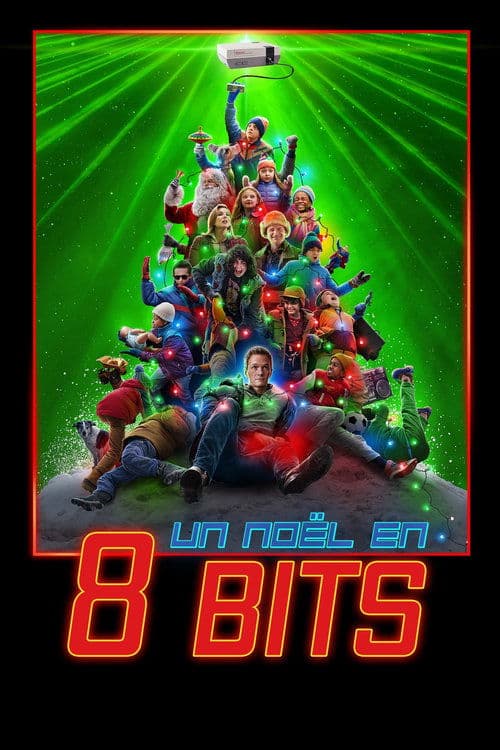
8-Bit Christmas
Does this age rating seem accurate to you?
Detailed parental analysis
8-Bit Christmas is a warm and nostalgic family comedy, carried by a joyful and slightly off-beat atmosphere that evokes children's adventure films from the 1980s. The plot follows a father who tells his daughter how, as a child in the 1980s, he did everything to get the most coveted video game console for Christmas. The film primarily targets children aged 8 to 12 and parents born in the 1970s-1980s, the latter being the true audience for the nostalgic layer.
Underlying Values
The film builds its entire narrative structure around an anti-consumerist message: obsession with a material object eventually gives way to the rediscovery of family bonds and what truly matters. It is an honest and well-delivered moral. In counterpoint, the narrative is nonetheless saturated with references to and implicit valorisation of Nintendo culture, which creates a slightly paradoxical tension between the message and the setting. Furthermore, an adult male character is depicted as hot-tempered and impulsive, regularly losing control of himself in dramatic fashion, and this tendency is treated as a source of comedy rather than as behaviour worth questioning. This is an angle worth pointing out to a child, as an adult's violence is normalised through the humorous register.
Parental and Family Portrayals
The father-daughter relationship forms the emotional backbone of the film and is handled with sincerity: the framing narrative allows the father to open up through a childhood story, and the final scene is genuinely moving. The paternal figure is nonetheless ambivalent: endearing in his clumsiness, yet portrayed as a man with disproportionate reactions whose excesses are consistently reframed positively. Parents can use this gap to engage in a concrete conversation about the difference between what makes us laugh in a film and what would be acceptable in real life.
Discrimination
The film contains a line asserting that attention deficit disorder with or without hyperactivity (ADHD) is an 'extremely rare' condition, which is factually untrue. This inaccuracy is not trivial: it touches on the representation of a neurological reality experienced by a large number of children, and may contribute to a distorted or stigmatising perception. This is a specific point to correct with a child who has this diagnosis themselves or knows someone who does.
Violence
A dog is injured by a falling television and subsequently appears with visible bandages and blood traces on its collar, though it survives. The scene may surprise young children who are sensitive to animals. A school bully character intimidates, pushes around and steals from his classmates repeatedly, without very explicit narrative consequence. These elements remain within moderate registers consistent with a family film, but they are definitely present.
Substances
Alcohol consumption is visible on several occasions within the adult setting: the father drinks beer, adults share wine at table, and a line references a bar in a shopping mall. These scenes are anecdotal in narrative terms but repeated, which gives them a diffuse presence. No particular valorisation, simply a silent normalisation.
Language
The register includes a few mild swear words in English ('damn', 'hell', 'crap') as well as typical playground insults ('idiot', 'nerd', 'jerk'). For a film in the original language, these elements are in the lower range of the American PG rating. In the dubbed version, the impact may vary depending on translation choices.
Sex and Nudity
A cover of Sports Illustrated Swimsuit Edition is visible on screen and a reference to a nude magazine is made in a fleeting manner. These elements are fleeting and undeveloped, but they exist and may prompt a question from an attentive child.
Strengths
The film succeeds in making two levels of reading coexist without one overwhelming the other: the child follows a brisk and funny Christmas adventure, while the adult parent receives a narrative about memory and transmission. The framing narrative structure, with an adult narrator recounting his childhood to his daughter, gives the film an unusual emotional depth for the genre. The conclusion avoids easy sentimentality and finds a sincere balance between humour and emotion. It is a film that works well as an object of intergenerational sharing, provided the adult is willing to guide the viewing.
Age recommendation and discussion points
The film is suitable from age 8 onwards, with parental guidance recommended for ages 8-10 regarding bullying scenes and the dog's injury. From age 10, viewing is straightforward without major reservations. Two angles for discussion are worth exploring after the film: why does the father who loses his temper make us laugh when this behaviour would be unacceptable in real life, and what has the hero ultimately come to understand is more important than his video game console?
Synopsis
In suburban Chicago during the late 1980s, ten-year-old Jake Doyle embarks on a herculean quest to get the latest and greatest video game system for Christmas.
About this title
- Format
- Feature film
- Year
- 2021
- Runtime
- 1h 37m
- Countries
- United States of America
- Original language
- EN
- Directed by
- Michael Dowse
- Main cast
- Neil Patrick Harris, Winslow Fegley, Steve Zahn, June Diane Raphael, Bellaluna Resnick, Sophia Reid-Gantzert, Che Tafari, Santino Barnard, Max Malas, Brielle Rankins
- Studios
- Star Thrower Entertainment, New Line Cinema
Content barometer
- Violence1/5Mild
- Fear1/5Mild
- Sexuality1/5Allusions
- Language2/5Moderate
- Narrative complexity1/5Accessible
- Adult themes1/5Mild
Values conveyed
- Acceptance of difference
- Loyalty
- friendship
- generosity
- family love
- perseverance
- work ethic
- nostalgia
- Christmas spirit