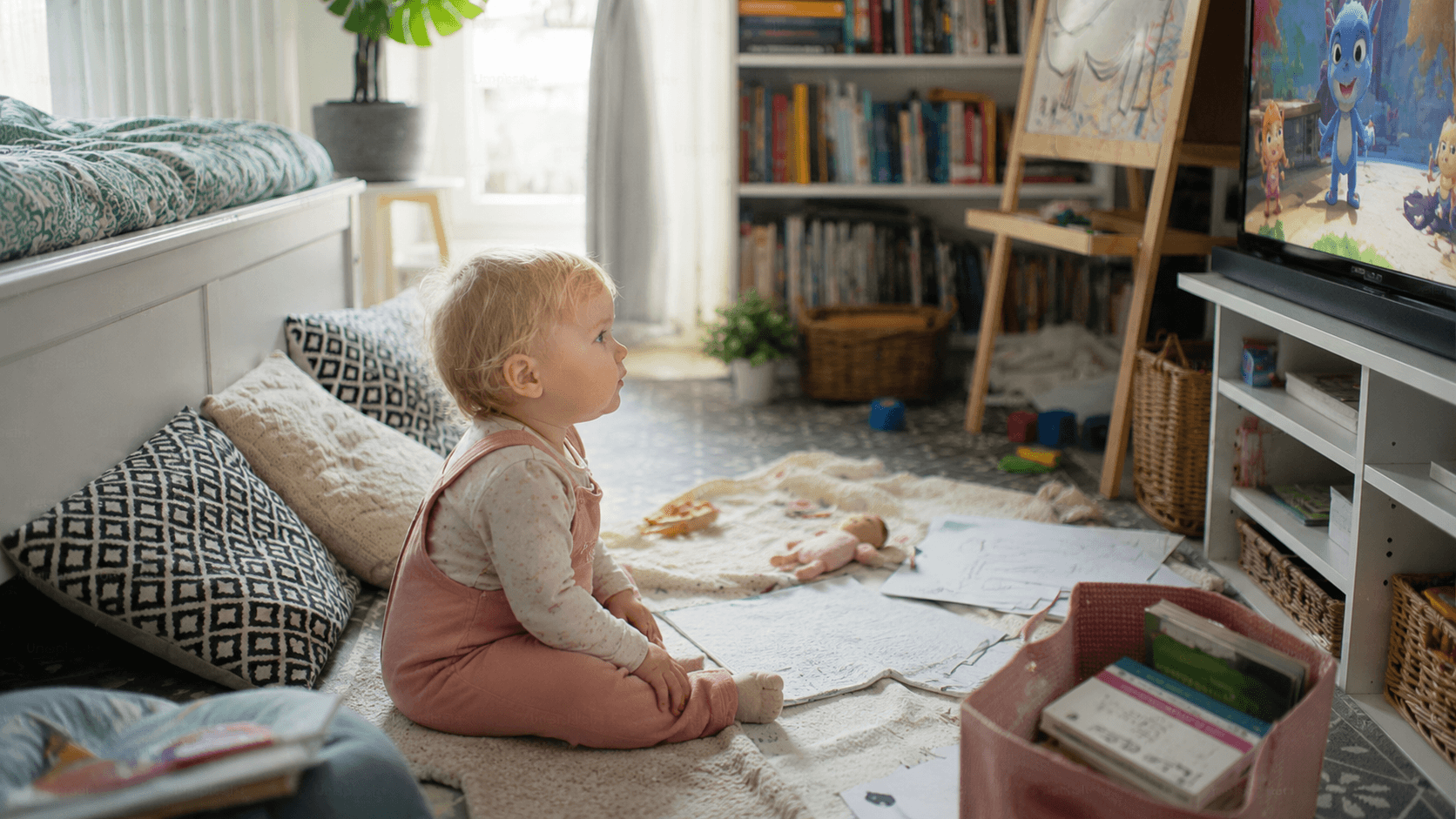
The question of screens before age three crystallizes many parental concerns, often fueled by alarmist messaging. An examination of meta-analyses published over the past five years reveals a more nuanced picture: total screen time matters, but content quality and adult presence weigh equally—sometimes more.
A screen's impact on a young child depends as much on the object itself as on the nature of the content and the presence of an adult who comments on it.
Institutional Recommendations and the Precautionary Principle
The international reference framework remains the World Health Organization's guidelines: no sedentary screen time before age 2, and a maximum of 1 hour per day for children aged 2 to 4, with less being preferable 1. A systematic review of 41 recommendation documents worldwide confirms this trend: 20 out of 22 documents recommend zero screens before age 2, and 17 out of 21 cap usage at 1 hour per day between ages 2 and 5 (Nuvoli et al., 2025).
It is important to understand how these recommendations are constructed. The WHO itself qualifies the overall quality of evidence linking sedentary screen time to negative health effects in children under 5 as "very weak" 1. As the recent British EYSTAG report emphasizes, the majority of available studies are cross-sectional: they capture a situation at a single point in time but do not allow for establishing strict causal links (EYSTAG, 2026).
Faced with incomplete data, recommendations therefore rely on the precautionary principle: preventing the risk that screens displace activities essential to development (sleep, physical play, social interactions).
What Meta-Analyses Show About Language
To move beyond the limitations of isolated studies, researchers rely on meta-analyses that synthesize results from dozens of research projects.
Regarding language, the data converge. A meta-analysis of 42 studies and 18,905 children shows that total screen quantity is negatively correlated with language skills (r = −0.14), with an even more pronounced negative correlation for background television (r = −0.19) (Madigan et al., 2020). Another recent meta-analysis, covering 100 studies and more than 176,000 participants aged 0 to 5.99 years, confirms this association between background TV and less favorable cognitive outcomes (r = −0.10) (Mallawaarachchi et al., 2024).
These same meta-analyses bring a fundamental nuance: the quality of viewing modifies the nature of the effect.
- Programs specifically designed as educational are associated with better language skills (r = 0.13)
- Co-viewing with a parent is too (r = 0.16)
- Later introduction to screens is correlated with better verbal outcomes (r = 0.17)
- All of these effects, positive and negative alike, remain statistically small to moderate in size (Madigan et al., 2020; Mallawaarachchi et al., 2024)
Screens are neither a major cause of language delay nor a miraculous learning tool. They are one environmental factor among many.
Attention, Pacing, and Content: What Recent Research Says
The idea that the fast pace of cartoons would exhaust young children's brains is widespread. A recent meta-analysis strongly qualifies this: among 19 studies analyzed, there is no reliable pattern of short-term effects of editing pace on attention and executive functions in children (Hinten, Scarf, & Imuta, 2025).
Conversely, among 16 studies devoted to fantastical content, results are clearer:
Children's cognitive performance is worse immediately after viewing fantastical content than after viewing realistic content.
The young child's brain must exert significant effort to process events that defy the laws of physics or causality. It is the unrealism of the content, more than its speed, that overwhelms its resources in the short term.
More broadly, a meta-analysis seeking to evaluate the link between total screen time and executive functions in children under 6 found no statistically significant association (r = 0.05, 95% confidence interval: −0.04 to 0.15) (Bustamante, Fernández-Castilla, & Alcaraz-Iborra, 2023). This invites caution regarding claims that screens systematically destroy attention capacity.
On the sleep front, a 2026 review concludes, based on experimental studies, that in the 0–5 age group there is preliminary evidence of a causal effect of screens on sleep quality—but not on sleep duration or sleep schedules. Experimental studies remain underrepresented in this area, however (Hermesch et al., 2026).
The Decisive Role of the Adult: Engagement and Attention
The most determining variable identified by research is not technological but human.
A meta-analysis of 17 studies evaluating joint media use by adult and child aged 0 to 6 finds a positive, modest but significant association (g = 0.20) with the child's learning capacity, compared to solo use (Taylor, Sala, Kolak, Gerhardstein, & Lingwood, 2024). An adult who names, points, and interacts during viewing helps the child bridge the gap between two-dimensional content and the real world.
Conversely, parents' screen use in the presence of the child during daily routines (sometimes called technoference) is negatively associated with the child's psychosocial development (r = −0.11) (Mallawaarachchi et al., 2024). The parent's divided attention reduces the quality of verbal and non-verbal exchanges, which are essential for the young child's emotional regulation.
What Studies Cannot (Yet) Conclude
Several scientific limitations prevent formulating absolute certainties.
Causality Remains Partial
The majority of studies are cross-sectional. As the EYSTAG report (2026) reminds us, these methodologies do not allow determining whether screen time causes behavioral difficulties, or whether parents of children with more difficult temperaments use screens more to soothe them. For sleep, preliminary experimental data exist (Hermesch et al., 2026); for other outcomes, the absence of large longitudinal and experimental studies maintains uncertainty.
Passive vs. Interactive: Still Poorly Measured
Meta-analyses often include older studies that do not distinguish between passive television and interactive tablets. It remains difficult to assess precisely whether a touchscreen engages cognition differently from a television. Current data often group everything together under the broad term "screen time."
In Practice: How to Manage Screens Before Age 3?
The most robust data allow for four concrete principles.
1. Turn Off Background Television
The meta-analysis by Mallawaarachchi et al. (2024) confirms a negative association between background TV and cognitive outcomes in children aged 0 to 5. When no one is actively watching, the screen is off.
2. Prioritize Realistic Content
For children under 3, choose programs rooted in real life (animals, everyday situations) rather than magical or fantastical worlds. It is unrealism, not speed, that poses a problem in the short term (Hinten et al., 2025).
3. Practice Active Co-Viewing
Do not leave the child alone in front of the screen. Sit with them, describe what is happening, ask questions, make connections to their own life. You transform passive time into social exchange—the protective mechanism identified by research (Taylor et al., 2024).
4. Manage Your Own Screen Use
Limit your smartphone use during moments of direct interaction (meals, play, bedtime). Uninterrupted parental attention is one of the factors correlated with the young child's psychosocial development (Mallawaarachchi et al., 2024). It is probably the most underestimated lever in daily life.
The "Pause-and-Question" Method
During viewing, regularly pause the video. Ask your child:
- "What is the cat doing?"
- "Do you think it's sad or happy?"
This simple gesture limits cognitive overload and directly stimulates the child's language and pragmatic skills. It is exactly the protective mechanism documented in research on co-viewing (Taylor et al., 2024).
To Learn More
- Our editorial selection for age 3, with carefully curated programs
- Our MovieByAge rating methodology explains how each guide is constructed
References
-
Bustamante, J. C., Fernández-Castilla, B., & Alcaraz-Iborra, M. (2023). Relation between executive functions and screen time exposure in under 6 year-olds: A meta-analysis. Computers in Human Behavior, 145, 107739. https://doi.org/10.1016/j.chb.2023.107739
-
EYSTAG. (2026). Screen use by children aged under 5: independent report of the Early Years Screen Time Advisory Group. UK Government. https://www.gov.uk/government/publications/screen-use-by-children-aged-under-5
-
Hermesch, N., Konrad, C., Barr, R., Herbert, J. S., & Seehagen, S. (2026). Early childhood screen use and sleep: Evaluating the strength of the evidence. Computers in Human Behavior Reports, 21, 100921.
-
Hinten, A. E., Scarf, D., & Imuta, K. (2025). Meta-analytic review of the short-term effects of media exposure on children's attention and executive functions. Developmental Science, 28(6), e70069. https://doi.org/10.1111/desc.70069
-
Madigan, S., McArthur, B. A., Anhorn, C., Eirich, R., & Christakis, D. A. (2020). Associations between screen use and child language skills: A systematic review and meta-analysis. JAMA Pediatrics, 174(7), 665–675. https://doi.org/10.1001/jamapediatrics.2020.0327
-
Mallawaarachchi, S., Burley, J., Mavilidi, M., Howard, S. J., Straker, L., Kervin, L., Staton, S., Hayes, N., Machell, A., Torjinski, M., Brady, B., Thomas, G., Horwood, S., White, S. L. J., Zabatiero, J., Rivera, C., & Cliff, D. (2024). Early childhood screen use contexts and cognitive and psychosocial outcomes: A systematic review and meta-analysis. JAMA Pediatrics, 178(10), 1017–1026. https://doi.org/10.1001/jamapediatrics.2024.2620
-
Nuvoli, V., Camanni, M., Mariani, I., Ponte, S., Black, M., & Lazzerini, M. (2025). Digital screen exposure in infants, children and adolescents: A systematic review of existing recommendations. Public Health in Practice, 10, 100653. https://doi.org/10.1016/j.puhip.2025.100653
-
Taylor, G., Sala, G., Kolak, J., Gerhardstein, P., & Lingwood, J. (2024). Does adult-child co-use during digital media use improve children's learning aged 0–6 years? A systematic review with meta-analysis. Educational Research Review, 44, 100614. https://doi.org/10.1016/j.edurev.2024.100614
Footnotes
-
World Health Organization. (2019). Guidelines on physical activity, sedentary behaviour and sleep for children under 5 years of age. https://www.who.int/publications/i/item/9789241550536 ↩ ↩2